SwaPrep presents · A chapter in Polity
The 73rd & 74th Amendments
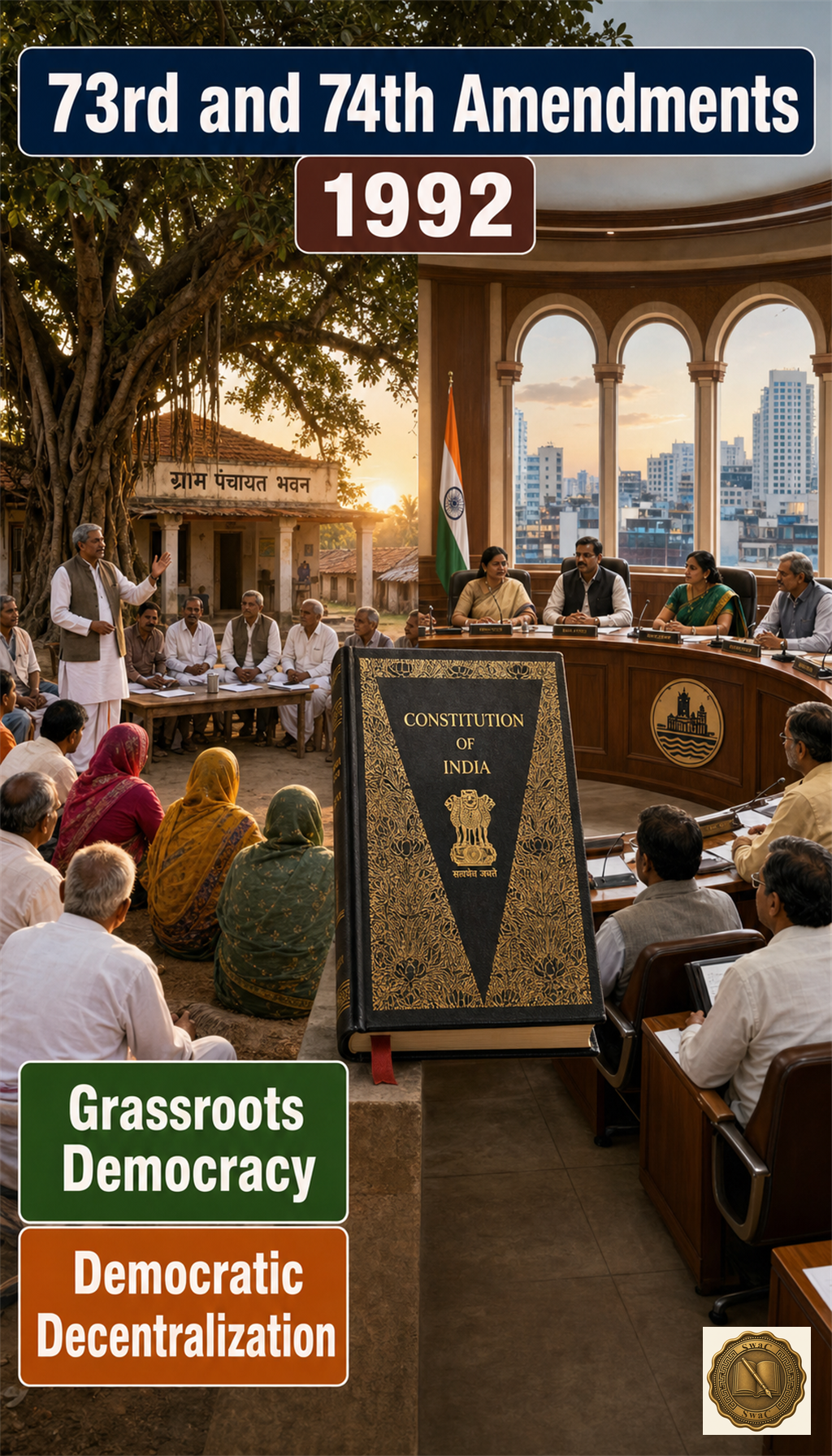
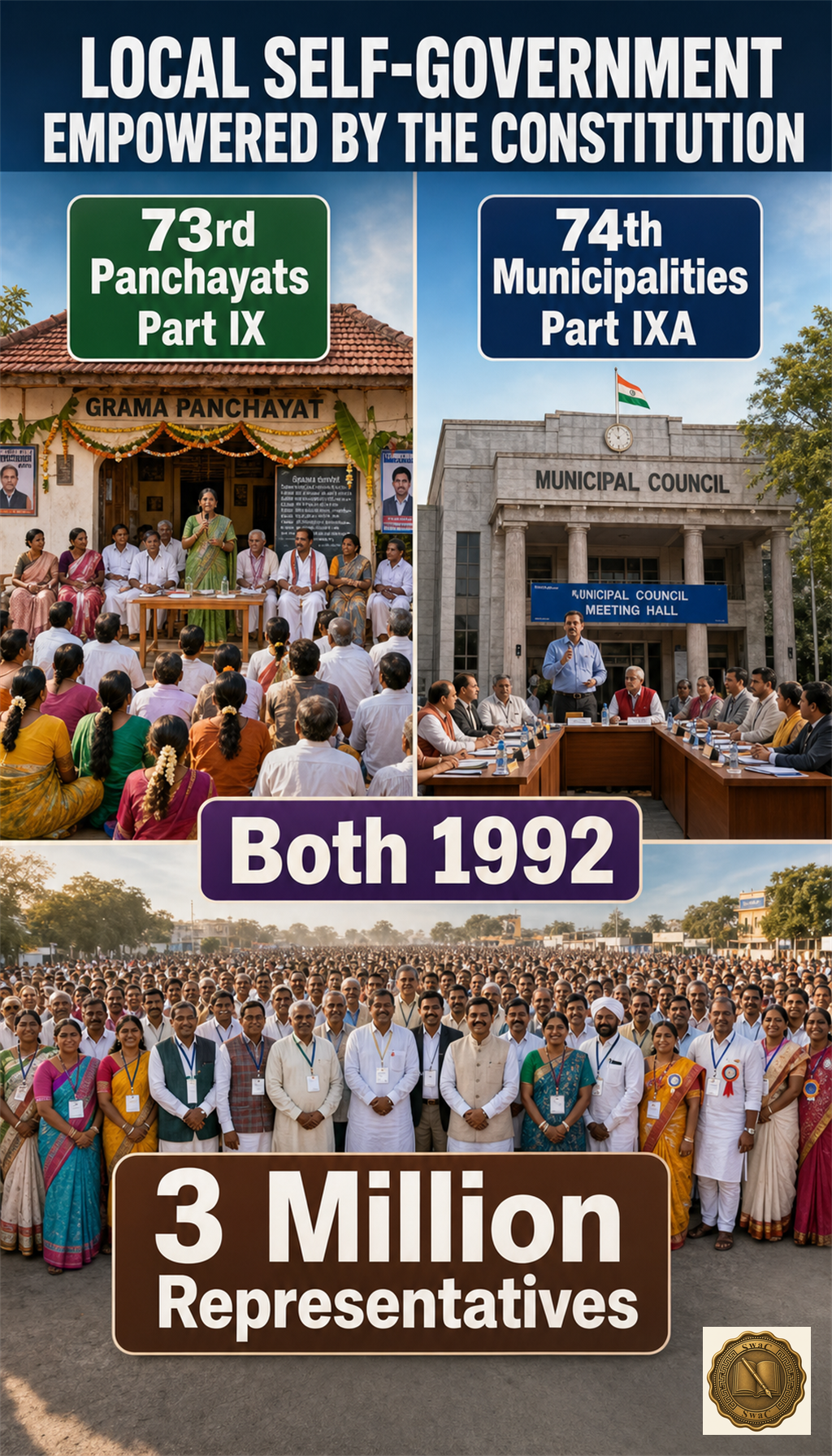
In 1992, India rewrote the architecture of power — and carried democracy to over three million grassroots representatives.
7 acts · 15 scenes · scroll to play↓
I
The Silent Century
Before the law1992
Democracy that stopped at the state capital
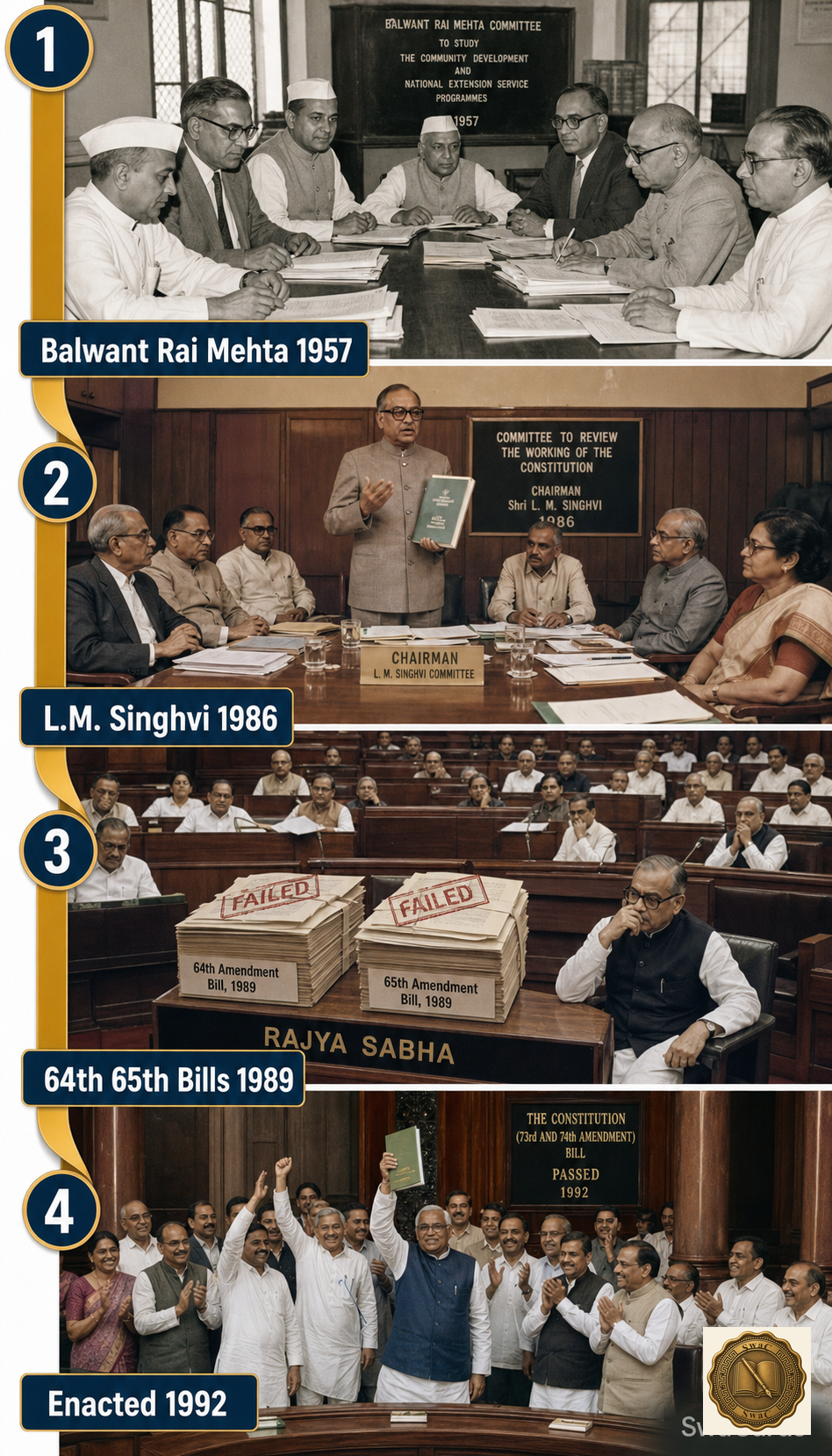
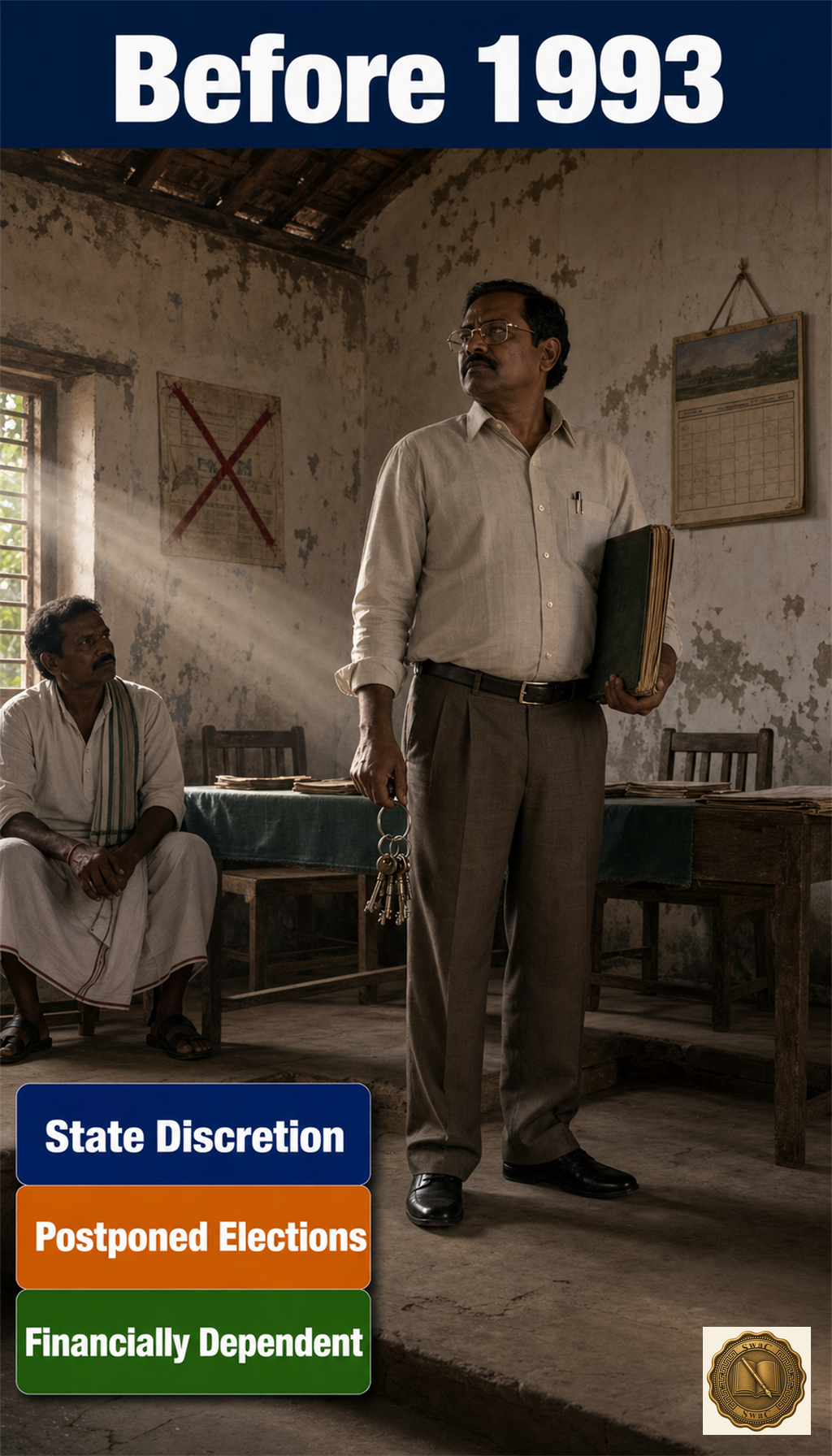
Before 1993, local bodies in India existed entirely at the discretion of state governments — there was no constitutional requirement to hold elections, provide reservations, or devolve functions, and states routinely postponed local elections for years, superseded elected bodies with administrators, and kept them financially dependent. Committee after committee, from Balwant Rai Mehta in 1957 to L.M. Singhvi in 1986, recommended strengthening local governance, and it was the Singhvi Committee's call for constitutional status that became the immediate catalyst. The Rajiv Gandhi government's 64th and 65th Amendment Bills failed in the Rajya Sabha in 1989. It was P.V. Narasimha Rao's revised versions that finally passed in 1992 as the 73rd and 74th Amendments.
Marks-winning facts · recall first
- 64th & 65th Amendment Bills (1989, Rajiv Gandhi) — failed in the Rajya Sabha
II
The Twin Charters
The twin laws1993
One country, two charters: village and city
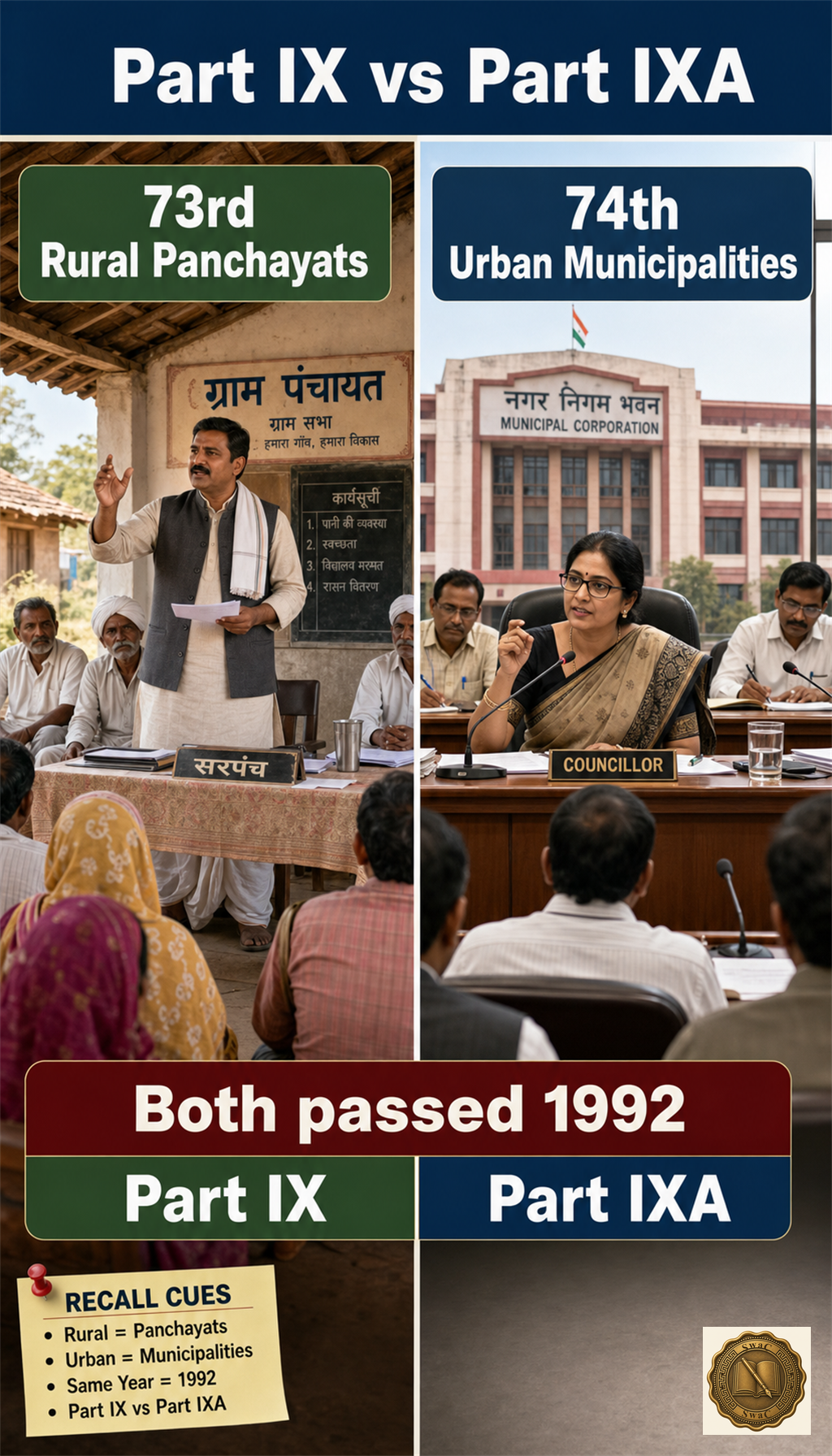
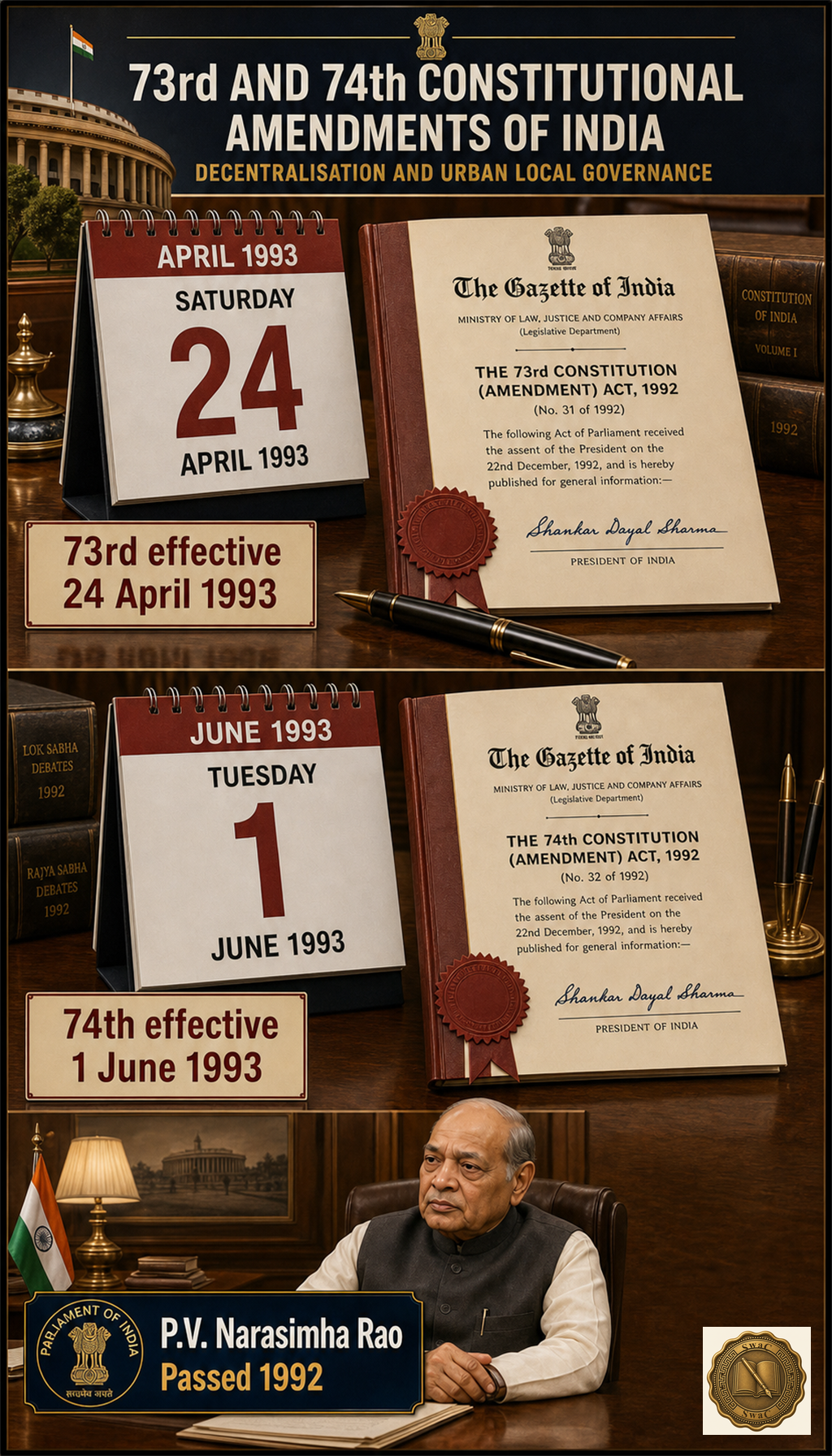
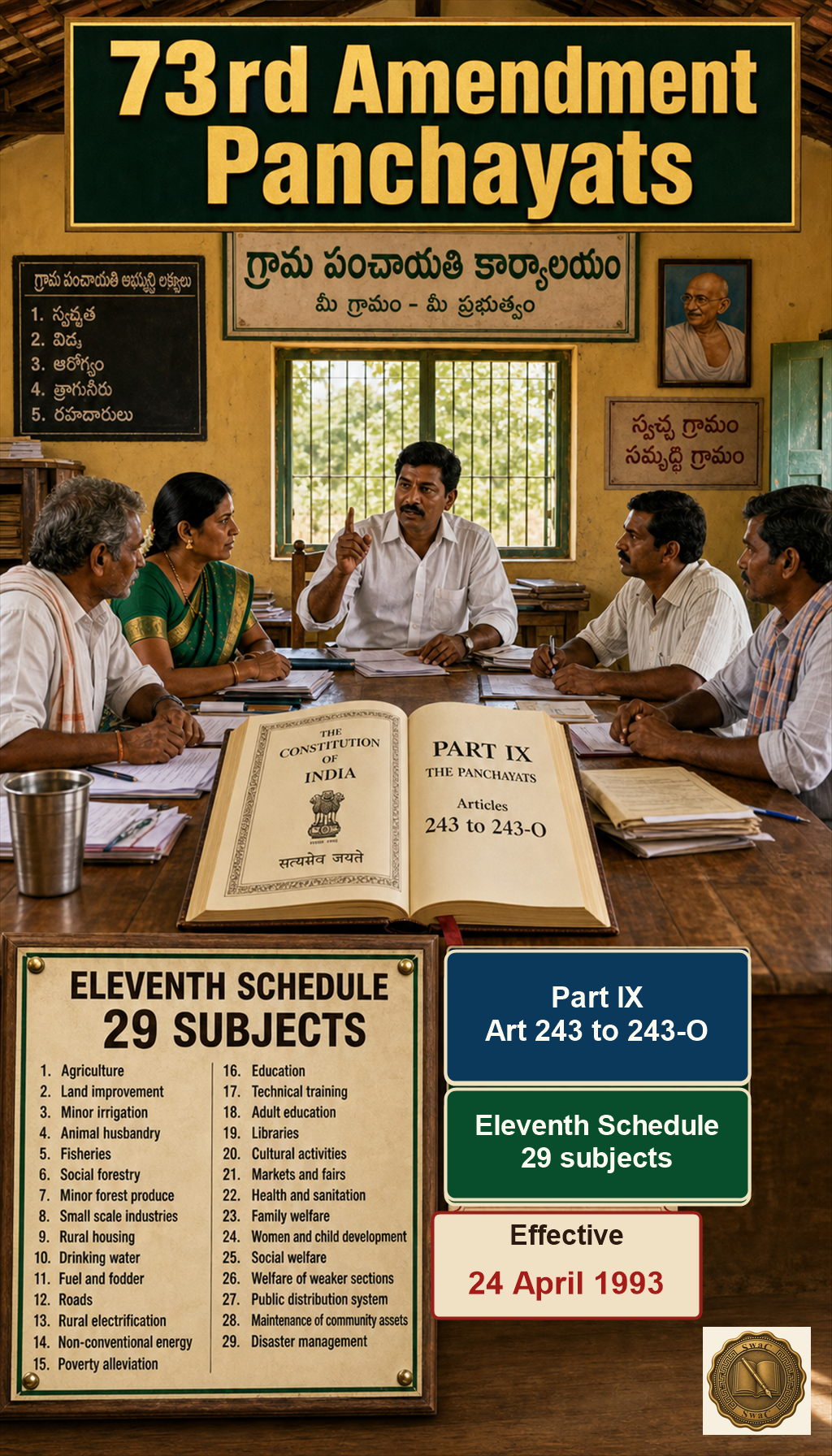
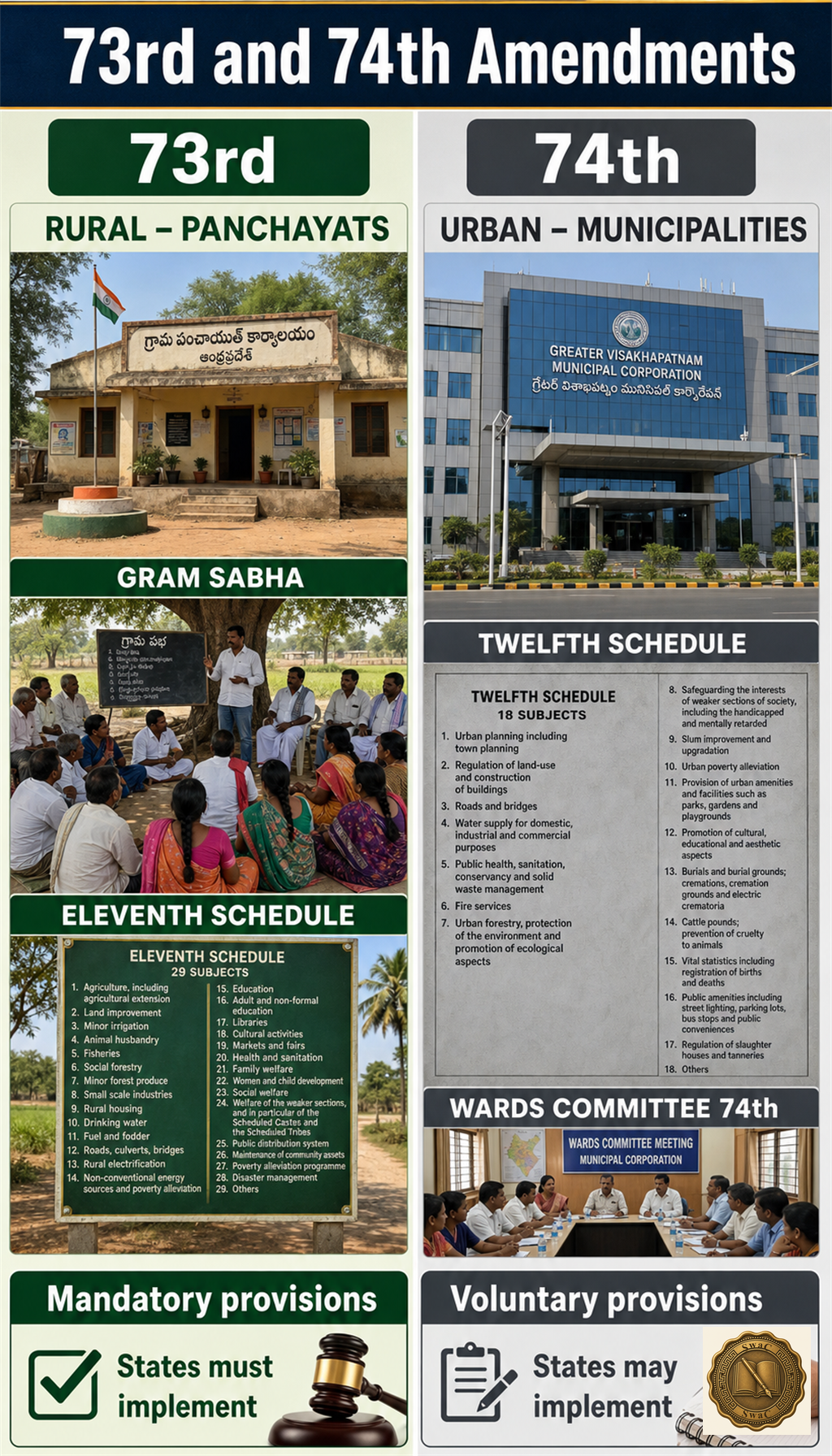
The 73rd Amendment constitutionalized Panchayati Raj Institutions for rural India, writing Part IX — Articles 243 to 243O — and the Eleventh Schedule into the Constitution. The 74th did the same for urban India's Municipalities, adding Part IXA — Articles 243P to 243ZG — and the Twelfth Schedule. The 73rd came into force on 24 April 1993 and the 74th on 1 June 1993, and together they form India's biggest democratic decentralization experiment.
Marks-winning facts · recall first
What only one has
A Gram Sabha for the village, planning committees for the city
Each amendment carries features the other lacks. Only the 73rd creates the Gram Sabha under Article 243A — the assembly of all voters, with no urban equivalent — and only the 73rd lets states with fewer than twenty lakh people make the intermediate panchayat tier optional. Only the 74th mandates Wards Committees for municipalities of three lakh or more people under Article 243S, a District Planning Committee under Article 243ZD, and a Metropolitan Planning Committee under Article 243ZE.
Marks-winning facts · recall first
III
The Iron Rules
The structure
Three tiers, direct elections, five-year clocks
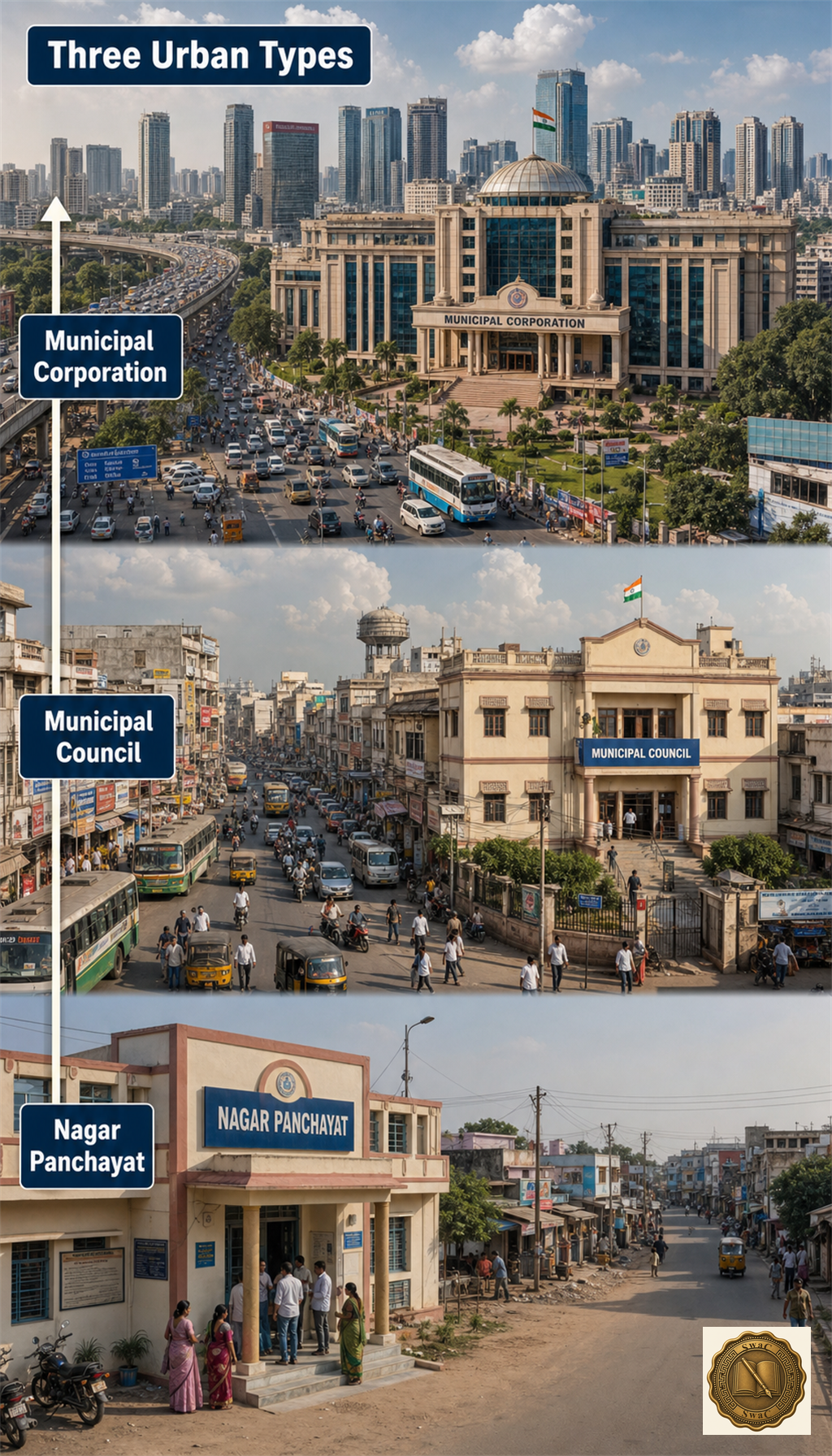
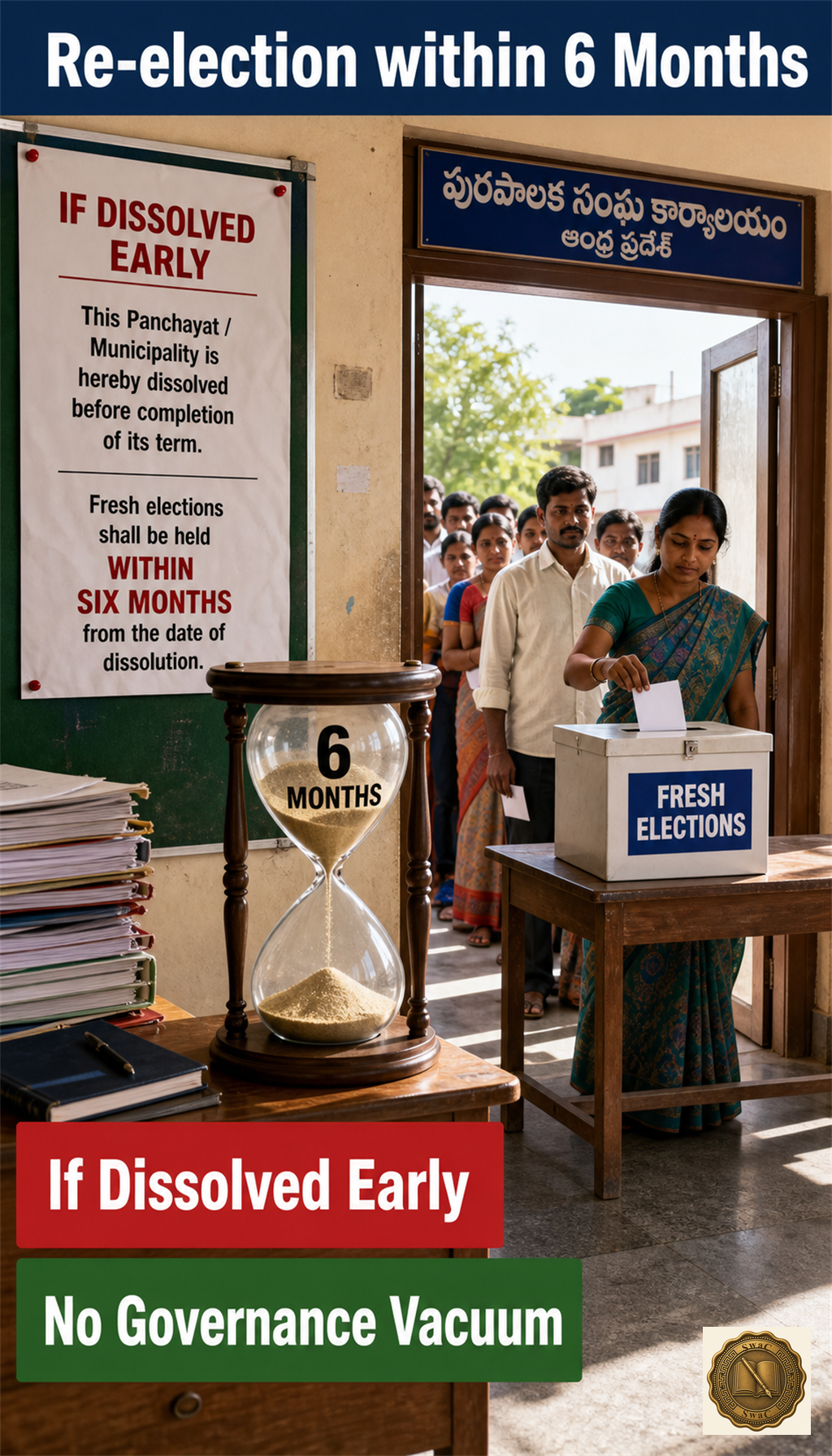
Both amendments lock a common structure into the Constitution that no state may override. Rural India gets a three-tier system — Village Panchayat, Intermediate Panchayat, District Panchayat — while urban India gets three types of bodies: Nagar Panchayat, Municipal Council and Municipal Corporation. Every seat at every level is filled by direct election from territorial constituencies. Each body runs for five years from the date of its first meeting, and if it is dissolved early, fresh elections must be held within six months.
Marks-winning facts · recall first
- Put in order · tap the steps in sequence
The quotas
One seat in three belongs to a woman
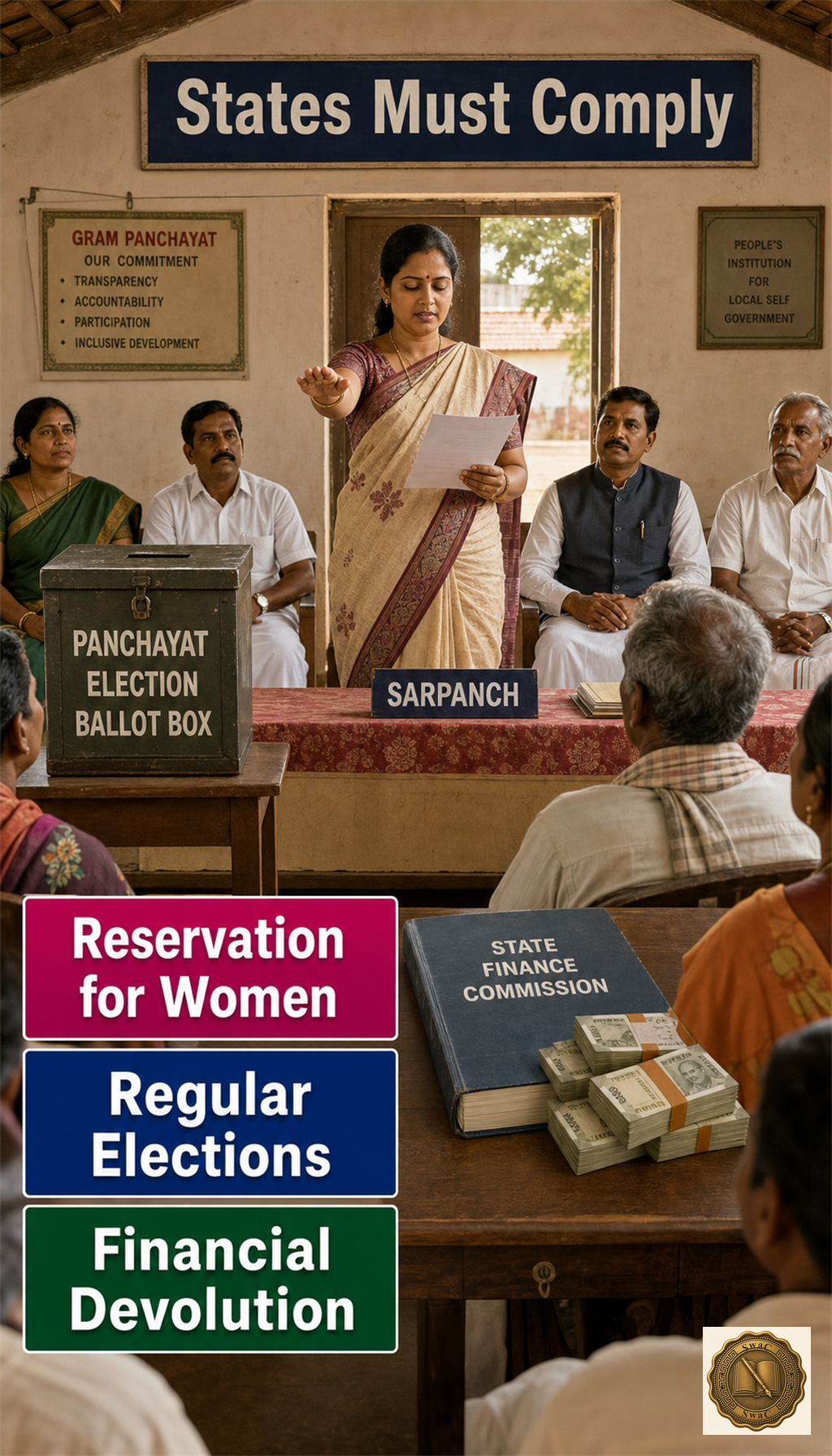
The amendments hard-wired representation for the excluded, and states cannot override or ignore it. Seats are reserved for Scheduled Castes and Scheduled Tribes in proportion to their population at all levels. And not less than one-third of the total seats — including within the SC and ST quotas — are reserved for women.
Marks-winning facts · recall first
The fine print
Twenty-one to stand, and no judges in the count
Two mandatory rules are easy to miss and beloved by examiners. The minimum age for membership of a local body is twenty-one years — not the twenty-five required for the State Legislature. And courts are barred from interfering in the electoral matters of local bodies: disputes travel only through election petitions, under Article 243O for Panchayats and Article 243ZG for Municipalities.
Marks-winning facts · recall first
- Bar on court interference in local electoral matters (Art 243O / 243ZG)
- Disputes only through election petitions
IV
The Guardians
The umpire
An election commission the state cannot bend
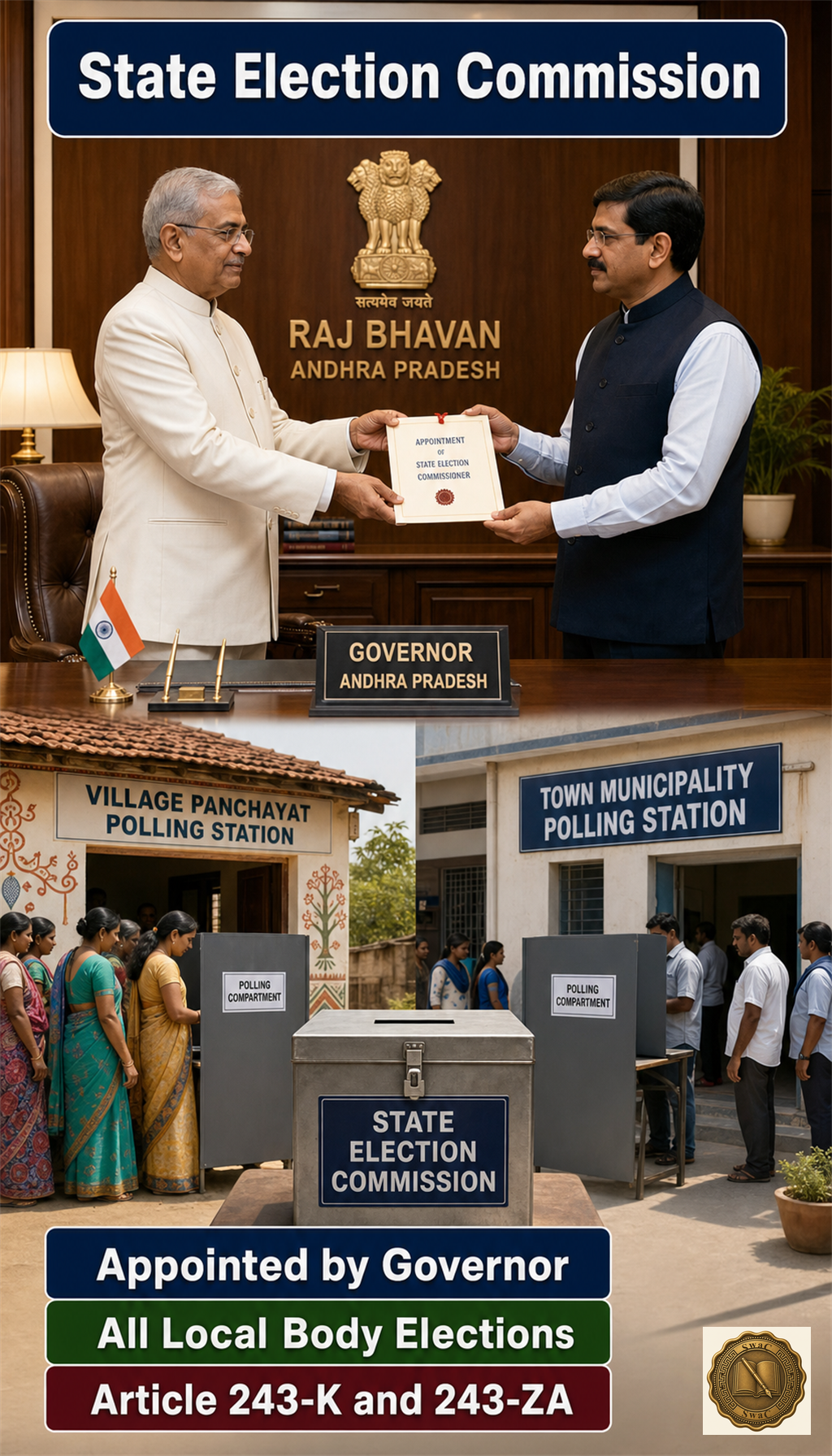
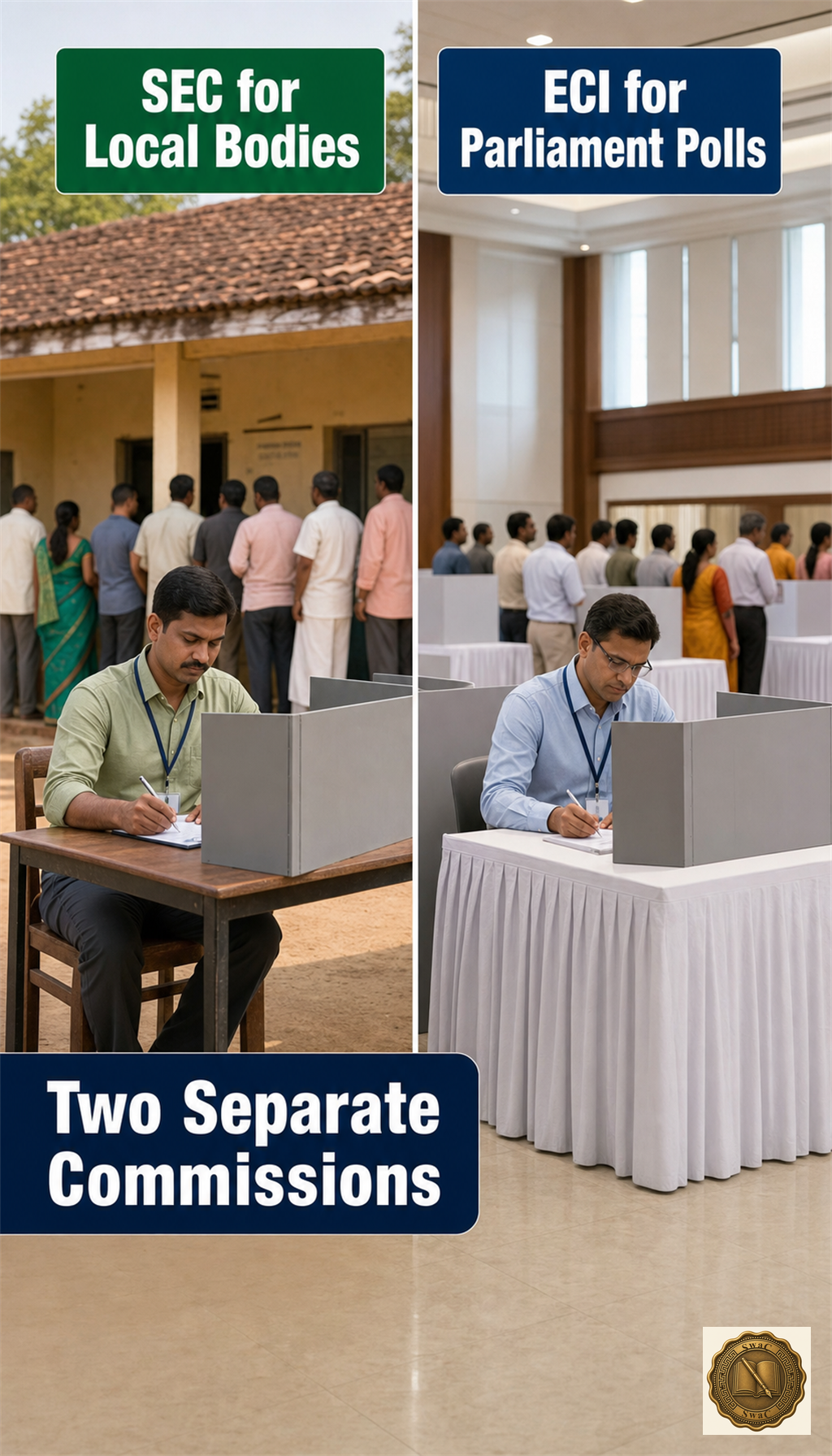
Every local election — Panchayat or Municipality — is conducted by a single State Election Commission, created under Article 243K for Panchayats and Article 243ZA for Municipalities. The SEC is appointed by the Governor, can be removed only in the manner of a High Court judge, and its service conditions cannot be varied to its disadvantage after appointment. It is entirely separate from the Election Commission of India, which handles only Parliament and State Legislature elections — a separation that prevents state governments from manipulating or postponing local elections as they frequently did before 1993.
Marks-winning facts · recall first
- SEC appointed by the GOVERNOR (not the President, not the CM)
- One SEC conducts ALL Panchayat and Municipality elections
The paymaster
Every five years, the money is counted
Money follows a constitutional rhythm. Under Articles 243I and 243Y, the Governor constitutes a State Finance Commission every five years to review the finances of local bodies. The SFC recommends how tax proceeds are distributed between the state and its local bodies, what grants-in-aid they receive, and measures to improve their financial position, and its report is placed before the State Legislature with an action-taken memorandum. The Central Finance Commission, under Article 280(3)(bb) and (c), considers these recommendations while allocating funds to states — a chain running from central finance to the grassroots.
Marks-winning facts · recall first
- Recommends tax sharing, grants-in-aid, and financial improvement measures
V
The Division of Labour
The village brief
Twenty-nine subjects for the panchayat
The Eleventh Schedule hands Panchayats a brief of twenty-nine subjects — the whole working life of village India. It runs from agriculture, land improvement and minor irrigation through animal husbandry, fisheries and social forestry to rural housing, drinking water, roads, and rural electrification. It also carries the social mandate: poverty alleviation, primary and secondary education, health and sanitation, family welfare, women and child development, and the public distribution system.
Marks-winning facts · recall first
- Agriculture, minor irrigation, rural housing, drinking water, roads, electrification
- Education, health and sanitation, poverty alleviation, PDS
The city brief
Eighteen tasks to run a town
The Twelfth Schedule gives Municipalities eighteen functional items — the anatomy of a working city. Urban planning and land-use regulation lead the list, followed by roads and bridges, water supply, public health, sanitation and solid waste management. The schedule reaches from fire services, urban forestry and environment protection to slum improvement, urban poverty alleviation, street lighting, parking and bus stops — and even the regulation of slaughter houses and tanneries and the vital statistics of births and deaths.
Marks-winning facts · recall first
- Urban planning, water supply, public health, solid waste management
- Fire services, slum improvement, vital statistics (births and deaths)
The options
What the states may give — or withhold
Beyond the mandatory core, both amendments leave a menu to each State Legislature's discretion. States may give local bodies powers to levy taxes, duties, tolls and fees, transfer functions and responsibilities to them, and grant financial autonomy and grants-in-aid. They may reserve seats for Backward Classes, give MPs, MLAs and MLCs representation in local bodies, and choose whether chairpersons are elected directly or indirectly. The mandatory provisions built the frame; these choices decide how much power each state actually hands down.
Marks-winning facts · recall first
- Backward Class reservation is VOLUNTARY (SC/ST and women are mandatory)
VI
The Edges of the Map
The exceptions
Where Part IX does not run
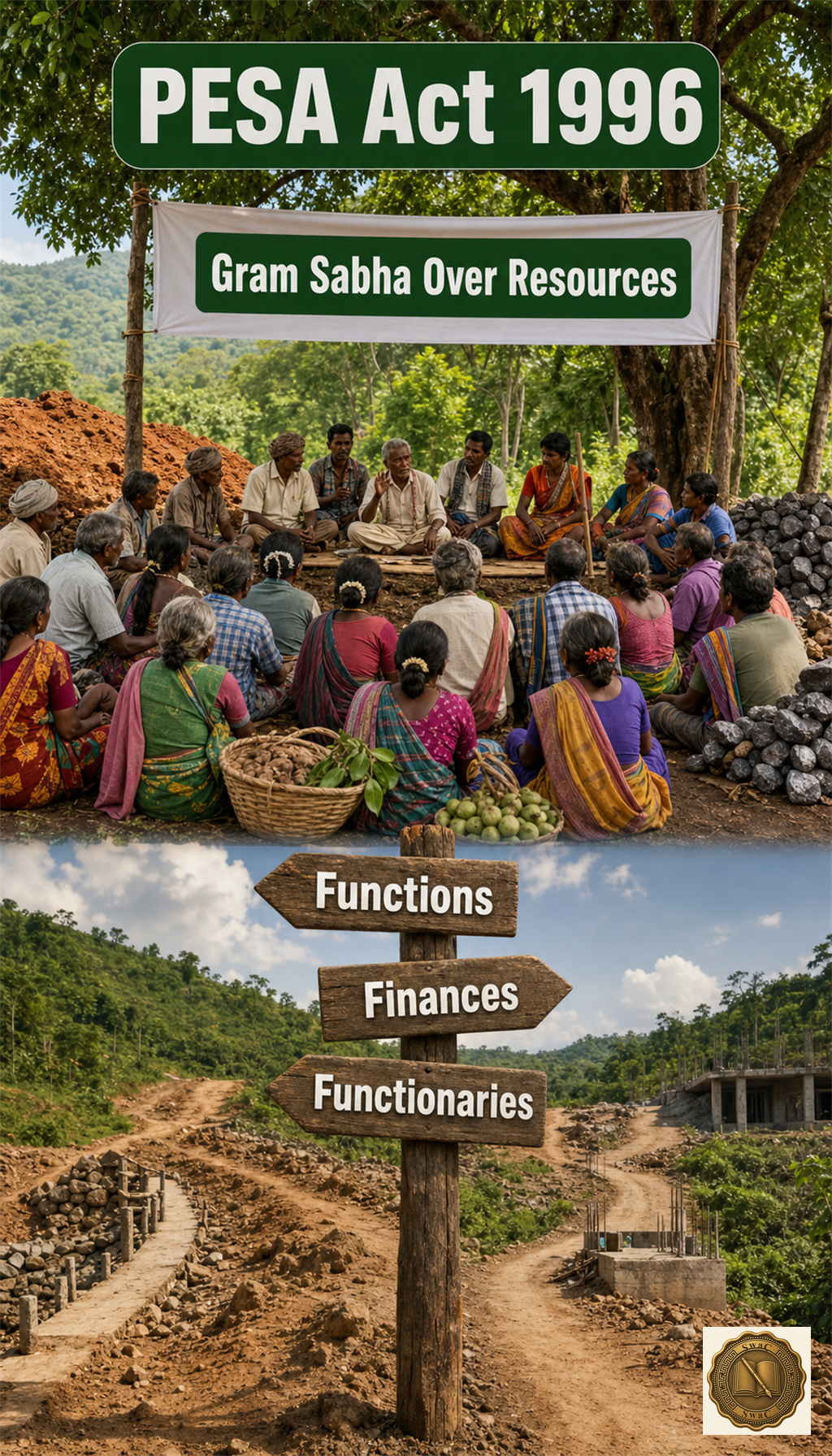
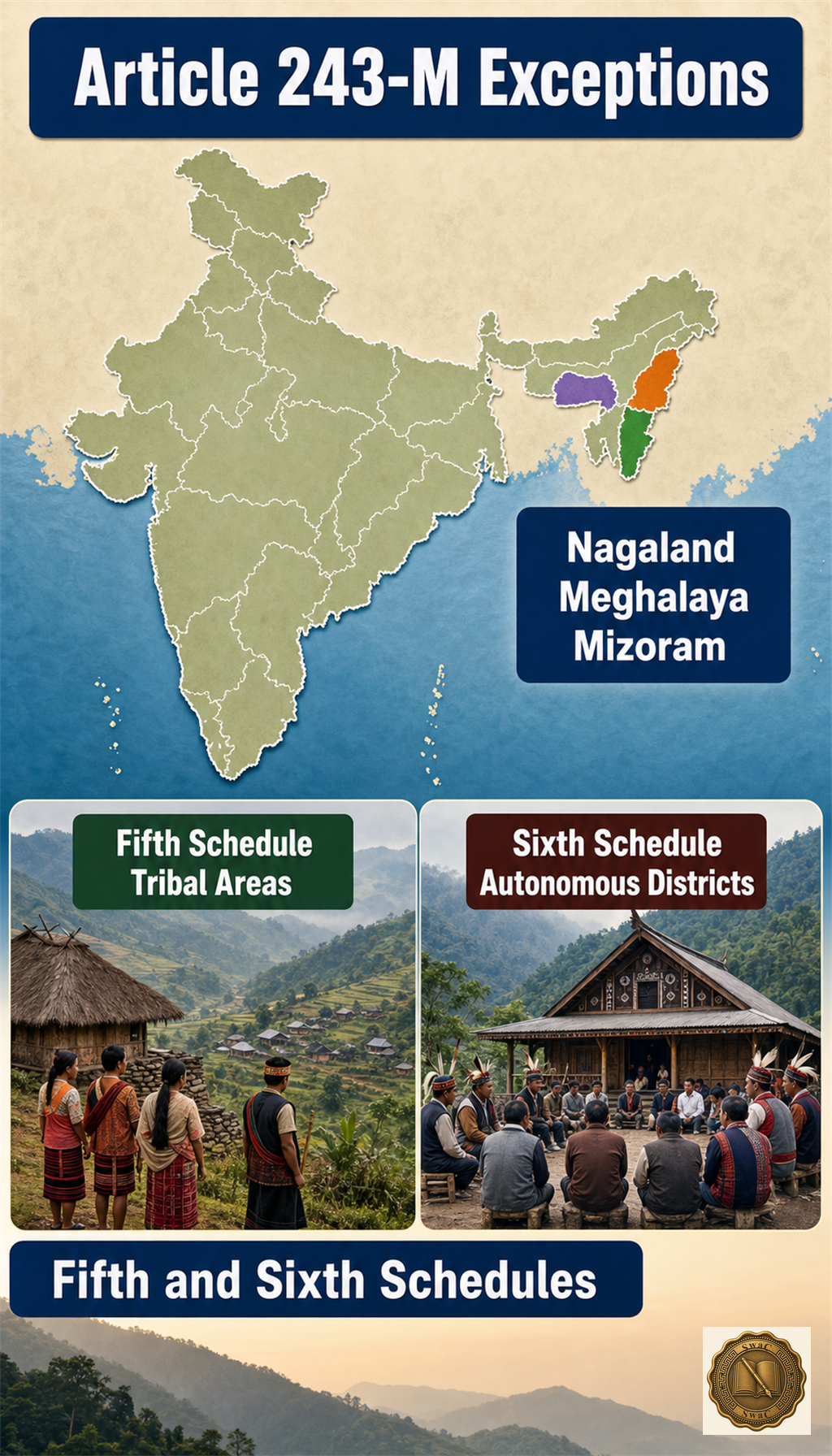
The Panchayat chapter has exceptions written into it. Under Article 243M, Part IX does not apply to Nagaland, Meghalaya and Mizoram, nor to areas under the Fifth and Sixth Schedules of the Constitution. The PESA Act of 1996 then extended Part IX into Fifth Schedule tribal areas with modifications that protect tribal autonomy — including the Gram Sabha's power over natural resources. And everywhere else a quieter limitation persists: many states have never fully devolved the 3Fs — Functions, Finances and Functionaries — so the constitutional framework still waits on state-level political will.
Marks-winning facts · recall first
The homeland
Mandal, not block: how Andhra Pradesh built its tiers
Andhra Pradesh implemented the 73rd Amendment through the AP Panchayati Raj Act of 1994, with a distinctive twist: the intermediate tier is the Mandal Parishad, aligned with the mandal administrative unit rather than the block. The rural ladder runs Gram Panchayat to Mandal Parishad to Zilla Parishad, while the AP Municipalities Act and the AP Municipal Corporation Act carry the 74th Amendment into the towns. The scale is vast — approximately 22 Zilla Parishads, 1,095 Mandal Parishads and 21,895 Gram Panchayats, alongside 123 urban local bodies — and the CAG has published performance audits of the state's implementation of both amendments.
Marks-winning facts · recall first
- Municipal Commissioner posts operate within the 74th Amendment framework
VII
The Final Paper
The armoury
The paired numbers that score the marks
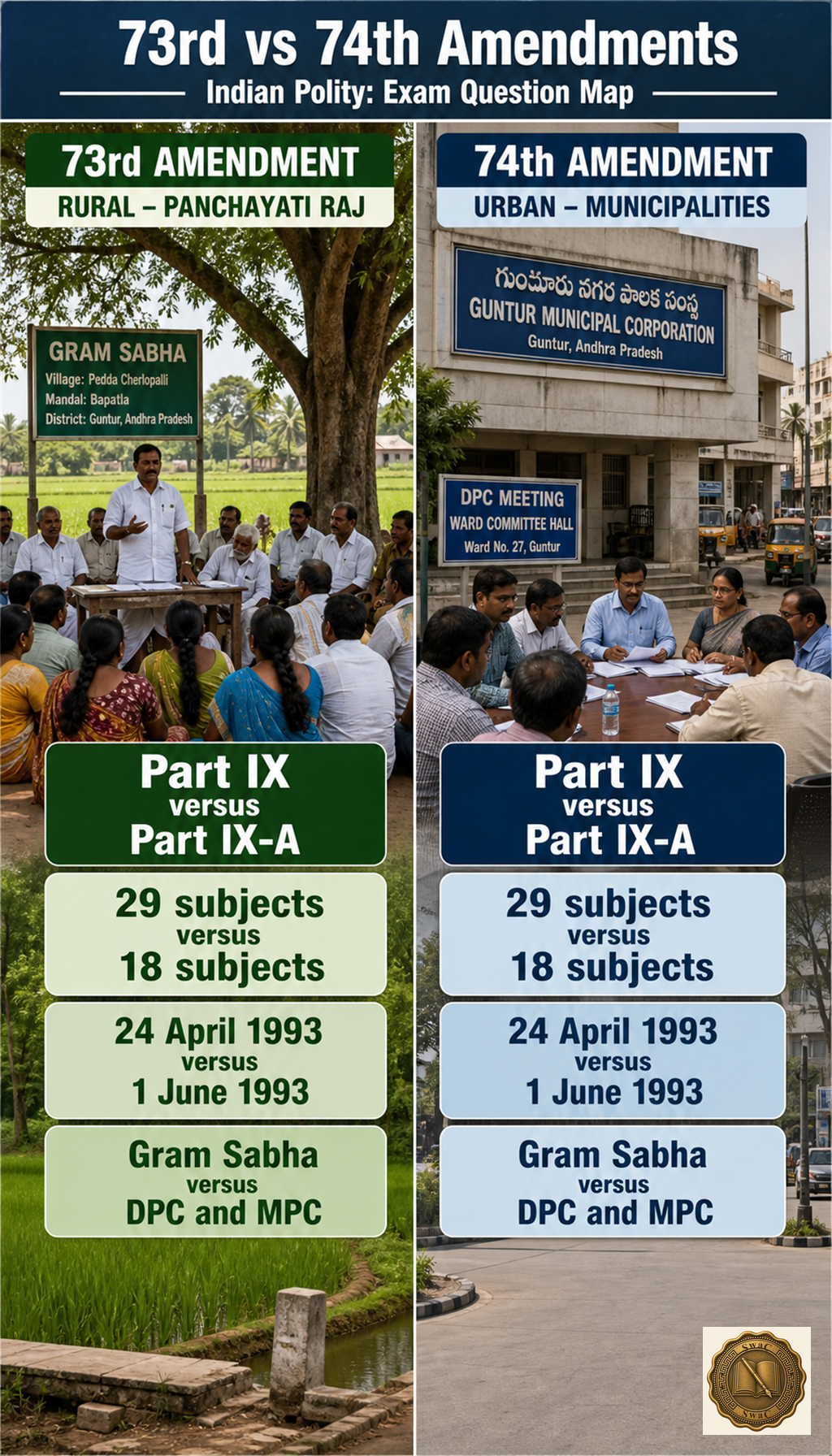
Distilled to its exam core, this chapter is a set of paired numbers. The 73rd means Part IX, Articles 243 to 243O, the Eleventh Schedule and 29 subjects; the 74th means Part IXA, Articles 243P to 243ZG, the Twelfth Schedule and 18 subjects. Both were passed in 1992 and both fix the same iron rules — direct elections, five-year terms, six-month re-elections, SC/ST reservation by population share and one-third for women — with an SEC and an SFC constituted under the Governor's hand. Hold on to the odd details too: minimum age twenty-one, a District Planning Committee with four-fifths elected members, a Metropolitan Planning Committee with two-thirds, and a Gram Sabha that exists only on the rural side.
Marks-winning facts · recall first
Exam tactics
73 is rural, 74 is urban — and the traps in between
APPSC tests this chapter through comparisons, so play it as a table — expect 2 to 3 questions on Part IX versus IXA, the Eleventh versus Twelfth Schedule, 29 versus 18 subjects, and the two effective dates of 24 April 1993 and 1 June 1993. The memory key is '73 is Rural, 74 is Urban', with one deliberate twist in the pattern: 73 is less than 74 and IX comes before IXA, but 29 is greater than 18, because the rural list has more subjects. Watch the classic traps: both amendments were passed in 1992 but came into force in 1993, planning committees belong to the 74th alone, the Gram Sabha to the 73rd alone, and the SEC is appointed by the Governor — never the President or the Chief Minister.
Marks-winning facts · recall first
End of chapter
Now make it yours
Part IX or IXA, 29 or 18, April or June — the comparison table decides the marks. Open the full notes, then test yourself.
Practice MCQs on this chapter →