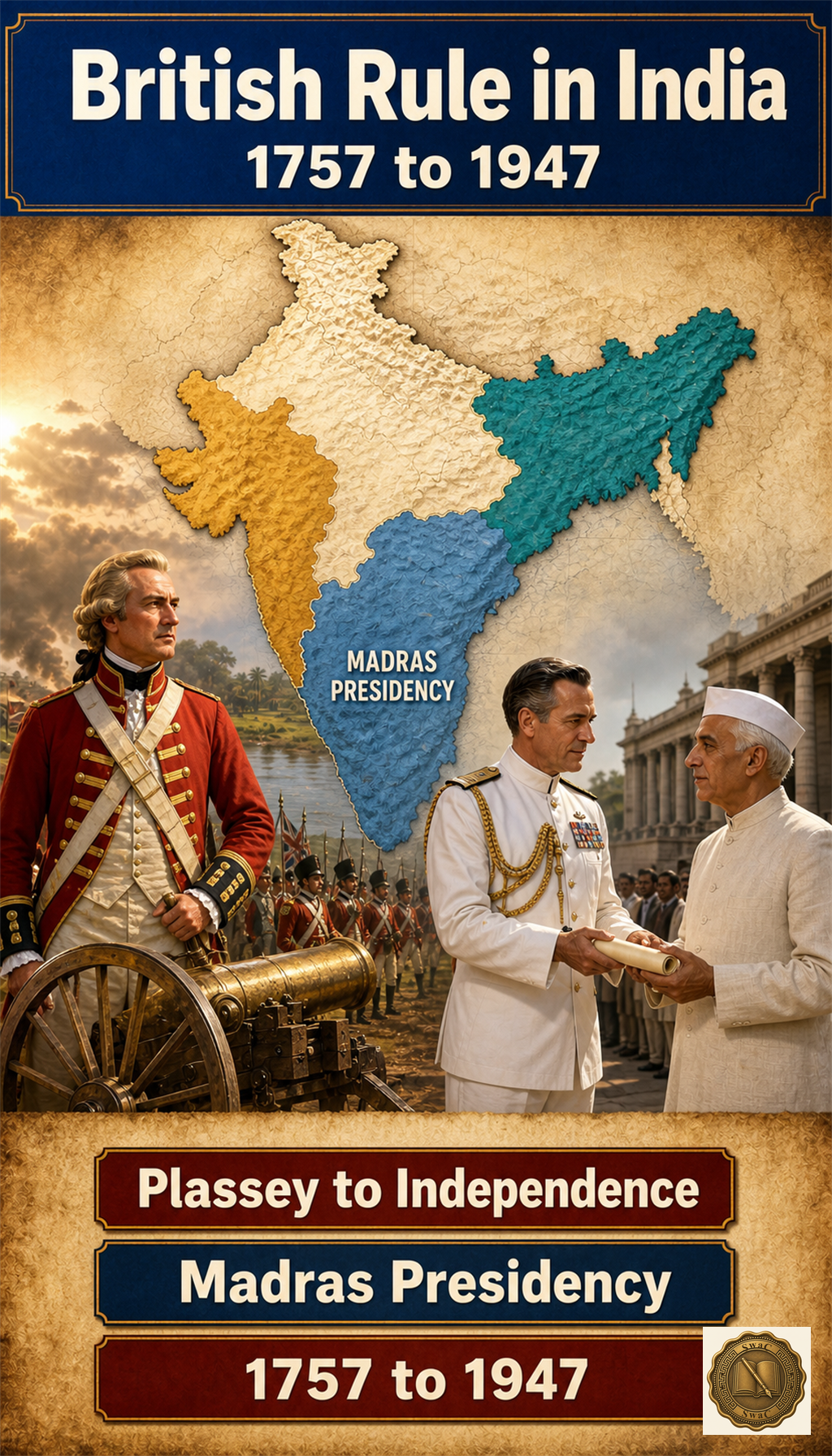
SwaPrep presents · A chapter in History
British Rule & Administration
Between 1757 and 1947, a trading company became an empire — and rewrote the map of the Telugu country in the process.
7 acts · 15 scenes · scroll to play↓
I
From Trade to Throne
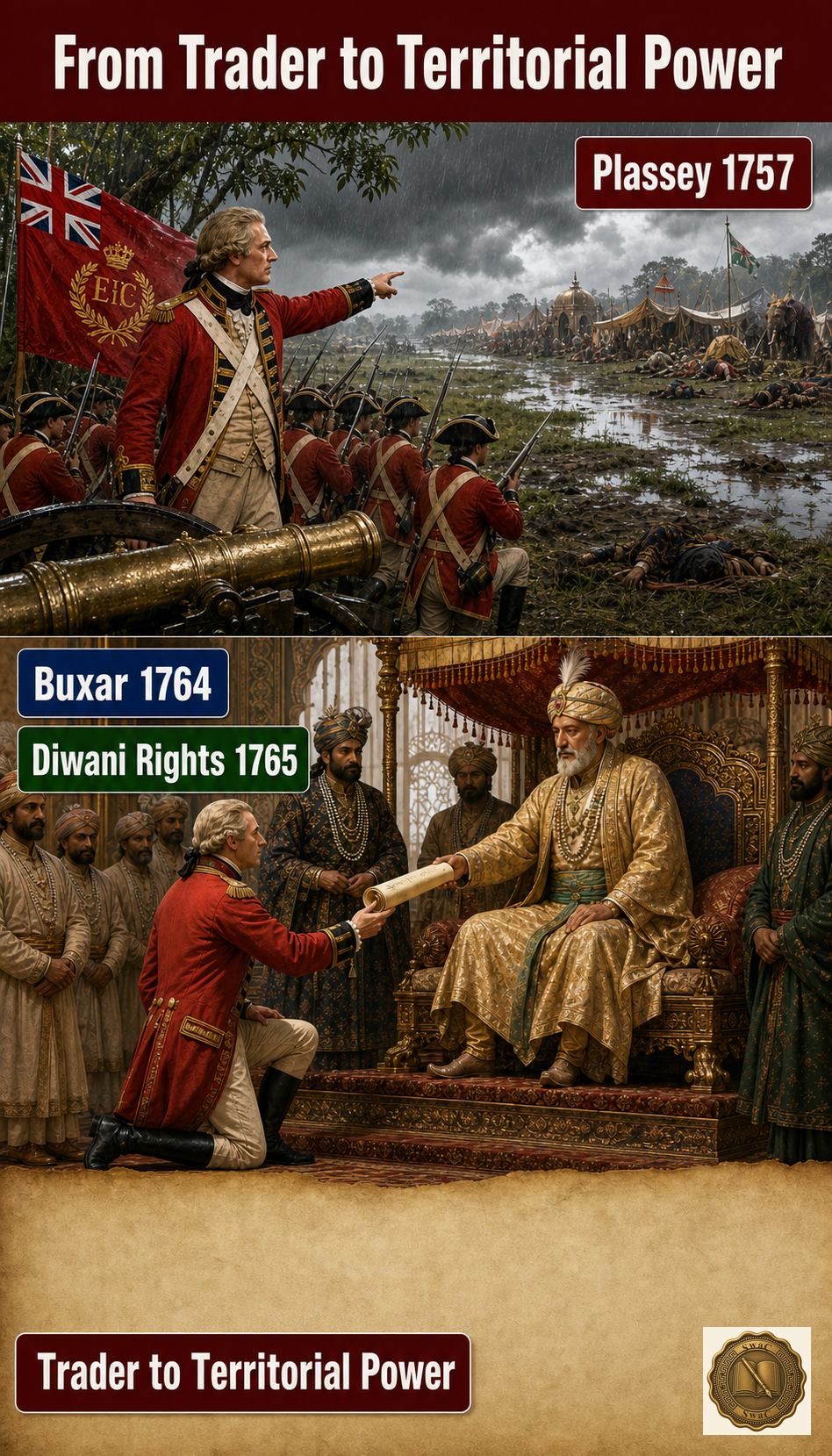
The turn1764 CE
A trading company becomes a territorial power
After the Battle of Plassey in 1757 and the Battle of Buxar in 1764, the East India Company stopped being a mere trading corporation and became a ruler of land. Victory at Buxar handed it real territorial power across Bengal, and from that moment the Company governed millions of Indians it had once only traded with. The transformation from merchant to sovereign had begun.
Marks-winning facts · recall first
- The EIC shifted from trading corporation to territorial power
- The base of British power in India was Bengal
Parliament steps in
London reaches for the reins
Alarmed by the Company's unchecked expansion, the British Parliament began passing regulatory acts from 1773 onward. Over the next century these laws progressively centralised power — first pulling authority from the Company to Parliament, then from Parliament to the Crown. While London tightened its legal grip from above, aggressive expansion policies absorbed Indian kingdoms below through war, diplomacy, and legal manipulation.
Marks-winning facts · recall first
- Put in order · tap the steps in sequence
- Expansion ran in parallel through war, diplomacy, and legal manipulation
II
The Letter of the Law
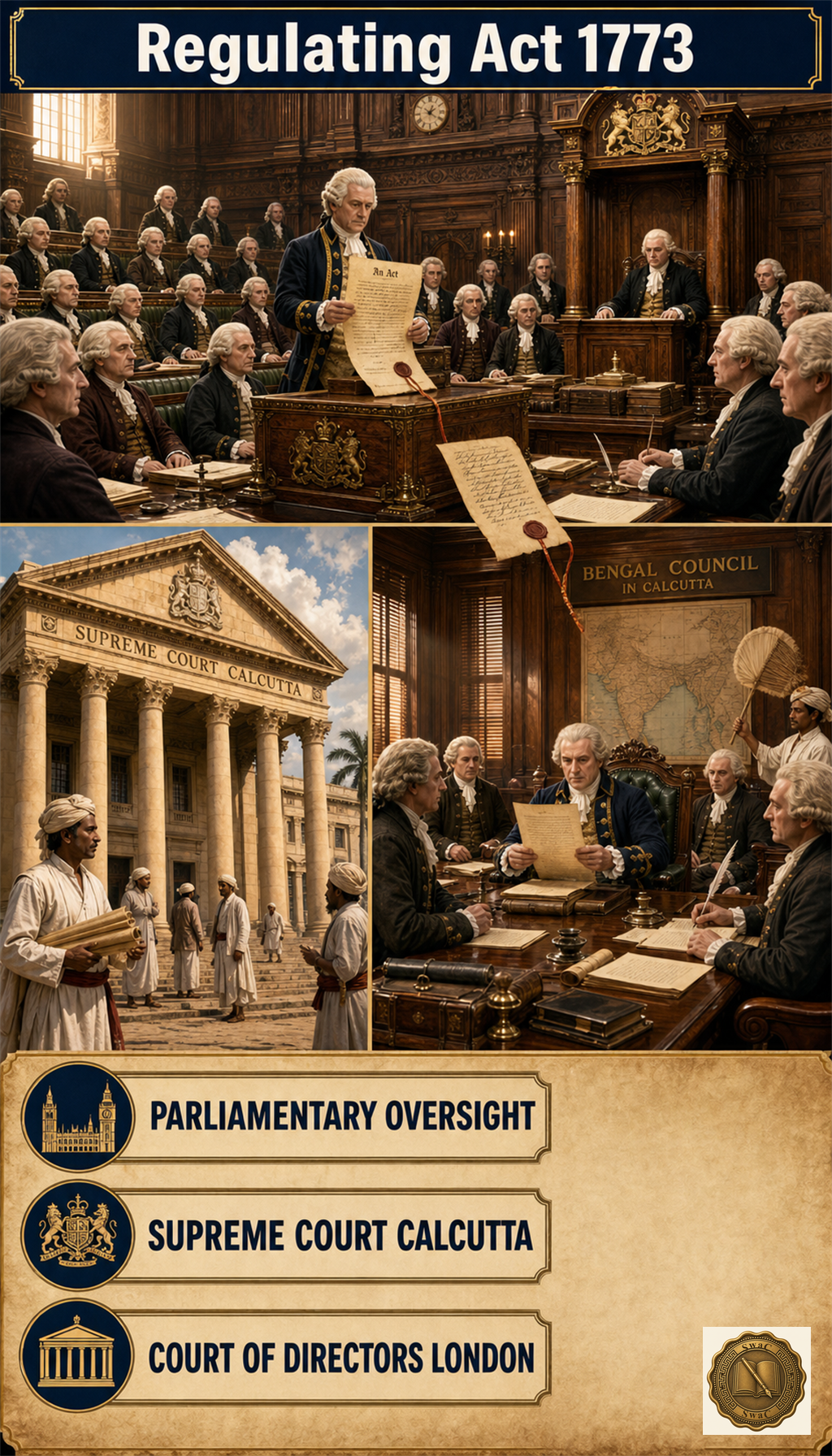
The first acts1773 CE
Regulating Act and the dual government
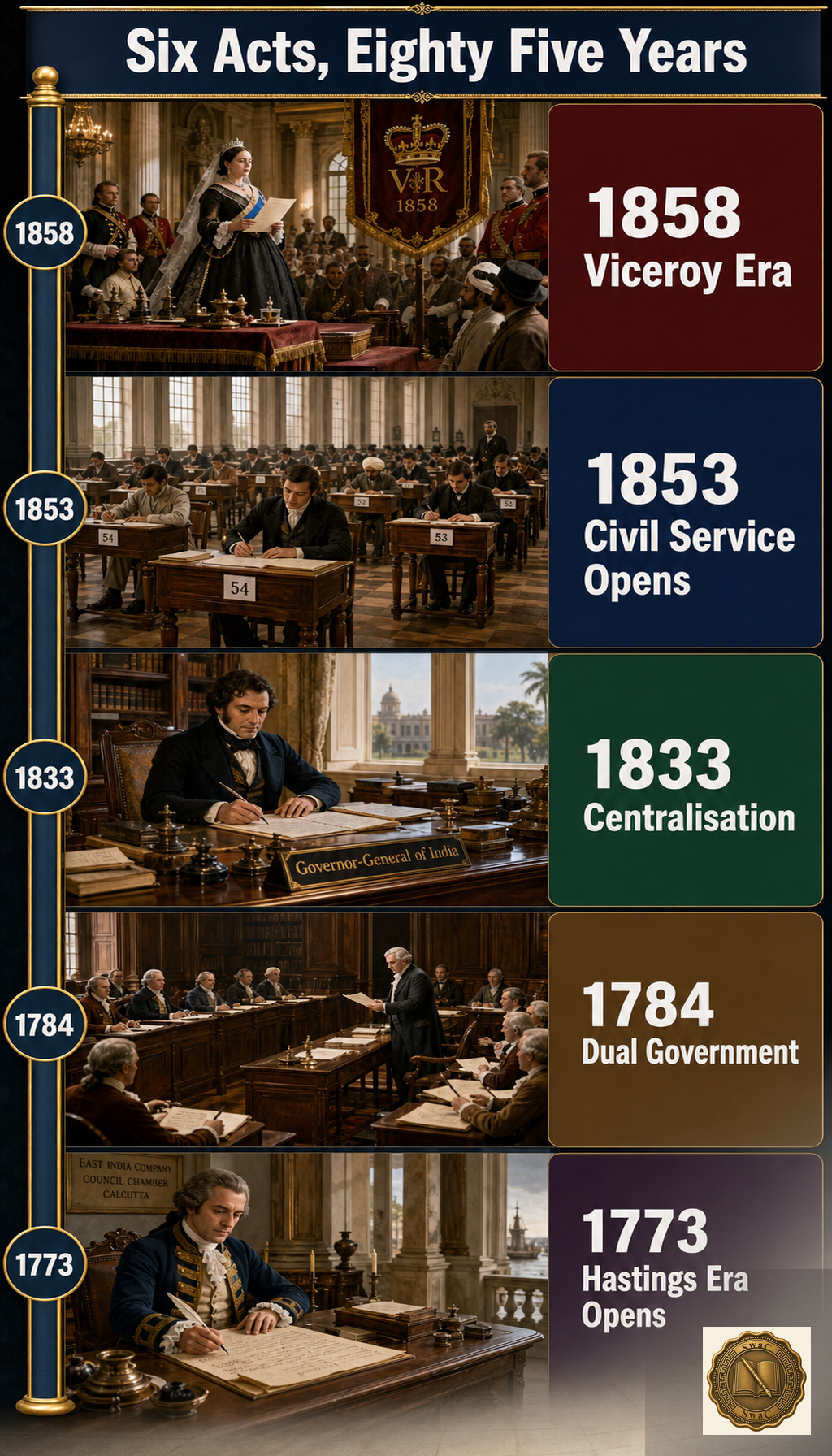
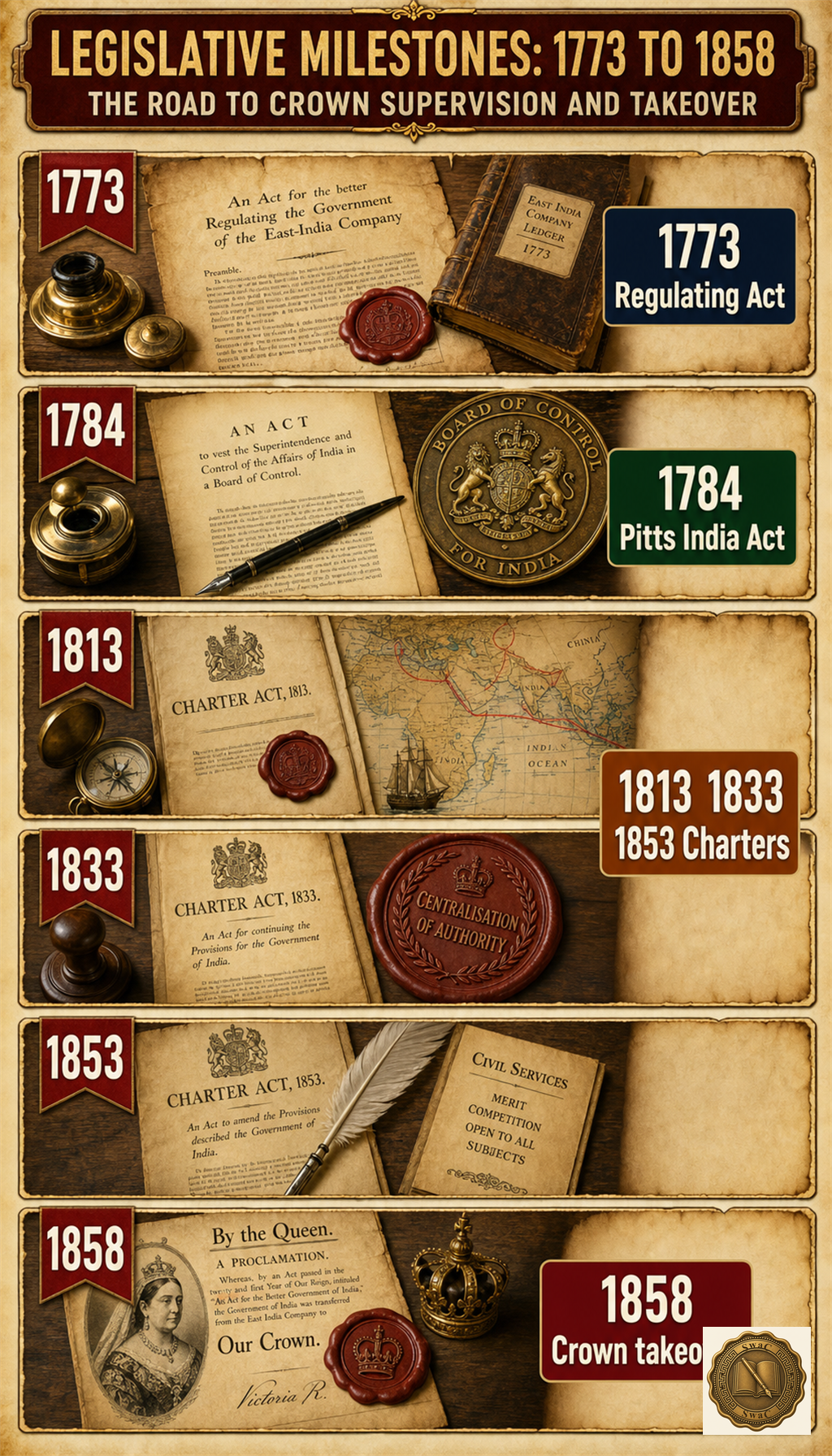
The Regulating Act of 1773 was the first parliamentary act to regulate the East India Company; it created the post of Governor-General of Bengal — Warren Hastings was the first — and set up the Supreme Court at Calcutta. Eleven years later, Pitt's India Act of 1784 created a Board of Control, building a dual government in which the Company and the Crown shared authority over Indian affairs. The Charter Act of 1813 then abolished the Company's trade monopoly in India, save the tea trade with China, and opened the door to Christian missionaries.
Marks-winning facts · recall first
Toward the Crown1858 CE
From Governor-General of Bengal to Viceroy
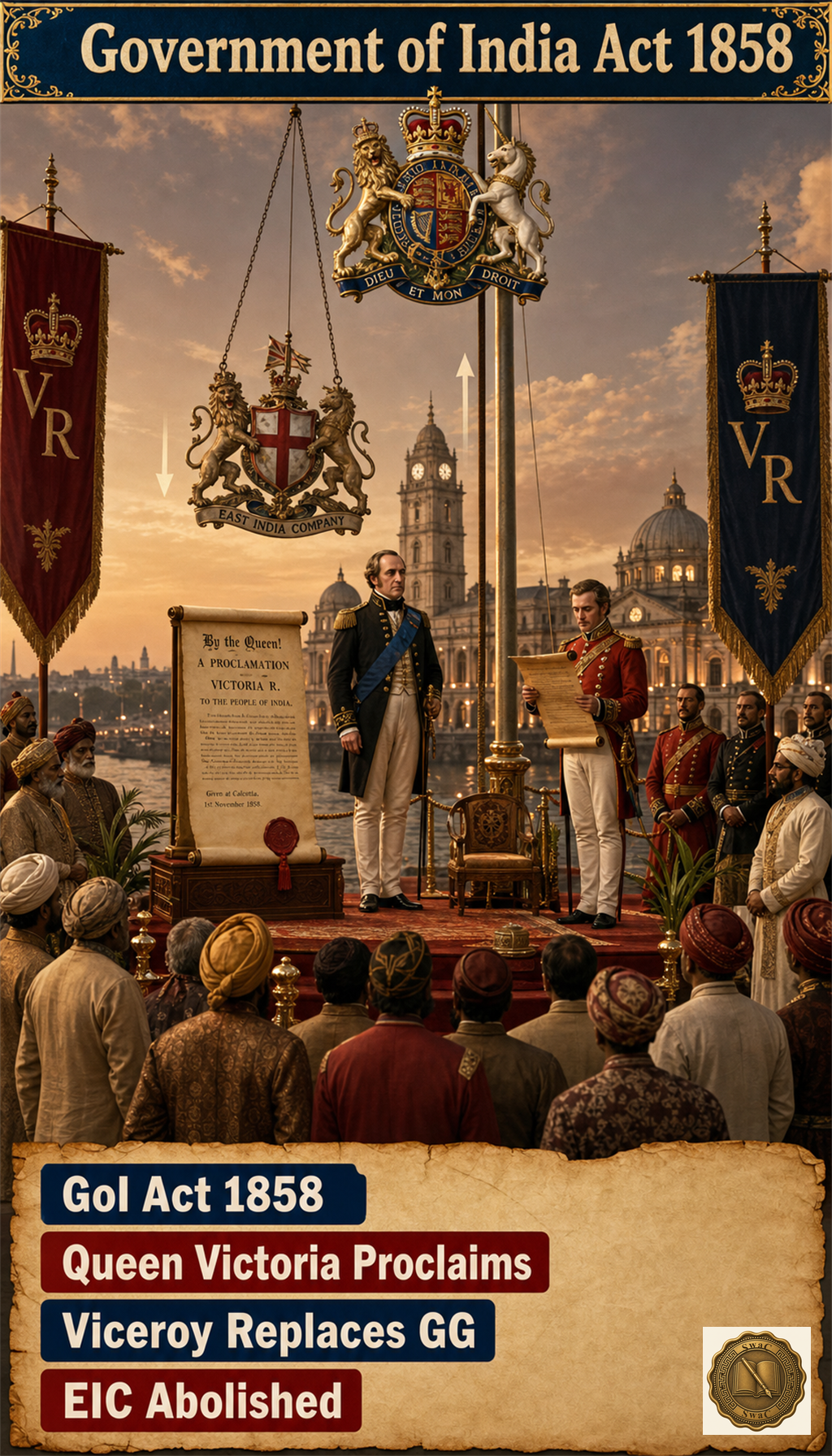
The Charter Act of 1833 elevated the Governor-General of Bengal to Governor-General of India — Lord William Bentinck was the first — centralising all of British India under one authority. The Charter Act of 1853 established the Indian Legislative Council and introduced open competition for the civil services, ending the old patronage system. Finally, the Government of India Act of 1858 abolished the East India Company outright, transferred all powers to the British Crown, and redesignated the Governor-General as Viceroy.
Marks-winning facts · recall first
III
The Men Who Ruled
The founders
Hastings the administrator, Cornwallis the reformer
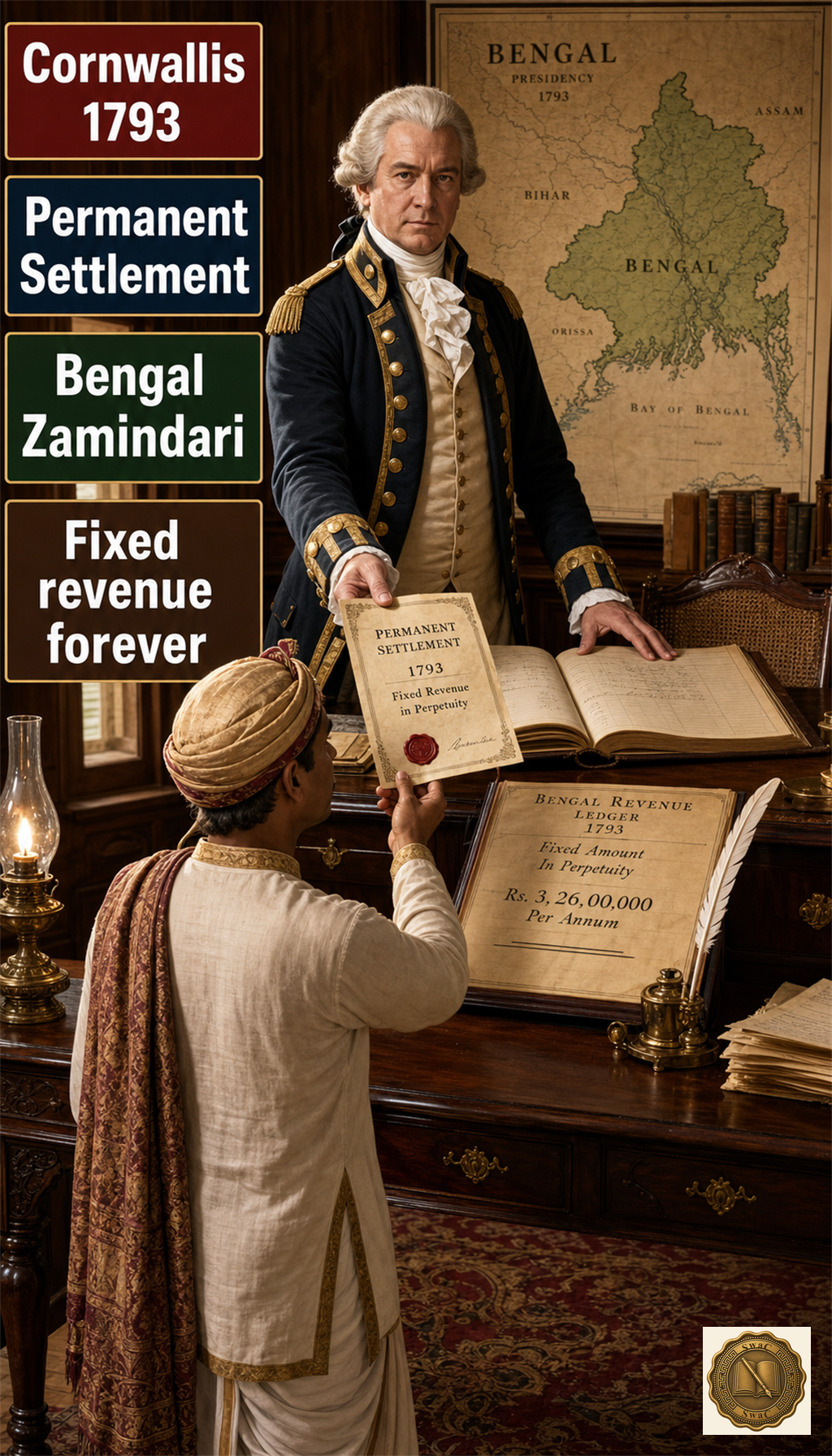
Warren Hastings, the first Governor-General, set up two courts in every district — the Diwani Adalat for civil cases and the Faujdari Adalat for criminal cases — and commissioned the compilation of Hindu and Muslim legal codes for European judges. His successor Lord Cornwallis introduced the Permanent Settlement in Bengal in 1793, making Zamindars hereditary owners with fixed revenue obligations. For reforming the bureaucracy, Cornwallis earned the title 'Father of Civil Service in India.'
Marks-winning facts · recall first
- Hastings commissioned Hindu and Muslim legal codes for European judges
The expanders1829 CE
Wellesley, Bentinck, and the relentless Dalhousie
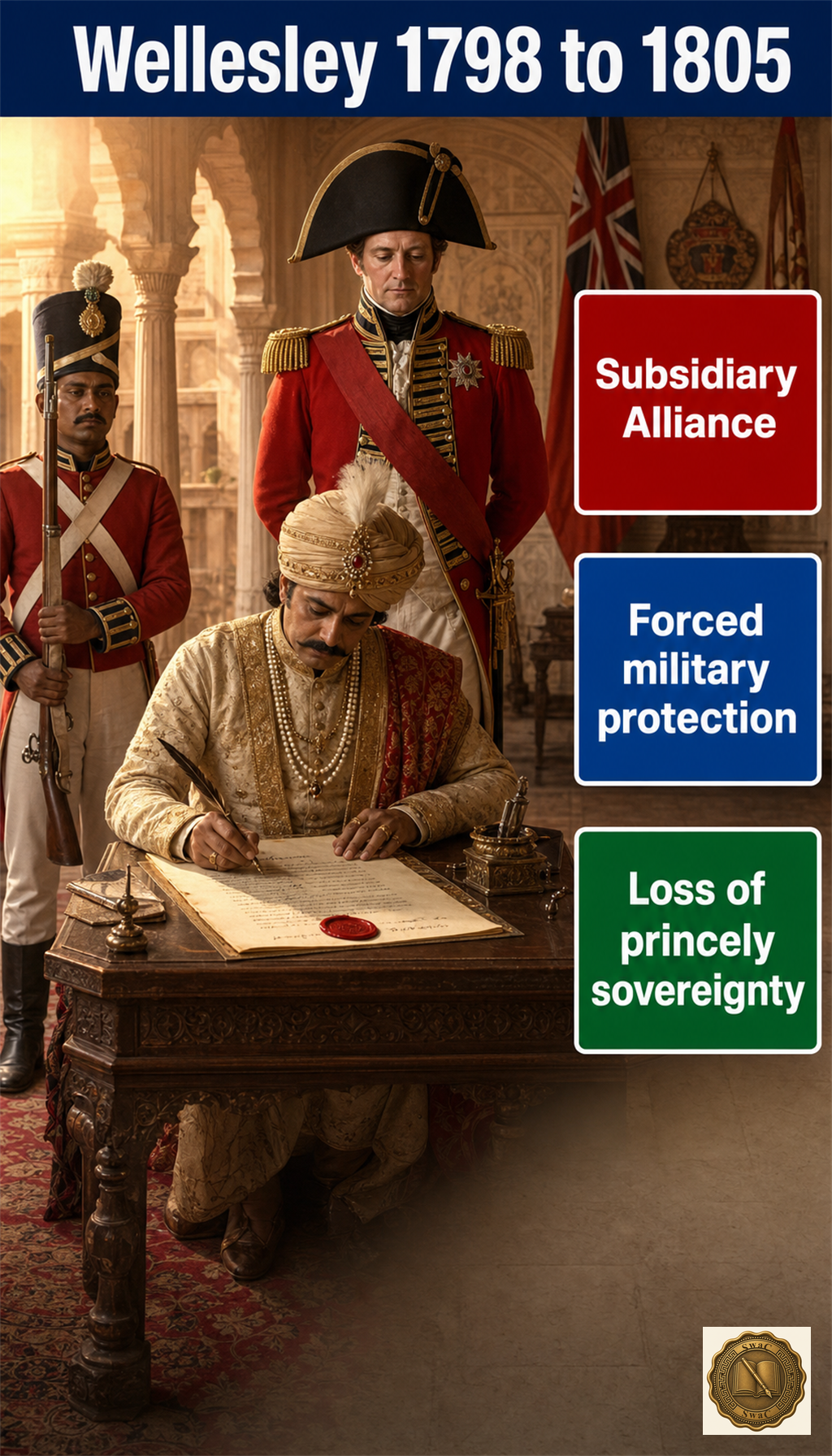
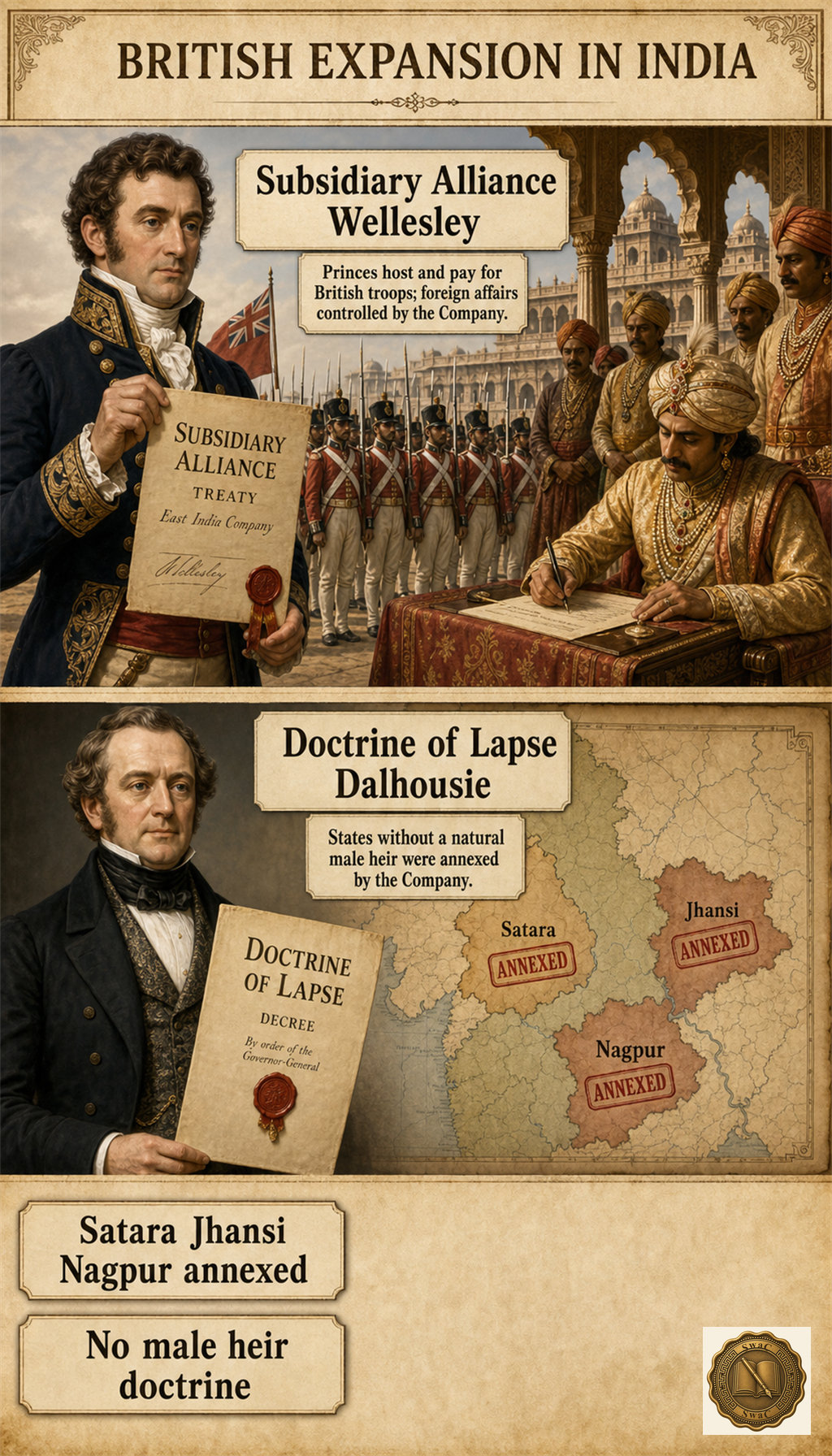
Lord Wellesley introduced the Subsidiary Alliance, forcing Indian rulers to maintain British troops at their own expense, surrender foreign policy, and accept a British Resident at court. Lord William Bentinck abolished Sati in 1829 and, through Macaulay's Minute of 1835, introduced English education to create 'a class of persons Indian in blood and colour, but English in tastes.' Lord Dalhousie then unleashed the Doctrine of Lapse — annexing Satara, Jhansi, and Nagpur — while Awadh was taken in 1856 on the separate pretext of 'misgovernance'; he also opened India's first railway from Bombay to Thane in 1853.
Marks-winning facts · recall first
The Crown's men
Canning, Curzon, and the last Viceroy
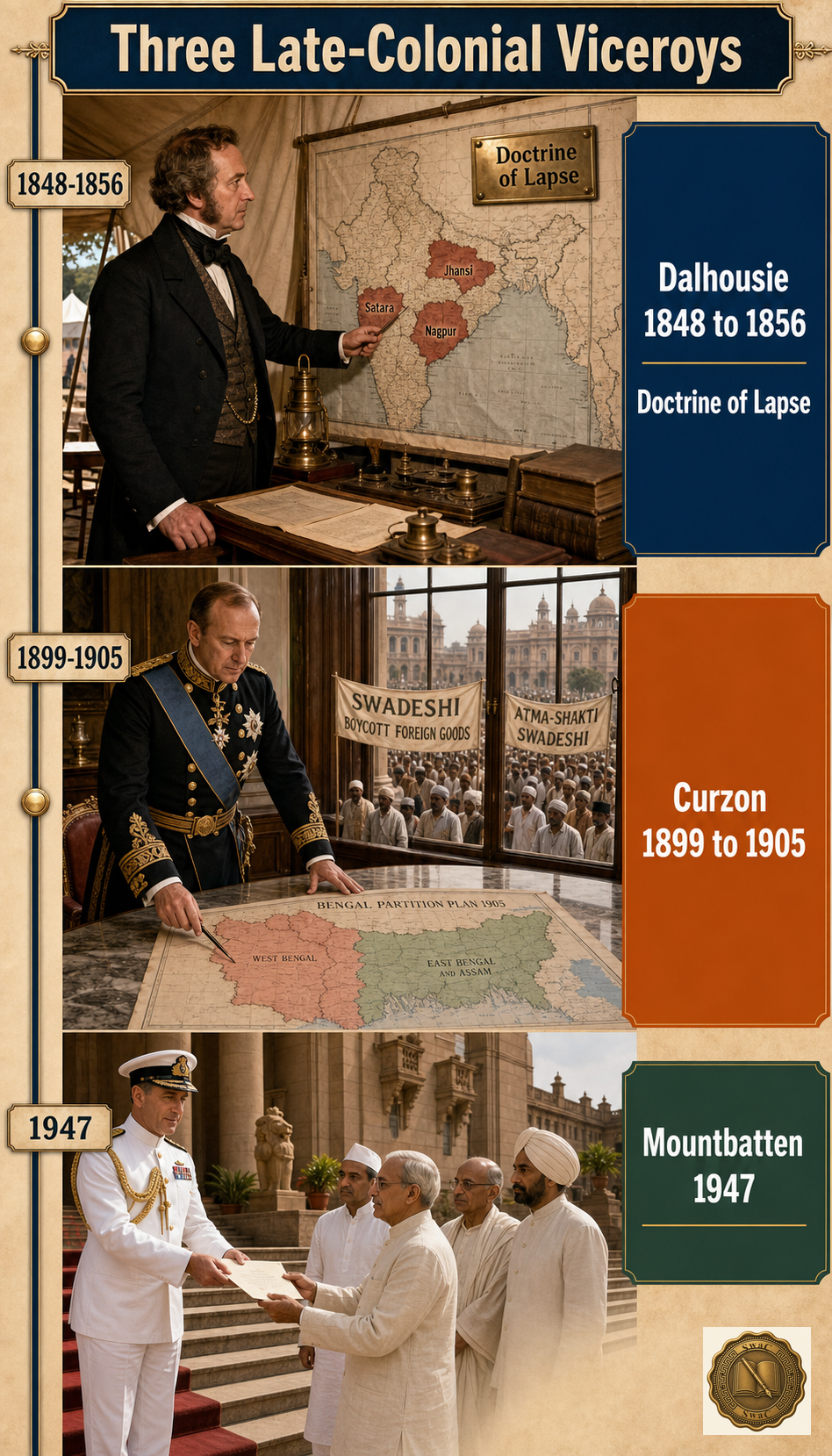
Lord Canning was the last Governor-General and the first Viceroy, managing the revolt of 1857 and overseeing the handover from Company to Crown. Lord Curzon partitioned Bengal in 1905, an act that triggered the Swadeshi movement. Decades later, Lord Mountbatten served as the last Viceroy, presiding over Indian independence and partition in 1947.
Marks-winning facts · recall first
IV
The Machinery of Conquest
Three methods
Alliance, lapse, and the sword
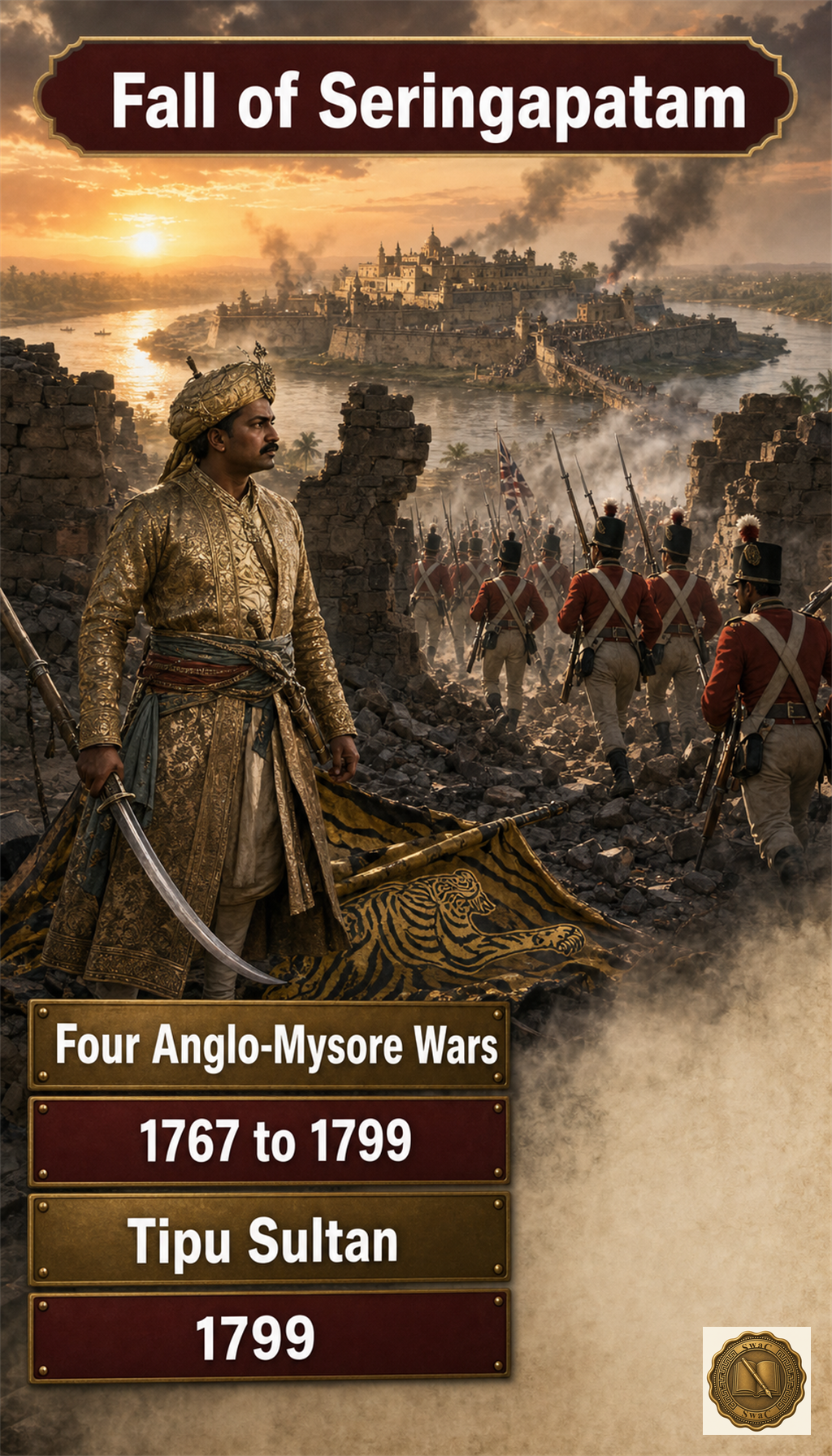
The British annexed India by three principal methods. Under the Subsidiary Alliance, rulers surrendered sovereignty in exchange for 'protection,' losing the right to keep independent armies, conduct foreign relations, or employ non-British Europeans; under the Doctrine of Lapse, adopted heirs were denied succession, violating longstanding Indian traditions of adoption. Where neither sufficed, direct military conquest did — four Anglo-Mysore Wars ended with Tipu Sultan's death at Seringapatam, three Anglo-Maratha Wars destroyed the Maratha Confederacy, and two Anglo-Sikh Wars annexed Punjab in 1849.
Marks-winning facts · recall first
V
The Price of the Land
Land revenue1793 CE
Three systems for taxing the soil
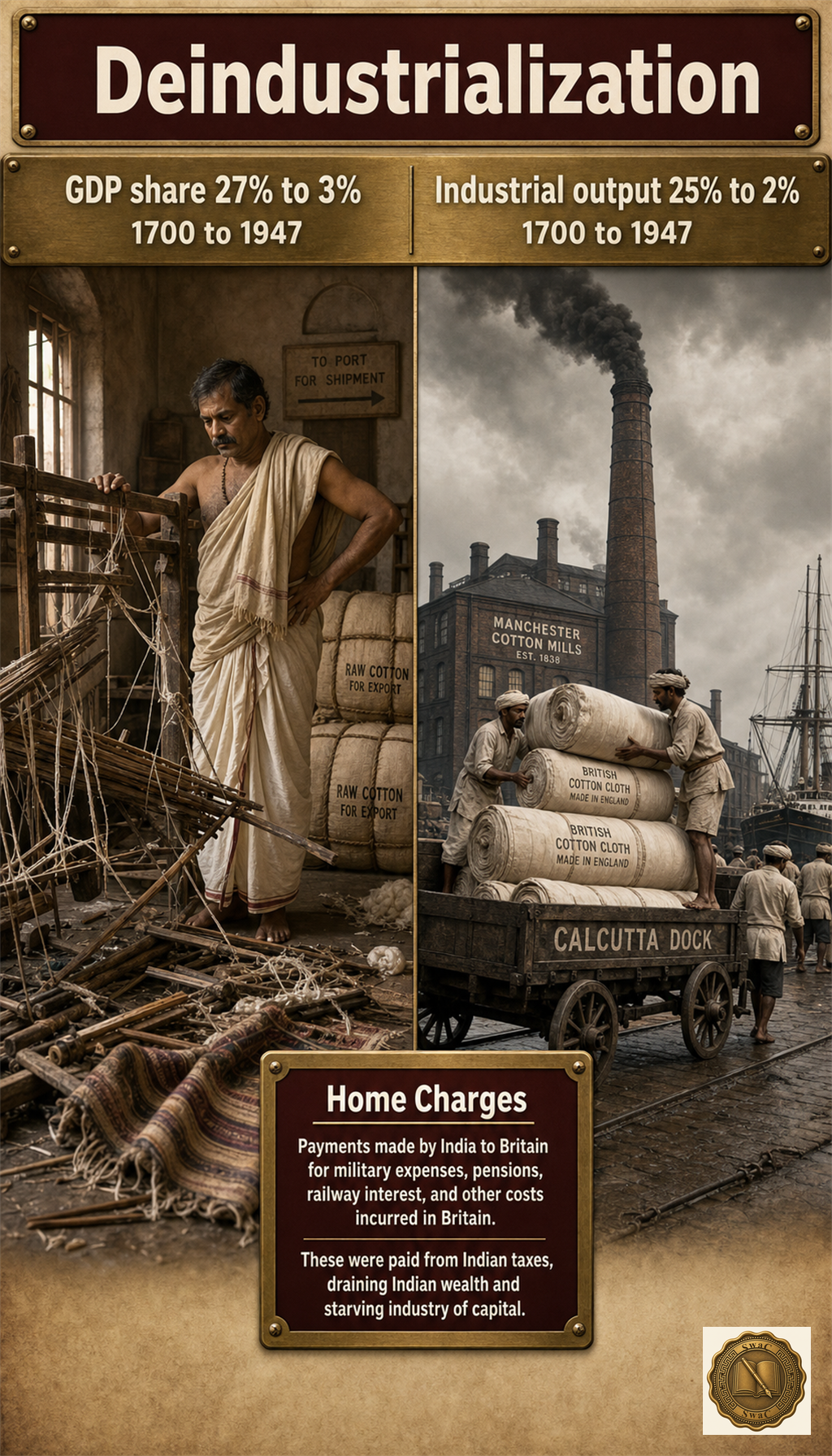
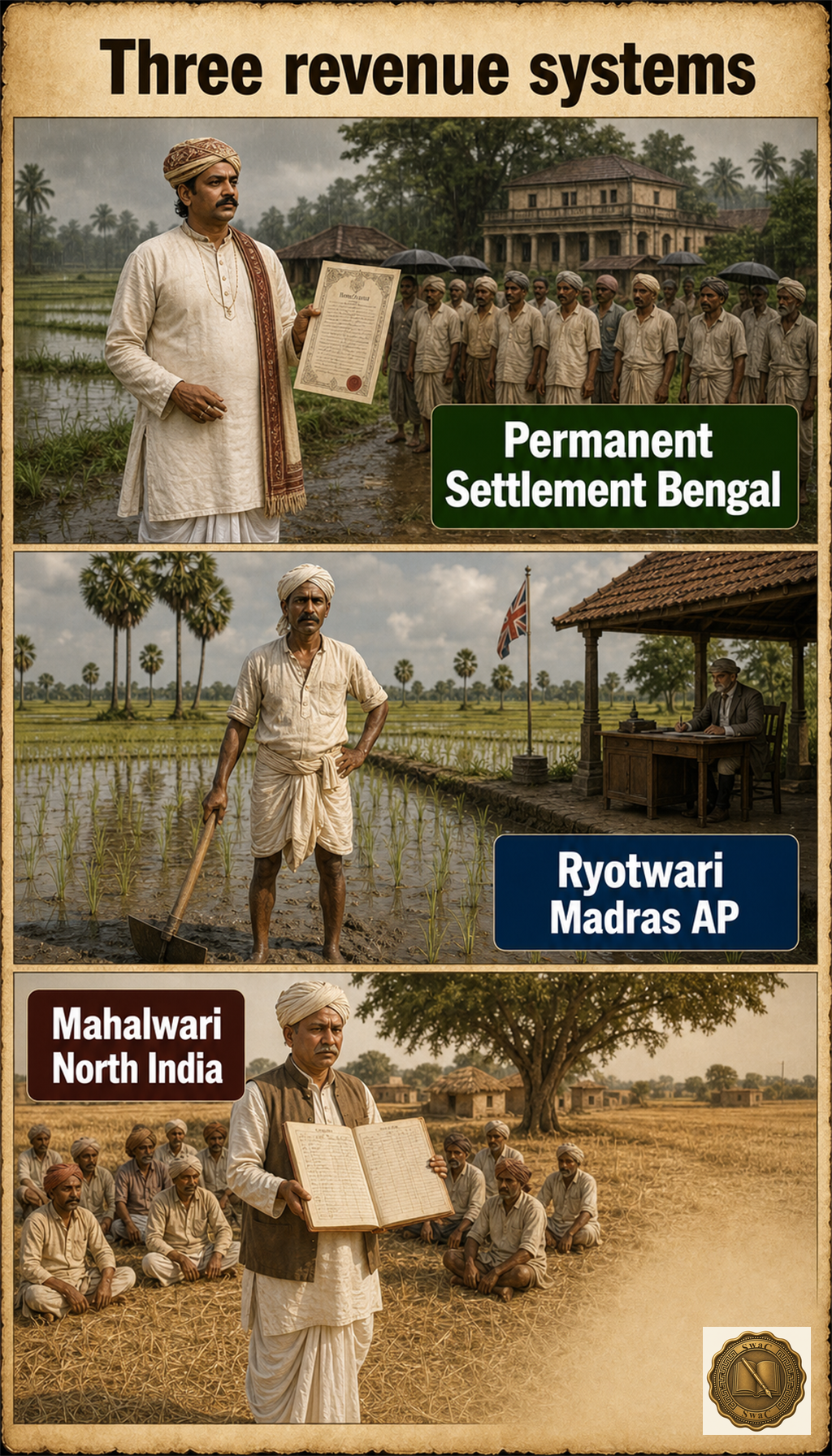
The British extracted revenue through three systems. The Permanent Settlement of 1793, introduced by Cornwallis in Bengal, made Zamindars hereditary owners with permanently fixed revenue — and auctioned the land if they failed to pay. The Ryotwari System, begun by Captain Read and refined by Sir Thomas Munro, let individual cultivators pay the state directly with no intermediary, and it dominated the Madras Presidency including all Telugu regions; the Mahalwari System of 1822, introduced by Holt Mackenzie, assessed and collected revenue village by village.
Marks-winning facts · recall first
The drain1901 CE
How the wealth flowed out
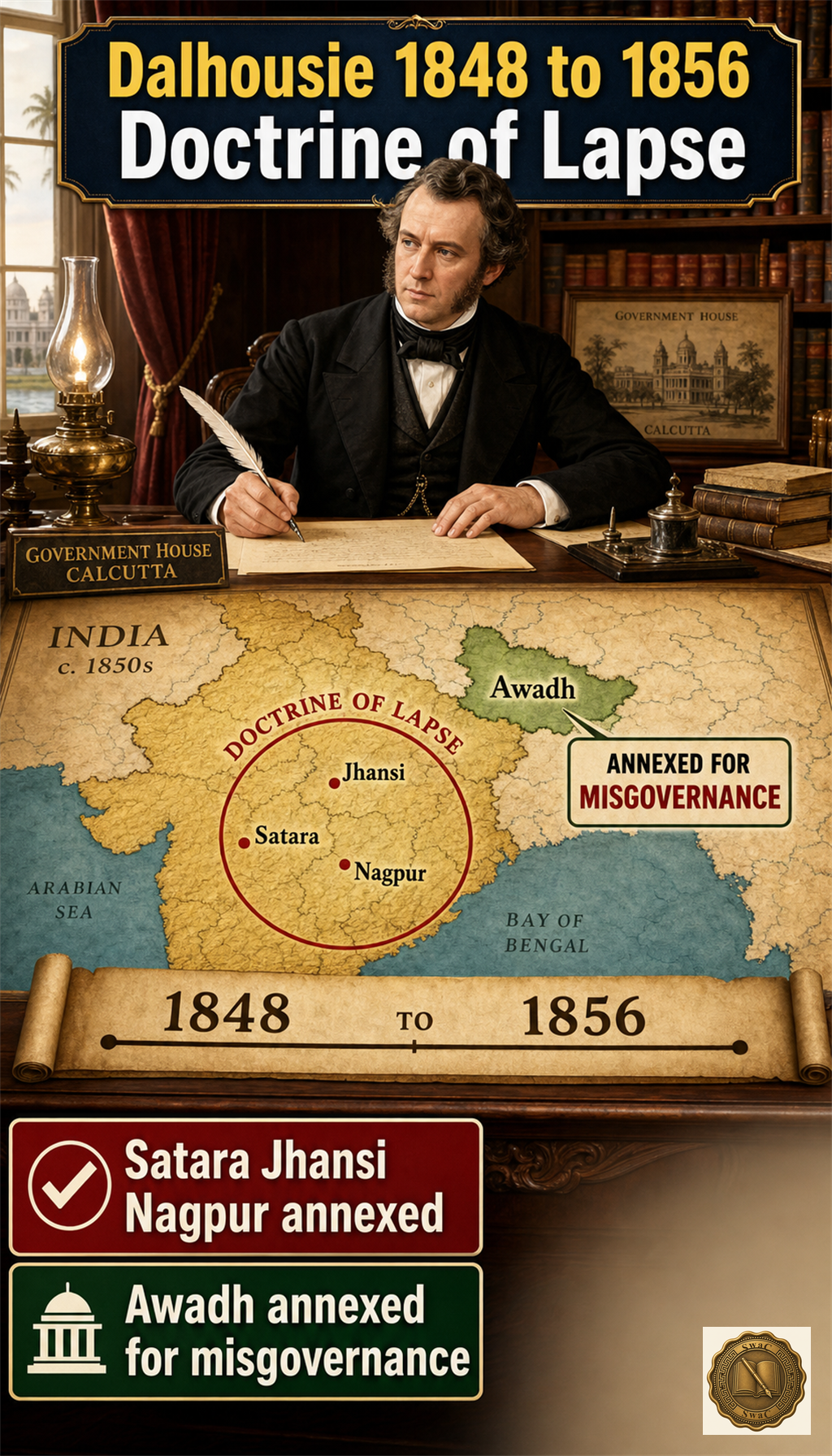
Dadabhai Naoroji's 'Drain Theory,' published in his 1901 book Poverty and Un-British Rule in India, quantified the annual drain at 30–40 million pounds. India's share of world GDP collapsed from 27% in 1700 to just 3% by 1947, and its share of global industrial output fell from 25% in 1750 to under 2% by 1900 — deliberate deindustrialization. 'Free trade' destroyed Indian textiles, turning a nation of finished-goods exporters into a supplier of raw materials and a market for British manufactures, while 'home charges' were all paid from Indian taxes.
Marks-winning facts · recall first
The hunger
Famines made, not merely suffered
High land-revenue taxes left peasants with little food security, and the forced shift from food crops to cash crops like indigo and cotton made whole populations vulnerable to starvation. The Bengal Famine of 1770 killed 10 million people, the Great Famine of 1876–78 killed 5.5 million, and the Bengal Famine of 1943 killed 3 million. Resistance did erupt — the Indigo Revolt of 1859–60 in Bengal was a direct response to forced cultivation by British planters.
Marks-winning facts · recall first
VI
The Telugu Country
The presidency1652 CE
How the Madras Presidency made Andhra
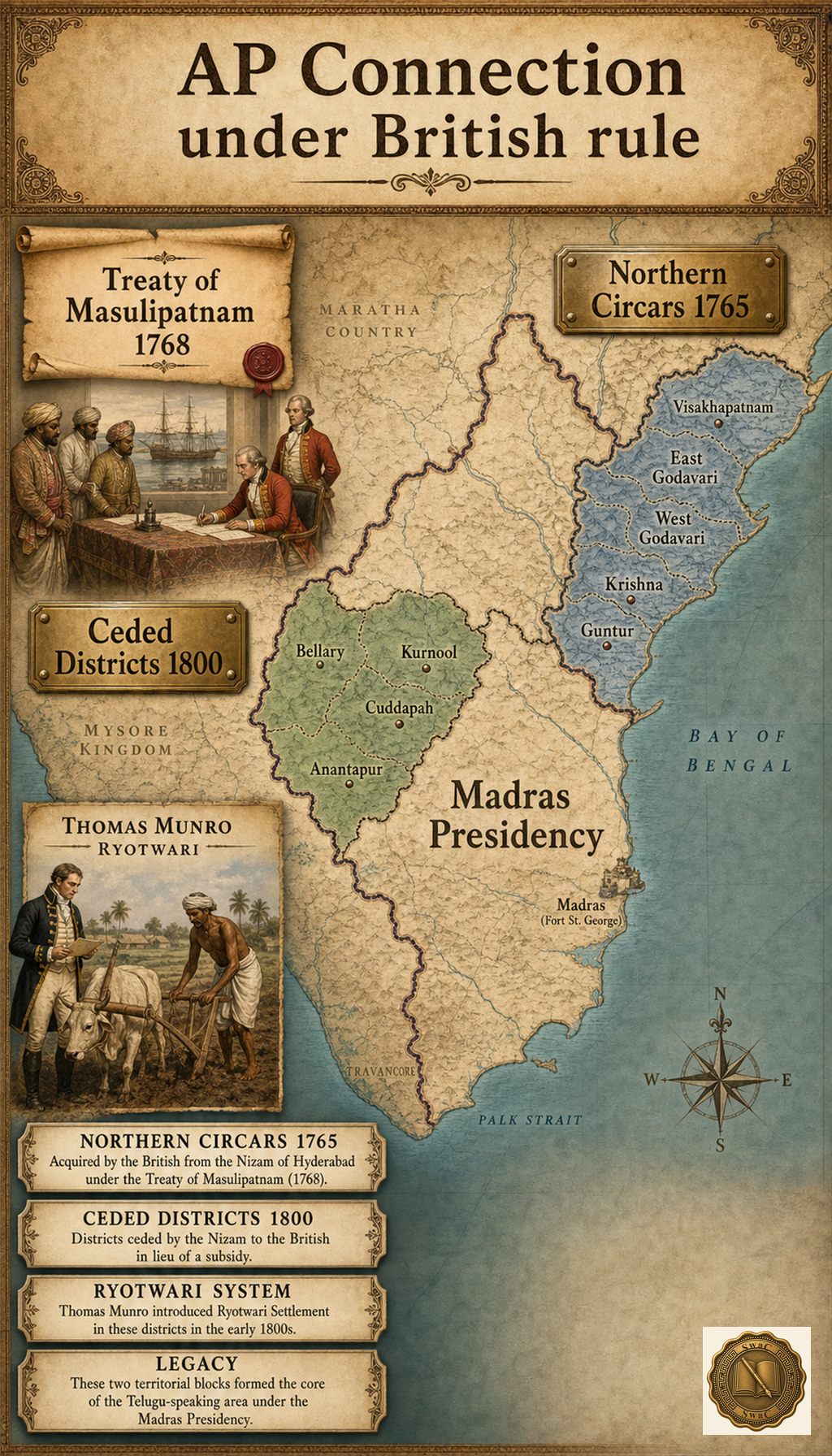
Andhra Pradesh's administrative geography was shaped entirely by British policy. The Madras Presidency, established in 1652, included the AP districts of Chittoor, Nellore, Cuddapah, Anantapur, Guntur, Kurnool, Krishna, East Godavari, West Godavari, and Visakhapatnam. The Ryotwari system was the dominant land-revenue system across these Telugu regions, and Thomas Munro's name is inseparable from it.
Marks-winning facts · recall first
- Ryotwari was the dominant revenue system across AP's Telugu regions
Two territories1800 CE
Northern Circars and the Ceded Districts
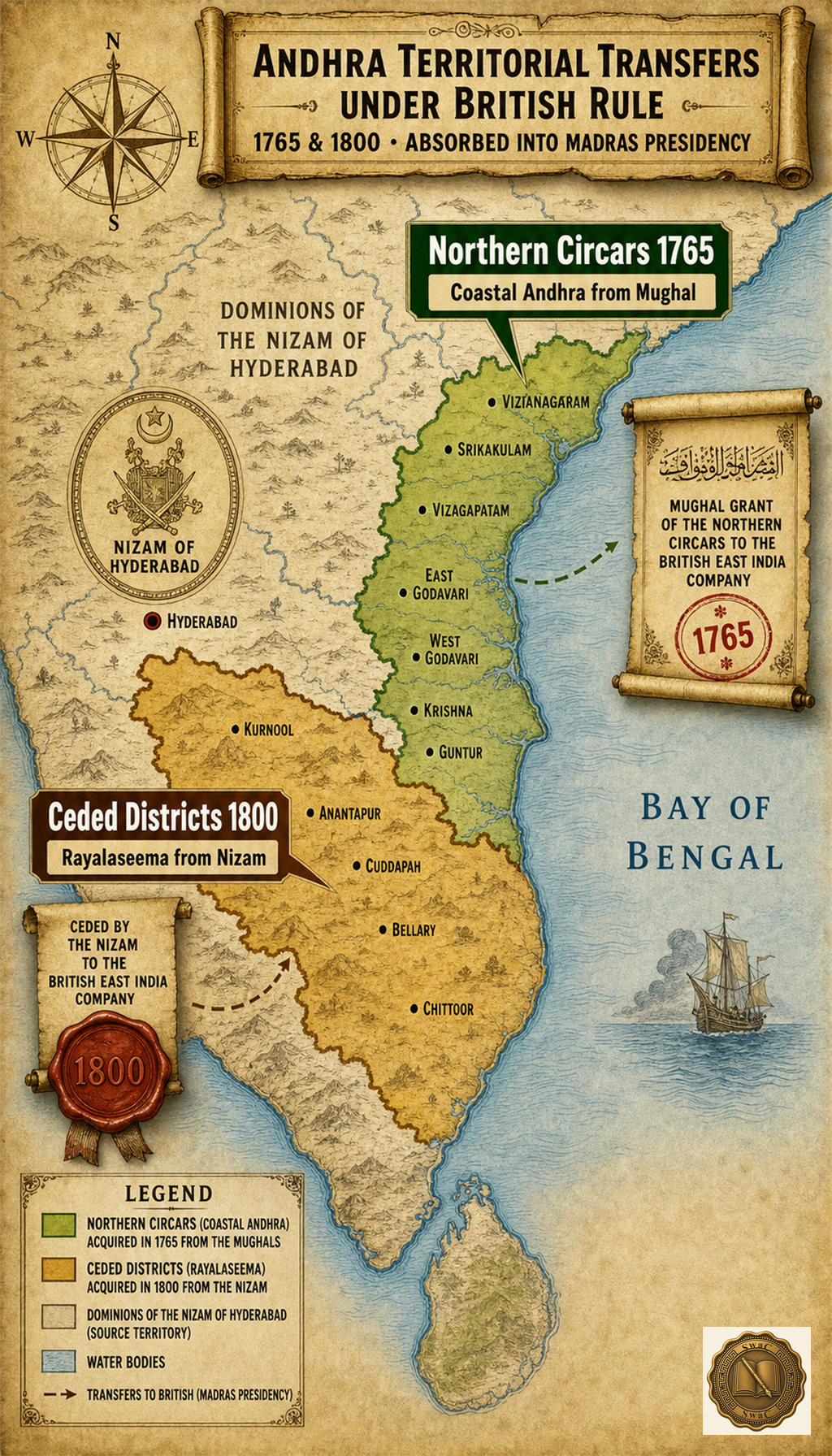
Two distinct territorial constructs defined AP under British rule. The Northern Circars — today's Coastal Andhra — came from the Mughal grant of 1765, confirmed by the Treaty of Masulipatnam in 1768, while the Ceded Districts — today's Rayalaseema — were transferred by the Nizam in 1800, comprising Kurnool, Cuddapah, Anantapur, and Bellary. The Telugu-speaking areas were later separated to form Andhra State in 1953 and, after merging with Telangana in 1956, became Andhra Pradesh.
Marks-winning facts · recall first
VII
The Exam Armoury
The essentials1853 CE
Seventeen facts that win the marks
A handful of facts recur in almost every paper, so commit them to memory. Pair each act to what it introduced — 1773 created the Governor-General of Bengal, 1833 made him Governor-General of India under Bentinck, and 1858 abolished the EIC and brought the Viceroy. Hold the other anchors too: Cornwallis as 'Father of Civil Service,' the first railway from Bombay to Thane in 1853, India's GDP share falling from 27% to 3%, and the EIC ruling 63% of territory and 78% of the population by 1857.
Marks-winning facts · recall first
Exam tactics
Match the man to the policy
APPSC's favourite question matches a Governor-General to his policy: Cornwallis to Permanent Settlement, Wellesley to Subsidiary Alliance, Dalhousie to Doctrine of Lapse, and Bentinck to the abolition of Sati. Know the acts in order — 1773, 1784, 1813, 1833, 1853, 1858 — and remember that any land-revenue question about the Madras Presidency or AP points to Ryotwari and Thomas Munro. Watch the two traps: Awadh was annexed for 'misgovernance,' not the Doctrine of Lapse, and the Ceded Districts are Rayalaseema while the Northern Circars are Coastal Andhra.
Marks-winning facts · recall first
End of chapter
Now make it yours
Acts, Governors-General, and land-revenue systems — the most tested tables live in the full notes. Open them, then test yourself.
Practice MCQs on this chapter →