 Image lesson · 50 cards
Introduction
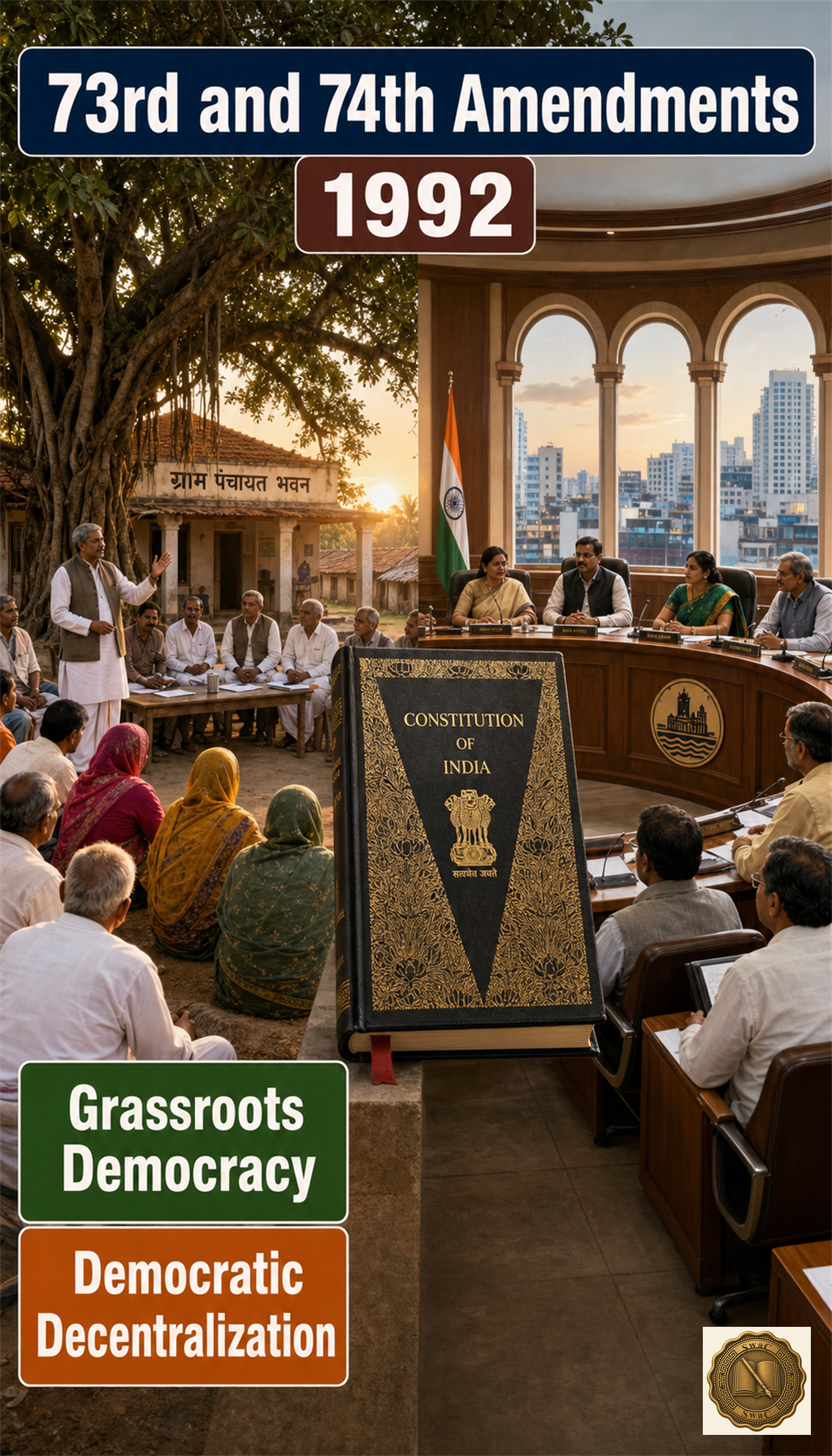
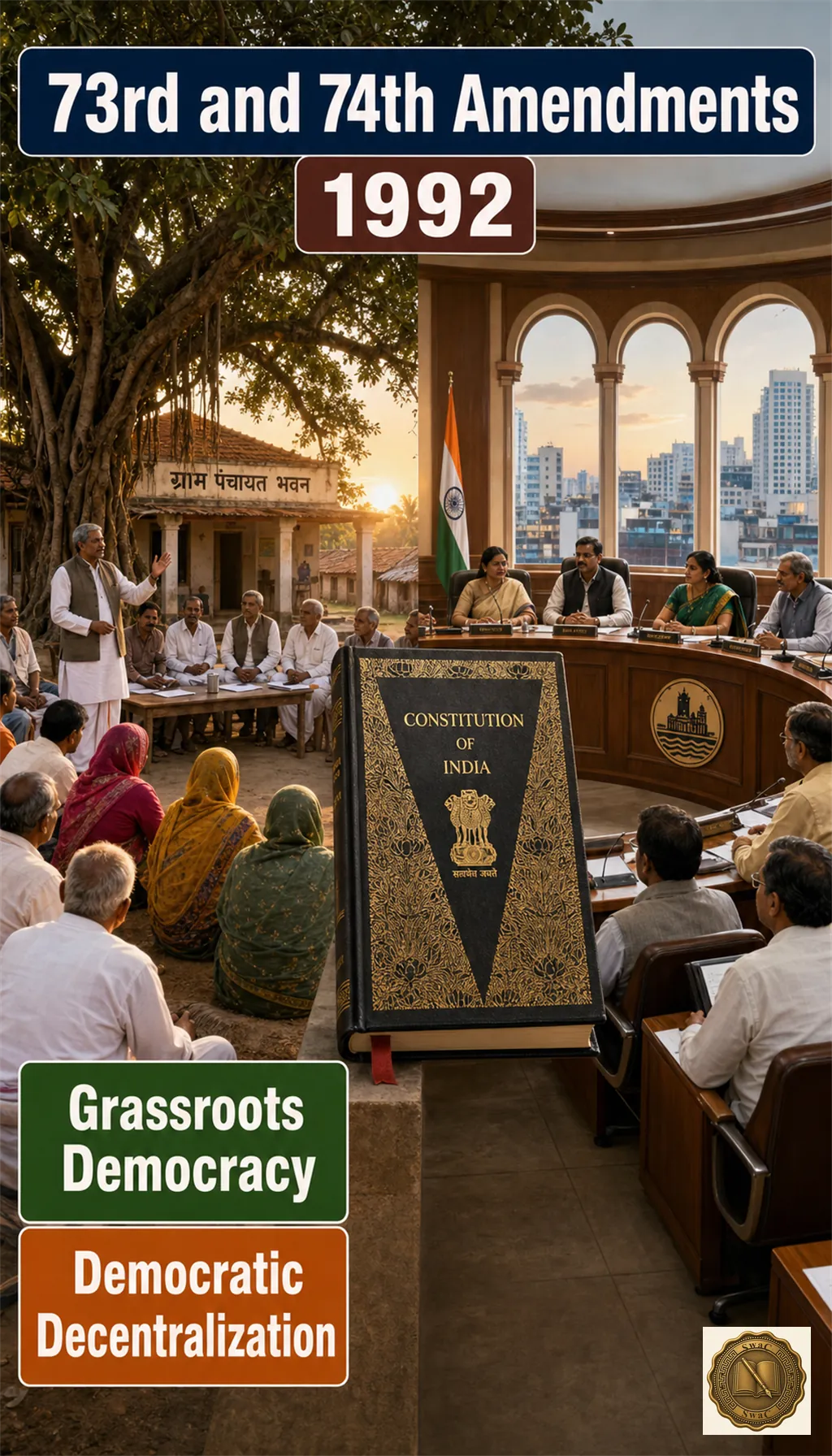
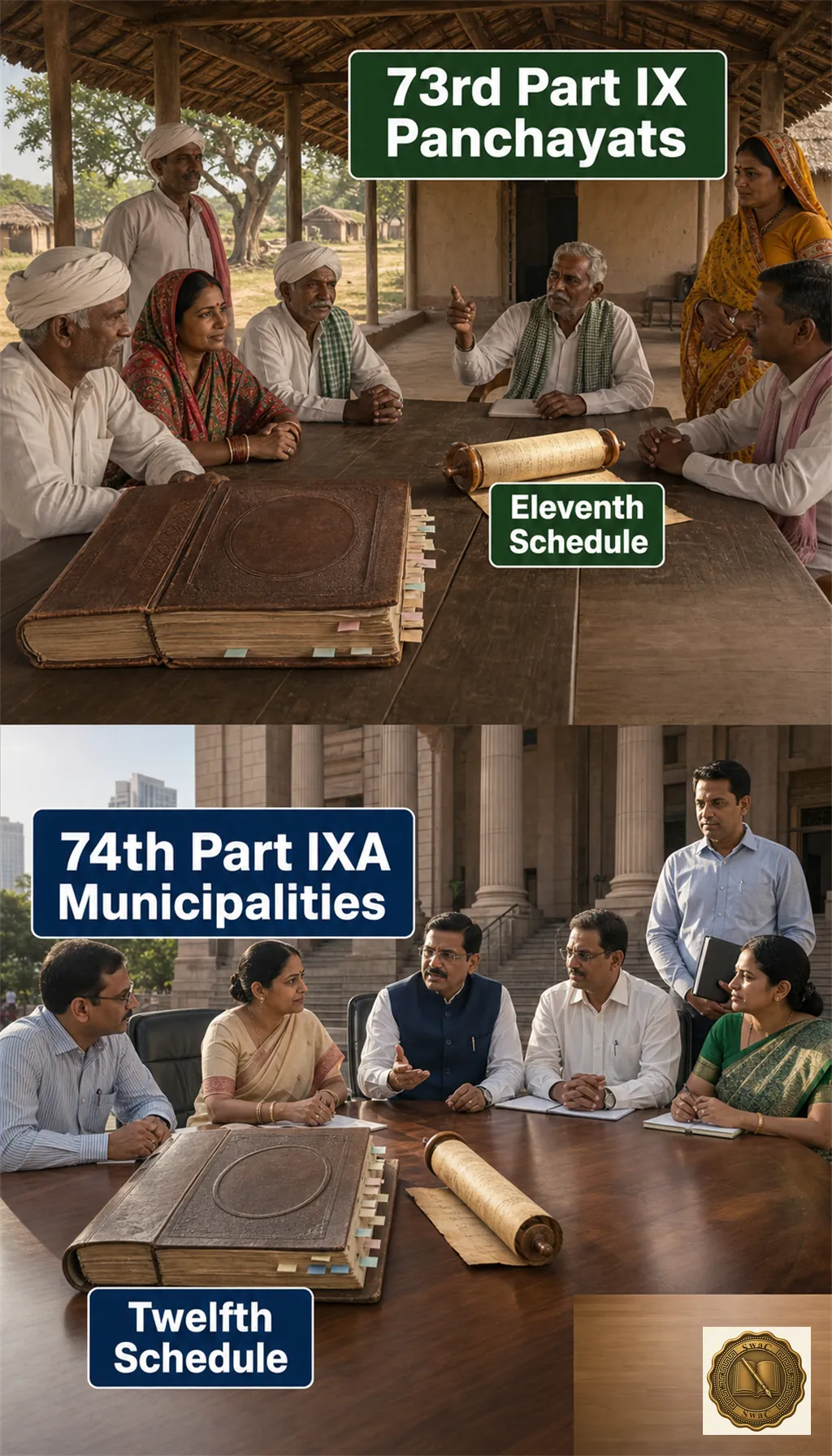
The 73rd and 74th Constitutional Amendment Acts of 1992 represent India's most significant democratic decentralization reforms. The 73rd Amendment constitutionalized Panchayati Raj Institutions (rural local governance), adding Part IX and the Eleventh Schedule, while the 74th Amendment constitutionalized Municipalities (urban local governance), adding Part IXA and the Twelfth Schedule. Together, they created a constitutional framework for grassroots democracy, mandatory reservations for women and marginalized communities, and institutional mechanisms for regular elections and financial devolution.
For APPSC Group 2, this is a guaranteed question topic. The comparison between the two amendments, their common and distinguishing features, and the mandatory vs voluntary provisions are tested repeatedly. Expect 2-3 questions focused on common features, key differences, and schedule comparisons.
Section 1: Historical Context
Before 1993, local bodies in India existed entirely at the discretion of state governments. There was no constitutional requirement to hold elections, provide reservations, or devolve functions. State governments routinely postponed local body elections for years, superseded elected bodies with administrators, and kept local bodies financially dependent.
Multiple committees had recommended strengthening local governance — from the Balwant Rai Mehta Committee (1957) to the L.M. Singhvi Committee (1986). The Singhvi Committee's recommendation for constitutional status was the immediate catalyst for the amendments.
The Rajiv Gandhi government introduced the 64th and 65th Amendment Bills in 1989, but they failed in the Rajya Sabha. The P.V. Narasimha Rao government successfully introduced revised versions that became the 73rd and 74th Amendments:
| Amendment | Passed | Effective Date |
|---|---|---|
| 73rd (Panchayats) | 1992 | 24 April 1993 |
| 74th (Municipalities) | 1992 | 1 June 1993 |
Together, these two amendments constitute India's biggest democratic decentralization experiment, bringing governance to the grassroots level for over 3 million elected representatives.
Section 2: Core Content
Common Mandatory Features (States MUST comply)
Both amendments share a set of mandatory provisions that states cannot override or ignore:
1. Structure:
- 73rd: Three-tier — Village Panchayat, Intermediate Panchayat, District Panchayat
- 74th: Three types — Nagar Panchayat, Municipal Council, Municipal Corporation
2. Direct Elections: All seats at all levels filled by direct election from territorial constituencies
3. Five-Year Term: Every local body continues for 5 years from the date of its first meeting; elections must be held before expiry
4. Re-elections within 6 Months: If dissolved before completing the term, elections must be held within 6 months of dissolution
5. Reservation for SC/ST: Seats reserved for Scheduled Castes and Scheduled Tribes in proportion to their population at all levels
6. Reservation for Women: Not less than 1/3 of total seats (including within SC/ST seats) reserved for women
7. State Election Commission (SEC): Independent body to conduct all local body elections (Article 243K for Panchayats / 243ZA for Municipalities). SEC appointed by the Governor; removal only like a High Court judge.
8. State Finance Commission (SFC): Governor constitutes SFC every 5 years to review finances of local bodies (Article 243I / 243Y)
9. Bar on Court Interference: Courts cannot interfere in electoral matters of local bodies — disputes only through election petitions (Article 243O / 243ZG)
10. Minimum Age: 21 years for membership in all local bodies (not 25 as for State Legislature)
Common Voluntary Features (State Legislature MAY provide)
These provisions are optional — state legislatures can choose whether and how to implement them:
- Powers to levy taxes, duties, tolls, and fees
- Transfer of functions and responsibilities from State to local bodies
- Reservation for Backward Classes
- Representation of MPs, MLAs, and MLCs in local bodies
- Granting of financial autonomy and grants-in-aid
- Manner of election of chairpersons (direct or indirect)
Key Differences — The Comparison Table
| Feature | 73rd Amendment (Panchayats) | 74th Amendment (Municipalities) |
|---|---|---|
| Part added | Part IX | Part IXA |
| Articles | 243 to 243O | 243P to 243ZG |
| Schedule | Eleventh (29 subjects) | Twelfth (18 subjects) |
| Date of effect | 24 April 1993 | 1 June 1993 |
| Scope | Rural areas | Urban areas |
| Bodies | Gram Panchayat, Panchayat Samiti, Zilla Parishad | Nagar Panchayat, Municipal Council, Municipal Corporation |
| Gram Sabha | Yes (Art 243A) — assembly of all voters | No equivalent |
| Intermediate level | Optional for states with population < 20 lakhs | Not applicable |
| Wards Committees | No provision | Mandatory for 3 lakh+ population (Art 243S) |
| DPC | No provision | Art 243ZD — District Planning Committee |
| MPC | No provision | Art 243ZE — Metropolitan Planning Committee |
Eleventh Schedule — 29 Subjects (73rd Amendment)
Key subjects for Panchayats:
- Agriculture, land improvement, minor irrigation
- Animal husbandry, fisheries, social forestry
- Small-scale industries, khadi and village industries
- Rural housing, drinking water, fuel and fodder
- Roads, bridges, ferries, waterways
- Rural electrification, non-conventional energy
- Poverty alleviation, education (primary and secondary)
- Technical training, adult and non-formal education
- Libraries, cultural activities, markets and fairs
- Health and sanitation, family welfare
- Women and child development, social welfare (SC/ST/backward)
- Public distribution system, maintenance of community assets
Twelfth Schedule — 18 Subjects (74th Amendment)
Key subjects for Municipalities:
- Urban planning, land-use regulation, building construction
- Economic and social development planning
- Roads and bridges, water supply
- Public health, sanitation, solid waste management
- Fire services, urban forestry, environment protection
- Safeguarding weaker sections, slum improvement
- Urban poverty alleviation, urban amenities (parks, gardens)
- Cultural and educational promotion
- Burials and cremations, cattle pounds
- Vital statistics (births and deaths)
- Public amenities (street lighting, parking, bus stops)
- Regulation of slaughter houses and tanneries
State Election Commission — Detailed Analysis
The creation of an independent SEC was one of the most important reforms of both amendments:
- Article 243K/243ZA: SEC appointed by Governor
- SEC conducts all Panchayat and Municipality elections — a single institution for all local body elections
- SEC is independent of the State Government — with safeguards similar to a High Court judge for removal
- Service conditions cannot be varied to disadvantage after appointment
- SEC is separate from the Election Commission of India (ECI) — ECI handles only Parliament and State Legislature elections
This separation ensures that local body elections are conducted by an independent authority, preventing state governments from manipulating or postponing elections as they frequently did before 1993.
State Finance Commission — Financial Backbone
The SFC mechanism ensures financial sustainability of local bodies:
- Article 243I/243Y: Governor constitutes SFC every 5 years
- SFC recommends: (a) distribution of tax proceeds between State and local bodies, (b) grants-in-aid, (c) measures to improve financial position
- SFC report placed before State Legislature along with action-taken memorandum
- Central Finance Commission also considers SFC recommendations while allocating funds to states (Article 280(3)(bb) and (c)) — creating a chain from central finance to the grassroots
Exceptions and Limitations
Article 243M: Part IX does NOT apply to Nagaland, Meghalaya, Mizoram, and areas under the Fifth and Sixth Schedules of the Constitution.
PESA Act, 1996 (Panchayats Extension to Scheduled Areas): Extended Part IX to Fifth Schedule tribal areas with modifications that protect tribal autonomy, including the Gram Sabha's power over natural resources.
Implementation Gaps: Despite constitutional mandates, many states have not fully devolved the 3Fs — Functions, Finances, and Functionaries to local bodies. The amendments provide the framework, but actual empowerment depends on state-level political will.
Section 3: AP Connection
AP's implementation of both amendments reflects the state's distinctive administrative structure:
- AP Panchayati Raj Act, 1994: Implements the 73rd Amendment; creates the distinctive three-tier system where the intermediate tier (Mandal Parishad) aligns with the mandal administrative unit rather than the block
- AP Municipalities Act and AP Municipal Corporation Act: Implement the 74th Amendment
- AP's structure: Gram Panchayat → Mandal Parishad → Zilla Parishad (rural); Nagar Panchayat/Municipality/Corporation (urban)
- AP has approximately 22 Zilla Parishads, 1,095 Mandal Parishads, 21,895 Gram Panchayats (rural) and 123 ULBs (urban)
- CAG has published performance audit reports on AP's implementation of both amendments
- For Group 2 aspirants: Municipal Commissioner posts operate within the 74th Amendment framework; many other Group 2 posts interface with 73rd Amendment institutions
Section 4: Key Points
- 73rd Amendment: Panchayats; Part IX (Art 243-243O); Eleventh Schedule (29 subjects); effective 24 April 1993
- 74th Amendment: Municipalities; Part IXA (Art 243P-243ZG); Twelfth Schedule (18 subjects); effective 1 June 1993
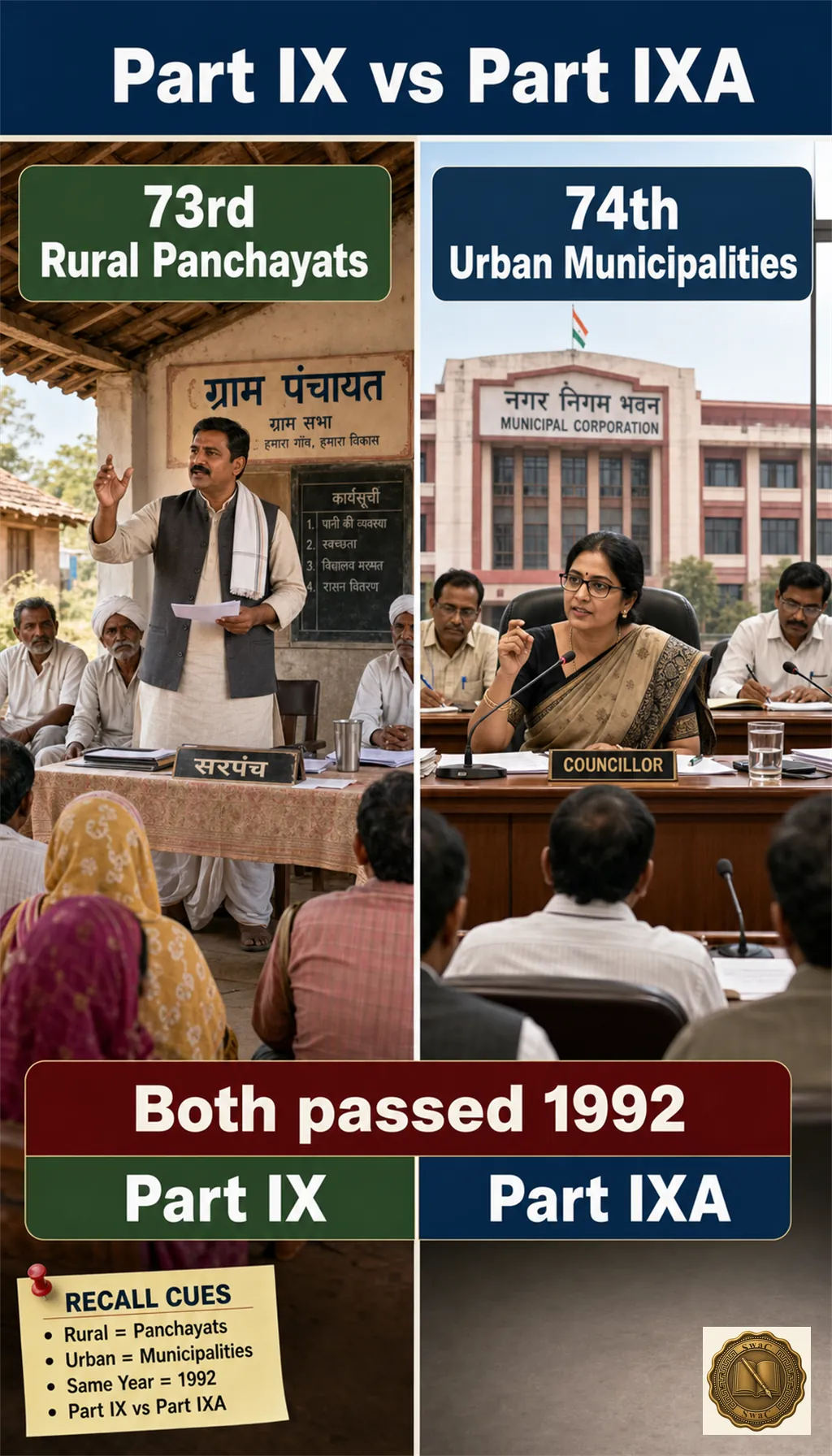
- Both passed in 1992 — the biggest democratic decentralization initiative in India
- Common mandatory features: Direct elections, 5-year term, 6-month re-election, SC/ST reservation, 1/3 women reservation
- Minimum age: 21 years for both Panchayats and Municipalities (not 25)
- SEC (State Election Commission): Conducts all local body elections; appointed by Governor; independent
- SFC (State Finance Commission): Reviews finances every 5 years; constituted by Governor
- 73rd only: Gram Sabha (Art 243A); optional intermediate tier for states < 20 lakh population
- 74th only: Wards Committees (Art 243S, 3 lakh+); DPC (Art 243ZD); MPC (Art 243ZE, 10 lakh+ metro)
- DPC has 4/5 elected members; MPC has 2/3 elected members
- Part IX does NOT apply to Nagaland, Meghalaya, Mizoram and scheduled/tribal areas
- PESA Act, 1996: Extended 73rd Amendment to Fifth Schedule areas with tribal autonomy protections
- Voluntary provisions: Tax powers, backward class reservation, representation of MPs/MLAs
- Central Finance Commission considers SFC recommendations (Art 280(3)(bb) and (c))
- 3Fs (Functions, Finances, Functionaries) — the measure of true devolution
- AP implements via AP Panchayati Raj Act, 1994 and AP Municipalities Act
Section 5: Exam Strategy
High-Probability Question Types:
- Comparison table — Part IX vs IXA, Eleventh vs Twelfth Schedule, 29 vs 18 subjects
- Effective dates — 73rd: 24 April 1993; 74th: 1 June 1993
- Common features — Direct election, 5-year term, 1/3 women reservation, SEC, SFC
- Unique features — Gram Sabha (73rd only), DPC/MPC and Wards Committees (74th only)
- Exceptions — Which states/areas are exempt from Part IX
Memory Technique — "73 is Rural, 74 is Urban":
- 73rd = Part IX = 11th Schedule = 29 subjects = Rural = Panchayats
- 74th = Part IXA = 12th Schedule = 18 subjects = Urban = Municipalities
- Notice the pattern: 73 < 74, IX < IXA, but 29 > 18 (rural has MORE subjects)
Common Traps:
- Both were passed in 1992 but came into force in 1993 (different dates)
- Eleventh Schedule has 29 subjects (rural/more); Twelfth has 18 (urban/fewer)
- DPC and MPC are 74th Amendment only — 73rd does not have planning committees
- Gram Sabha exists only in 73rd — there is no urban equivalent
- SEC appointment is by Governor (not President or CM)
Section 6: Key Terms Glossary
| Term | Telugu | Meaning |
|---|---|---|
| Democratic decentralization | ప్రజాస్వామ్య వికేంద్రీకరణ | Transfer of democratic governance to local levels |
| Eleventh Schedule | పదకొండవ షెడ్యూల్ | 29 subjects for Panchayats (73rd Amendment) |
| Twelfth Schedule | పన్నెండవ షెడ్యూల్ | 18 functional items for Municipalities (74th Amendment) |
| State Election Commission | రాష్ట్ర ఎన్నికల సంఘం | Independent body for local body elections |
| State Finance Commission | రాష్ట్ర ఆర్థిక సంఘం | Body reviewing local body finances every 5 years |
| Gram Sabha | గ్రామ సభ | Assembly of all voters — unique to 73rd Amendment |
| Wards Committee | వార్డు కమిటీ | Sub-municipal body — unique to 74th Amendment |
| DPC | జిల్లా ప్రణాళిక సంఘం | District Planning Committee (74th only) |
| MPC | మహానగర ప్రణాళిక సంఘం | Metropolitan Planning Committee (74th only) |
| PESA | పీసా చట్టం | Extension of Panchayats to Scheduled Areas (1996) |
| 3Fs | మూడు ఎఫ్లు | Functions, Finances, Functionaries — measure of devolution |
| Part IX | తొమ్మిదవ భాగం | Constitutional part for Panchayati Raj |
| Part IXA | తొమ్మిదవ-ఎ భాగం | Constitutional part for Municipalities |
| Mandatory provisions | తప్పనిసరి నిబంధనలు | Provisions states must implement |
| Voluntary provisions | ఐచ్ఛిక నిబంధనలు | Provisions states may choose to implement |
| Grassroots democracy | అట్టడుగు స్థాయి ప్రజాస్వామ్యం | Democracy at the village and ward level |
Learn it another way
The same chapter, in other formats
Image lesson
50 cardsThe whole chapter drawn as cards. Scroll through them; tap a card to zoom.


Audio lecture
The audio lecture for this chapter is being recorded. Until then, read the text or flip through the picture cards.
Back to the textVideo lecture
The video lecture for this chapter is being produced. Until then, read the text or flip through the picture cards.
Back to the textEnd of chapter8 min read
You finished 73rd & 74th Constitutional Amendments
- 6sections
- 3tables