 Image lesson · 24 cards
Introduction
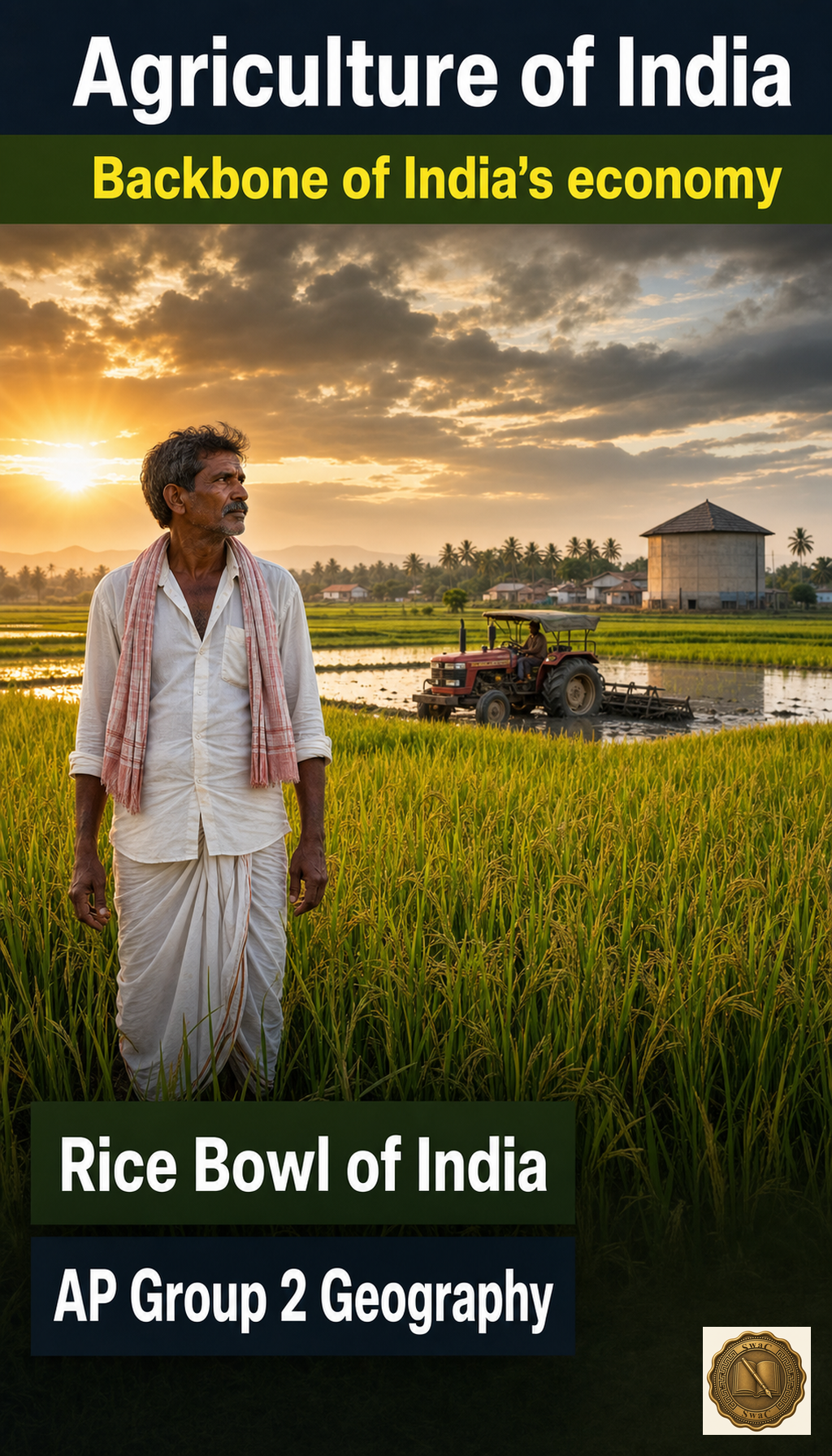
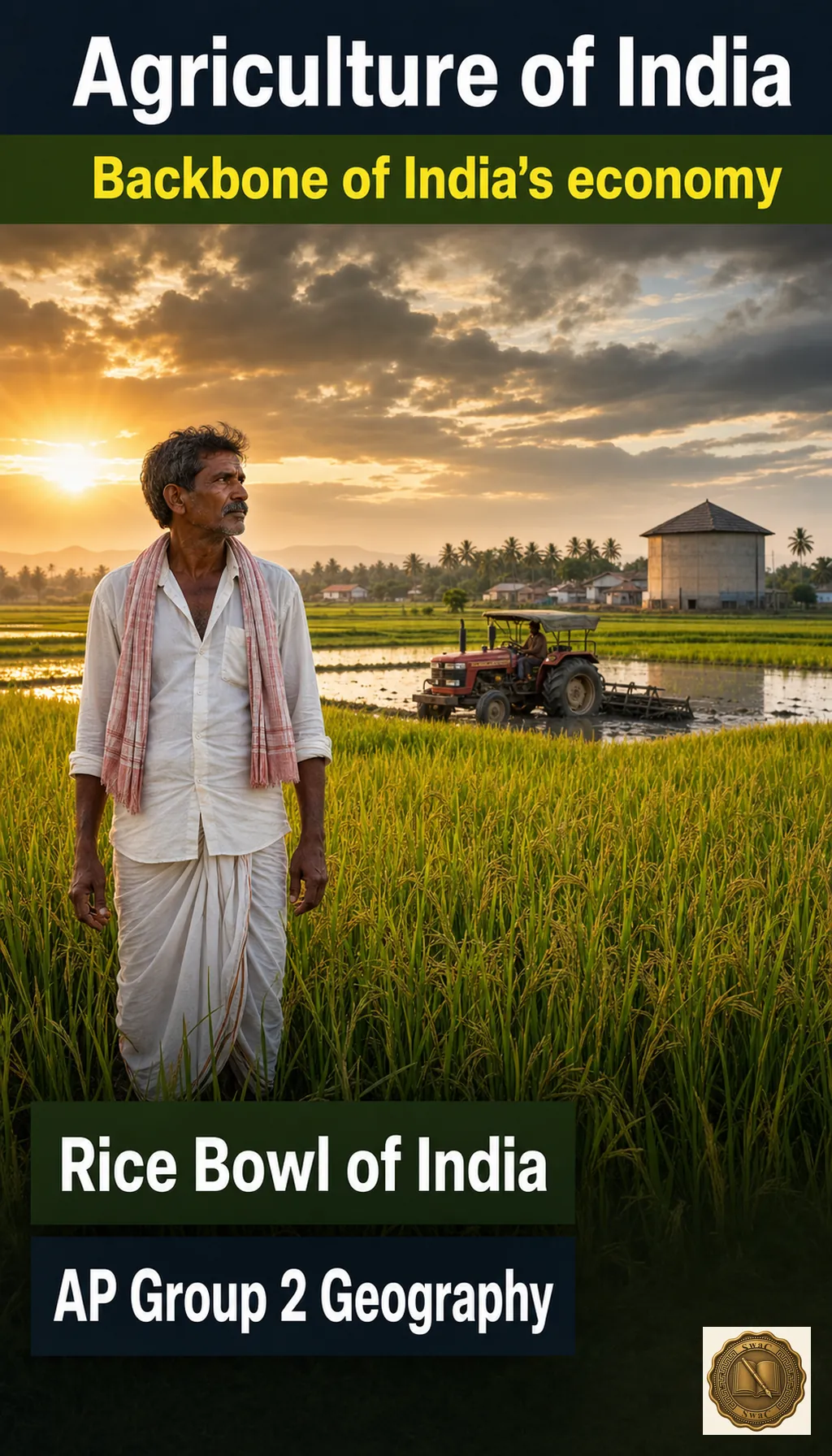
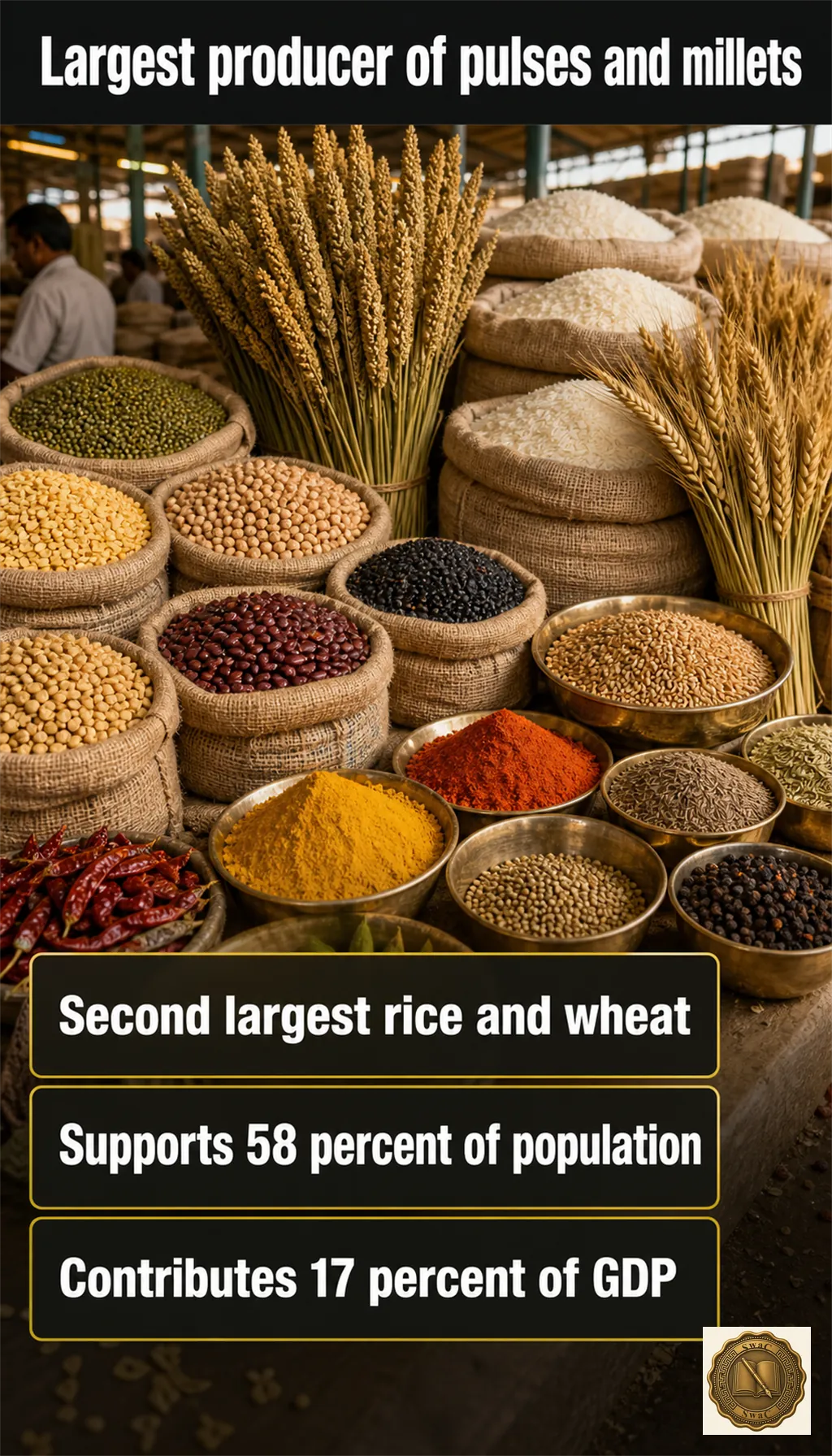
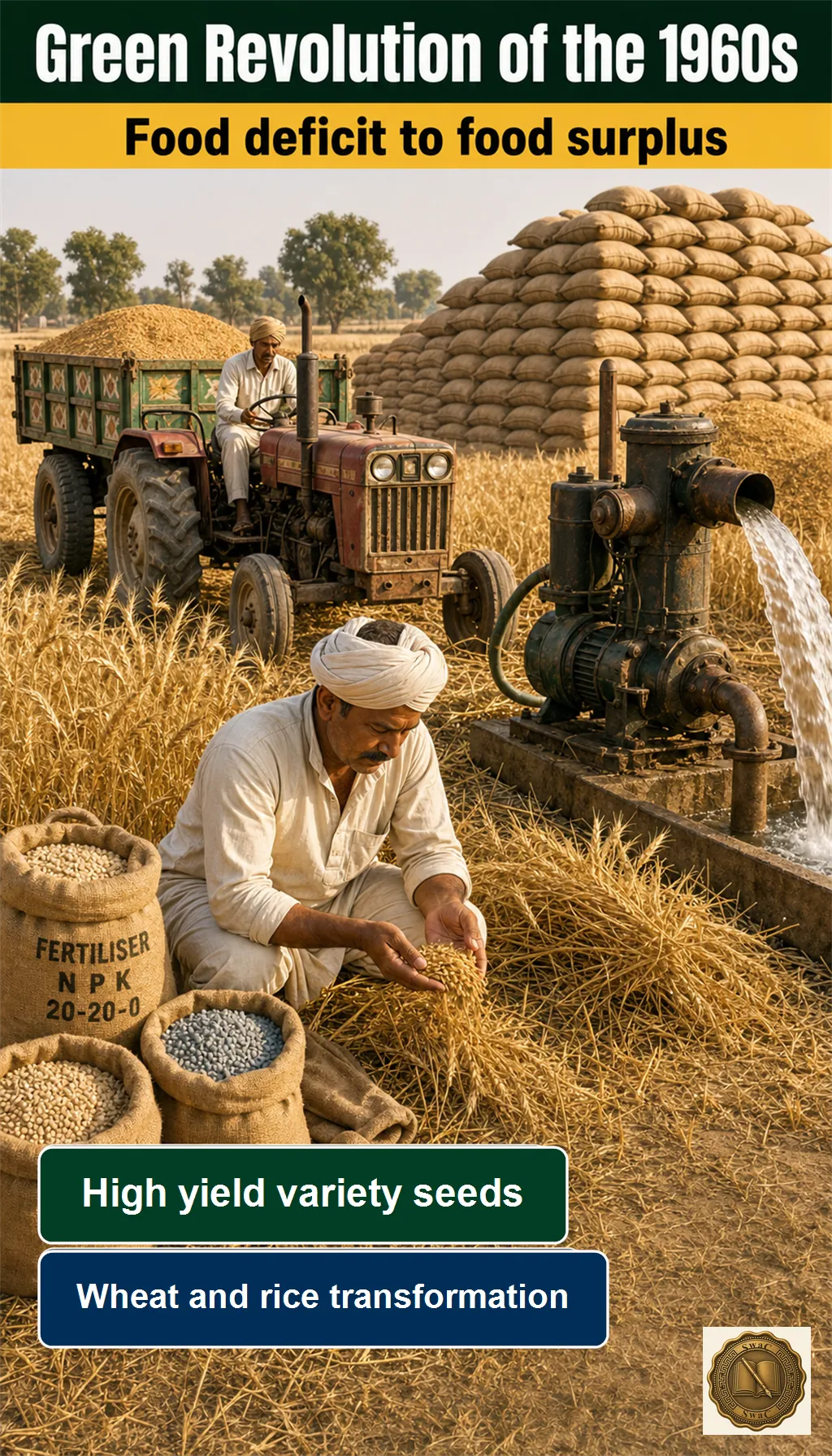
Agriculture is the backbone of India's economy, supporting ~58% of the population though contributing only ~17% of GDP. India is the world's largest producer of pulses, millets, spices, and jute, and the 2nd largest of rice, wheat, sugarcane, and cotton. The Green Revolution of the 1960s transformed India from a food-deficit nation to a food-surplus one. For AP Group 2, agriculture questions span crops, revolutions, irrigation, MSP, and AP's unique position as the "Rice Bowl of India."
Section 1: Context
India's agriculture is shaped by its monsoon dependence (~48% of cultivated area remains rainfed), small and fragmented landholdings (average 1.08 hectares), and three cropping seasons (Kharif, Rabi, Zaid). Despite challenges, India's food grain production has crossed 330 million tonnes (2024-25), and the country is a major global exporter of rice, spices, and marine products.
Section 2: Core Content
Cropping Seasons
| Season | Period | Key Crops |
|---|---|---|
| Kharif | June-October (monsoon) | Rice, Jowar, Bajra, Maize, Cotton, Jute, Groundnut, Soybean |
| Rabi | October-March (winter) | Wheat, Barley, Gram, Mustard, Peas, Linseed |
| Zaid | March-June (summer) | Watermelon, Muskmelon, Cucumber, Moong, Urad |
Major Food Crops
| Crop | India's Position | Requirements | Leading States |
|---|---|---|---|
| Rice | 2nd largest producer, largest exporter | 100+ cm rain/irrigation, 22-32 deg C | WB, UP, Punjab, TN, AP |
| Wheat | 2nd largest producer | Cool season, bright sunshine at harvest | UP, Punjab, Haryana, Rajasthan, MP (85%) |
| Maize | Major producer | 21-27 deg C, moderate rainfall | Karnataka, MP, Bihar, Rajasthan, AP |
| Millets (Bajra/Jowar/Ragi) | Largest producer globally | Drought-resistant, dry regions | Rajasthan, Maharashtra, Karnataka |
| Pulses | Largest producer AND consumer | Nitrogen-fixing | MP, Rajasthan, Maharashtra, UP |
Major Cash Crops
| Crop | India's Position | Leading States | Key Facts |
|---|---|---|---|
| Sugarcane | 2nd largest (after Brazil) | UP (50%+), Maharashtra, Karnataka | 21-27 deg C, 75-100 cm rain |
| Cotton | Largest area globally | Gujarat, Maharashtra, AP, Punjab | Black soil, 210 frost-free days; Bt Cotton since 2002 |
| Jute ("Golden Fibre") | Largest producer | WB (70%), Bihar, Assam | Warm, humid; alluvial soil |
| Tea | 2nd largest (after China) | Assam (largest), WB (Darjeeling), TN, Kerala | Well-drained slopes, acidic soil |
| Coffee | 6th largest globally | Karnataka (71%), Kerala, TN, AP (Araku) | Araku Valley coffee: GI tagged |
| Rubber | Tropical, equatorial | Kerala (91%) | >200 cm rainfall |
Oilseeds
| Crop | Leading States |
|---|---|
| Groundnut | Gujarat, AP, TN, Rajasthan |
| Mustard/Rapeseed | Rajasthan, UP, MP, Haryana |
| Soybean | MP, Maharashtra, Rajasthan |
| Coconut | Kerala, TN, Karnataka |
Agricultural Revolutions
| Revolution | Product | Key Person | Year |
|---|---|---|---|
| Green | Food grains (wheat, rice) | M.S. Swaminathan | 1966-67 |
| White (Operation Flood) | Milk | Dr. Verghese Kurien | 1970 |
| Blue | Fish/Aquaculture | Arun Krishnan | — |
| Yellow | Oilseeds | Sam Pitroda | — |
| Golden | Fruits/Horticulture | Nirpakh Tutej | — |
Green Revolution highlights: HYV seeds (Kalyan Sona, Sonalika for wheat), chemical fertilizers, irrigation; first in Punjab; wheat output 12 MT (1965) > 20 MT (1970); made India food self-sufficient; criticism: limited to wheat/rice, Punjab-Haryana focus, soil degradation, groundwater depletion.
White Revolution: Amul cooperative model; India became world's largest milk producer (~22% of global milk).
Irrigation
- Net irrigated area: ~48-52% of cultivated area; rest rainfed
- Sources: canals (most widespread), tube wells/bore wells (fastest growing), tanks (important in south)
- Drip irrigation: water-efficient; promoted in Maharashtra, Rajasthan, AP
Land Use Pattern
| Category | % of Total Area |
|---|---|
| Net sown area | 46% |
| Forests | 23% |
| Fallow land | 8% |
| Non-agricultural use | 9% |
| Barren & waste | 7% |
Section 3: AP Connection
- AP called "Rice Bowl of India": West Godavari, East Godavari, Krishna districts
- Paddy cultivated in 22+ lakh hectares; paddy, maize, cotton = 75% of total cropped area
- Guntur: "Chilli Capital of India" — largest chilli market in Asia
- Cotton: major crop in Kurnool, Guntur, Prakasam
- Tobacco: Guntur, Prakasam (Virginia flue-cured — AP produces ~40% of India's total)
- Aquaculture: AP is India's largest aquaculture producer; shrimp farming in Nellore, Krishna
- Araku Valley coffee: GI tag, internationally recognized
- Oil palm cultivation promoted in coastal AP
- Mango: Banganapalli (famous variety from Kurnool)
- Irrigation: major canal systems from Krishna, Godavari; tank irrigation in Rayalaseema
- India's largest producer of: chillies, eggs, aquaculture products — AP leads in all three
Section 4: Key Points Summary
- Agriculture employs ~58% of India's population but contributes only ~17% of GDP
- Three cropping seasons: Kharif (monsoon), Rabi (winter), Zaid (summer)
- Rice: 2nd largest producer; AP is "Rice Bowl of India"
- Wheat: UP, Punjab, Haryana, Rajasthan, MP produce 85%
- Green Revolution: 1966-67, M.S. Swaminathan, Punjab first, wheat/rice focus
- White Revolution: Verghese Kurien, Operation Flood (1970), Amul model
- India is world's largest milk producer (~22% global)
- Sugarcane: UP largest (50%+); Coffee: Karnataka (71%); Rubber: Kerala (91%)
- Jute = "Golden Fibre"; WB produces 70%
- Bt Cotton introduced 2002; India has largest cotton area globally
- India is world's largest producer of pulses, millets, spices
- ~48-52% of cultivated area is irrigated; rest depends on monsoon
- Average landholding: 1.08 hectares; 86% farmers are small/marginal
- Guntur (AP) = Chilli Capital; AP = largest aquaculture producer
- Araku Valley coffee has GI tag and international recognition
Section 5: Exam Strategy
- Crop-state matching: Rice=WB/UP/Punjab; Wheat=UP/Punjab; Coffee=Karnataka; Tea=Assam; Rubber=Kerala
- Revolutions: Green=Swaminathan/grains; White=Kurien/milk; Blue=fish; Yellow=oilseeds
- AP crops: Rice (deltas), Chillies (Guntur), Cotton (Kurnool-Guntur), Tobacco (Guntur-Prakasam), Shrimp (Nellore)
- Numbers to remember: 58% population in agriculture, 17% GDP, 46% net sown area
- Trick: India is 2nd in rice AND wheat (China is 1st in both); but India is LARGEST rice exporter
Section 6: Key Terms Glossary
| Term | Telugu | Meaning |
|---|---|---|
| Agriculture | వ్యవసాయం (Vyavasayam) | Cultivation of crops and livestock rearing |
| Crop | పంట (Panta) | Plant grown for food or commercial use |
| Rice/Paddy | వరి/ధాన్యం (Vari/Dhanyam) | Staple cereal crop |
| Wheat | గోధుమ (Godhuma) | Major Rabi cereal |
| Cotton | పత్తి (Patti) | Fiber crop for textiles |
| Sugarcane | చెరకు (Cheraku) | Raw material for sugar |
| Irrigation | నీటిపారుదల (Neetiparudala) | Artificial water supply to crops |
| Harvest | పంట కోత (Panta Kota) | Gathering mature crops |
| Farmer | రైతు (Raithu) | Person who cultivates land |
| Green Revolution | హరిత విప్లవం (Harita Viplavam) | Technological transformation of agriculture |
| HYV | అధిక దిగుబడి వంగడాలు (Adhika Digubadi Vangadaalu) | High Yielding Variety seeds |
| MSP | కనీస మద్దతు ధర (Kaneesa Maddatu Dhara) | Minimum Support Price |
| Kharif | ఖరీఫ్ | Monsoon season crops |
| Rabi | రబీ | Winter season crops |
| Aquaculture | ఆక్వాకల్చర్ | Farming of aquatic organisms |
Learn it another way
The same chapter, in other formats
Image lesson
24 cardsThe whole chapter drawn as cards. Scroll through them; tap a card to zoom.


Audio lecture
The audio lecture for this chapter is being recorded. Until then, read the text or flip through the picture cards.
Back to the textVideo lecture
The video lecture for this chapter is being produced. Until then, read the text or flip through the picture cards.
Back to the textEnd of chapter4 min read
You finished Agriculture of India
- 6sections
- 7tables