 Image lesson · 20 cards
Introduction
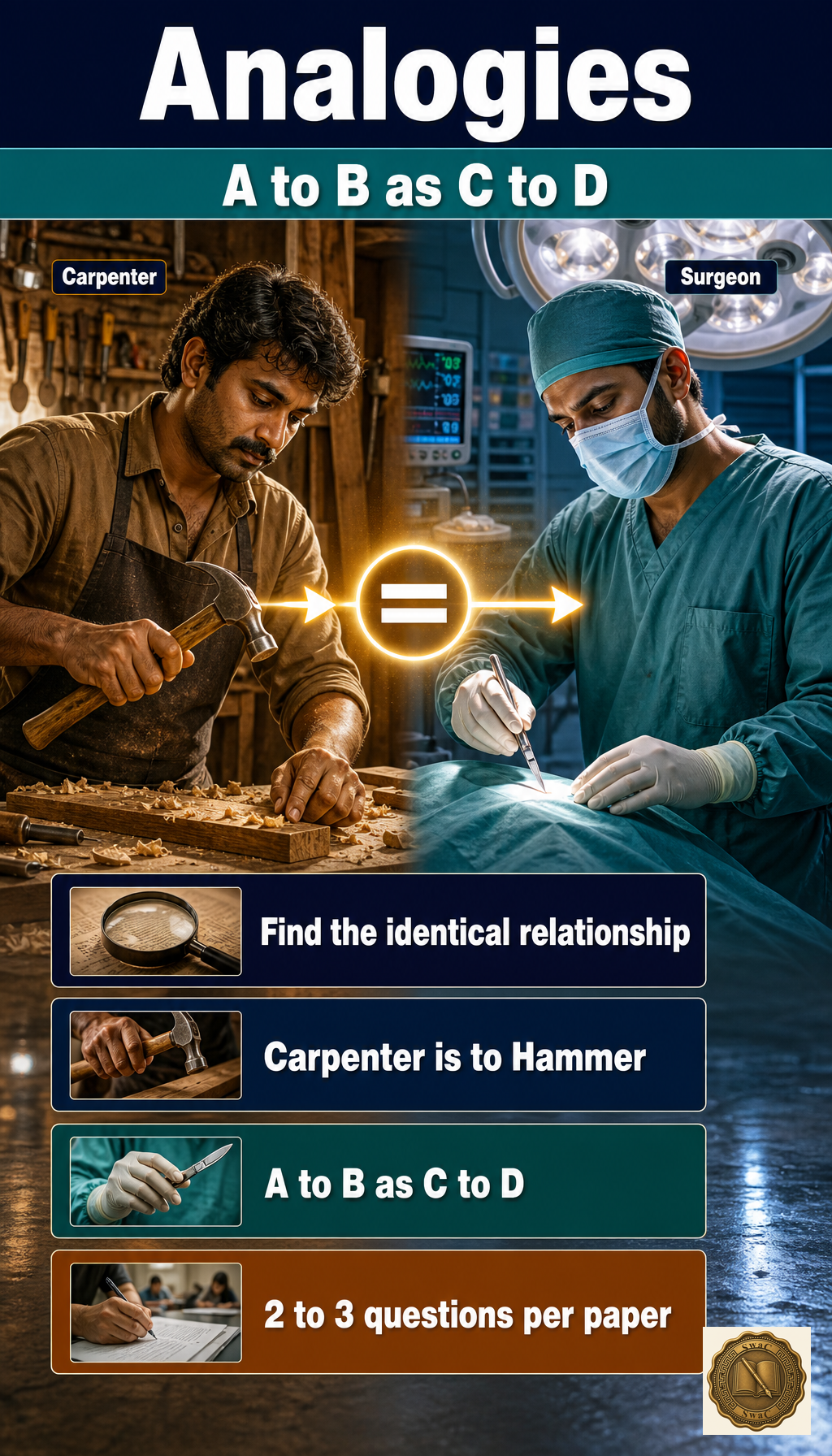
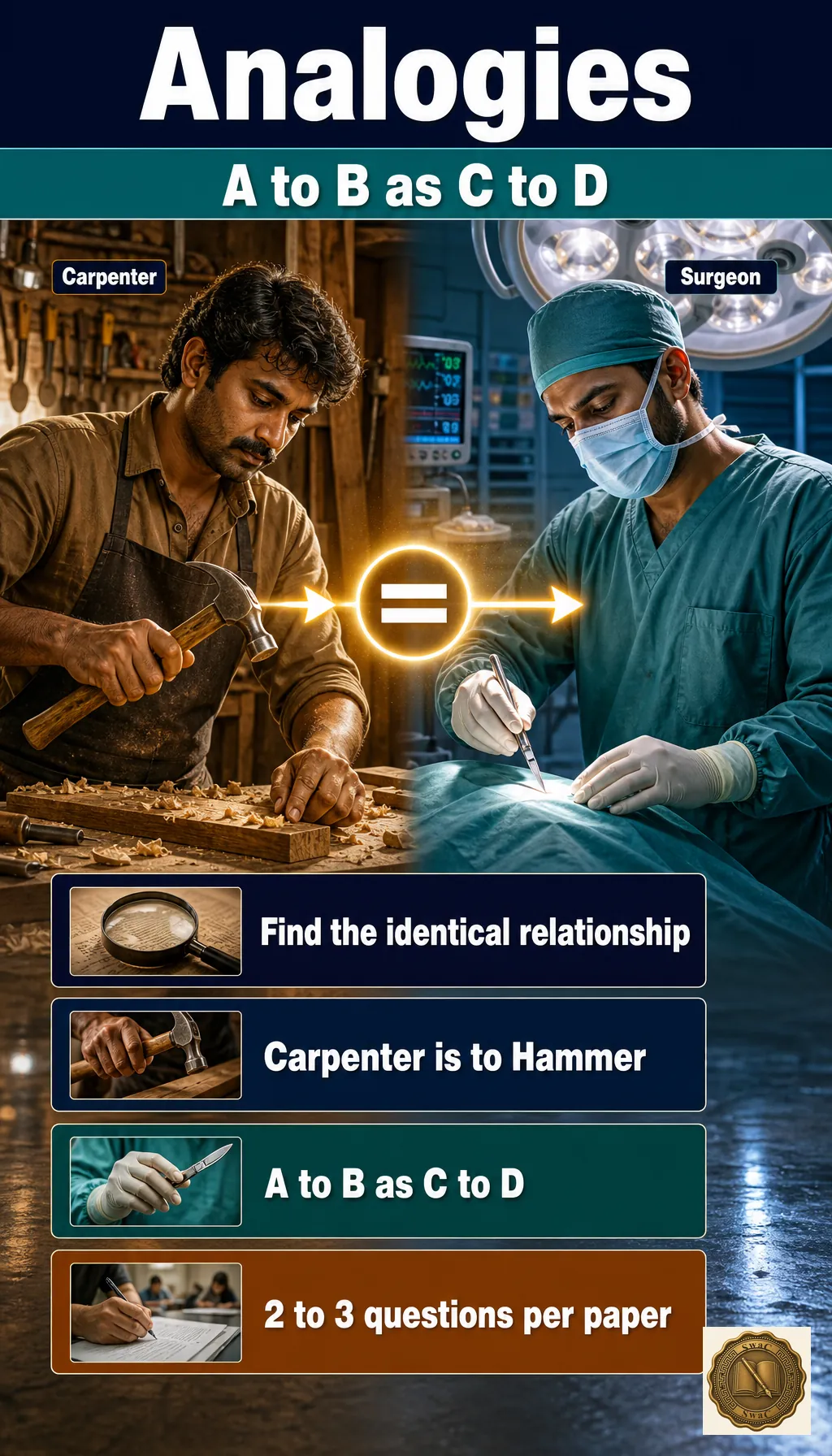
Analogy questions test your ability to identify the relationship between a given pair and find another pair with the identical relationship. APPSC favours word analogies (worker-tool, place-famous for) and number analogies (square, cube). Quick identification of relationship type is the key skill.
Section 1: Core Method
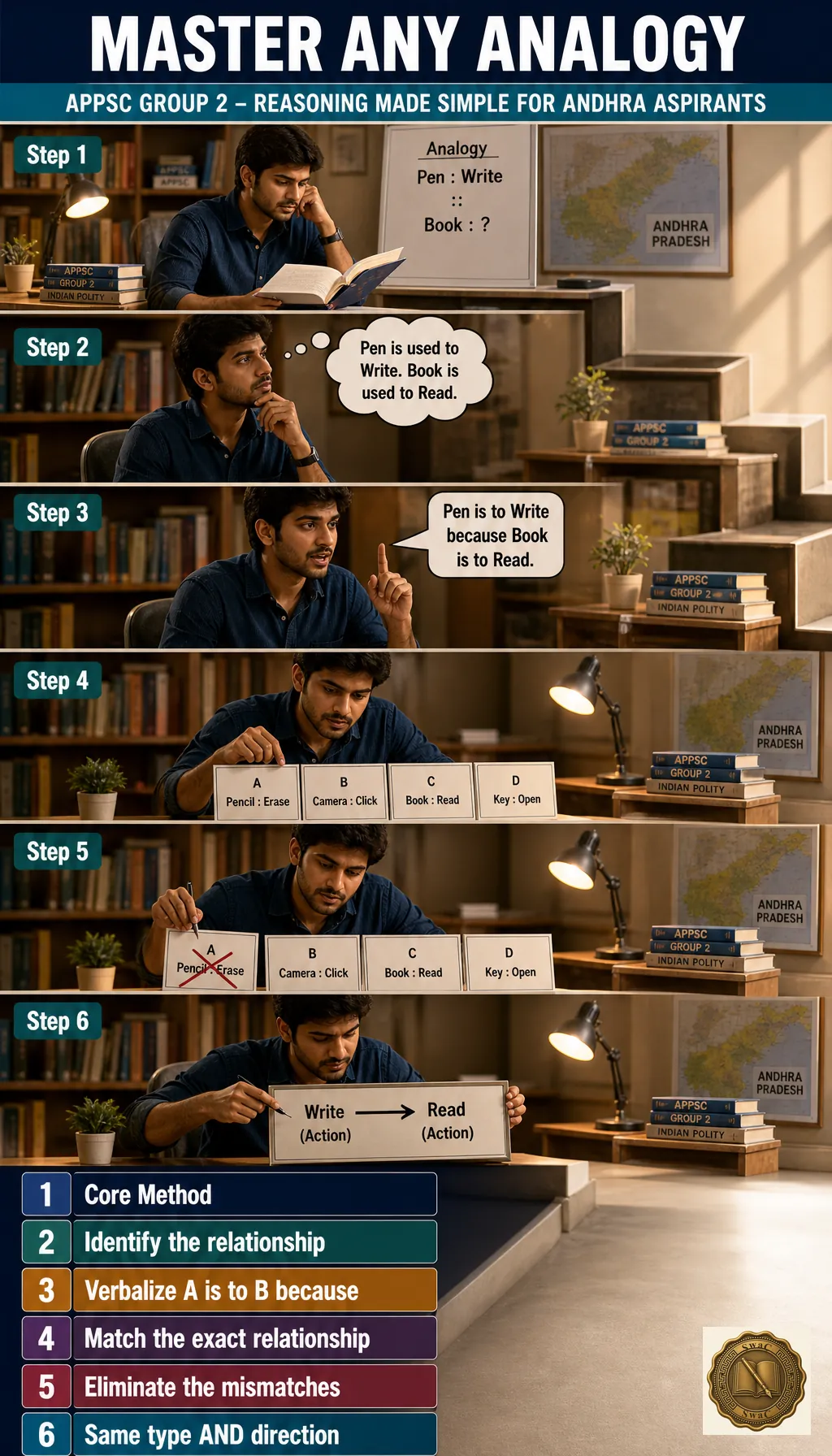
- Read the given pair and understand both words/numbers
- Identify the relationship — ask "What connects A to B?"
- Verbalize it — form a sentence: "A is to B because..."
- Apply to options — find the pair that mirrors the EXACT same relationship
- Eliminate distractors — superficial similarity is not the same logical link
- Verify direction — A:B must have the SAME direction as C:D
Golden Rule: The relationship must be identical in type AND direction.
Section 2: Types with Examples
| Type | Example | Relationship |
|---|---|---|
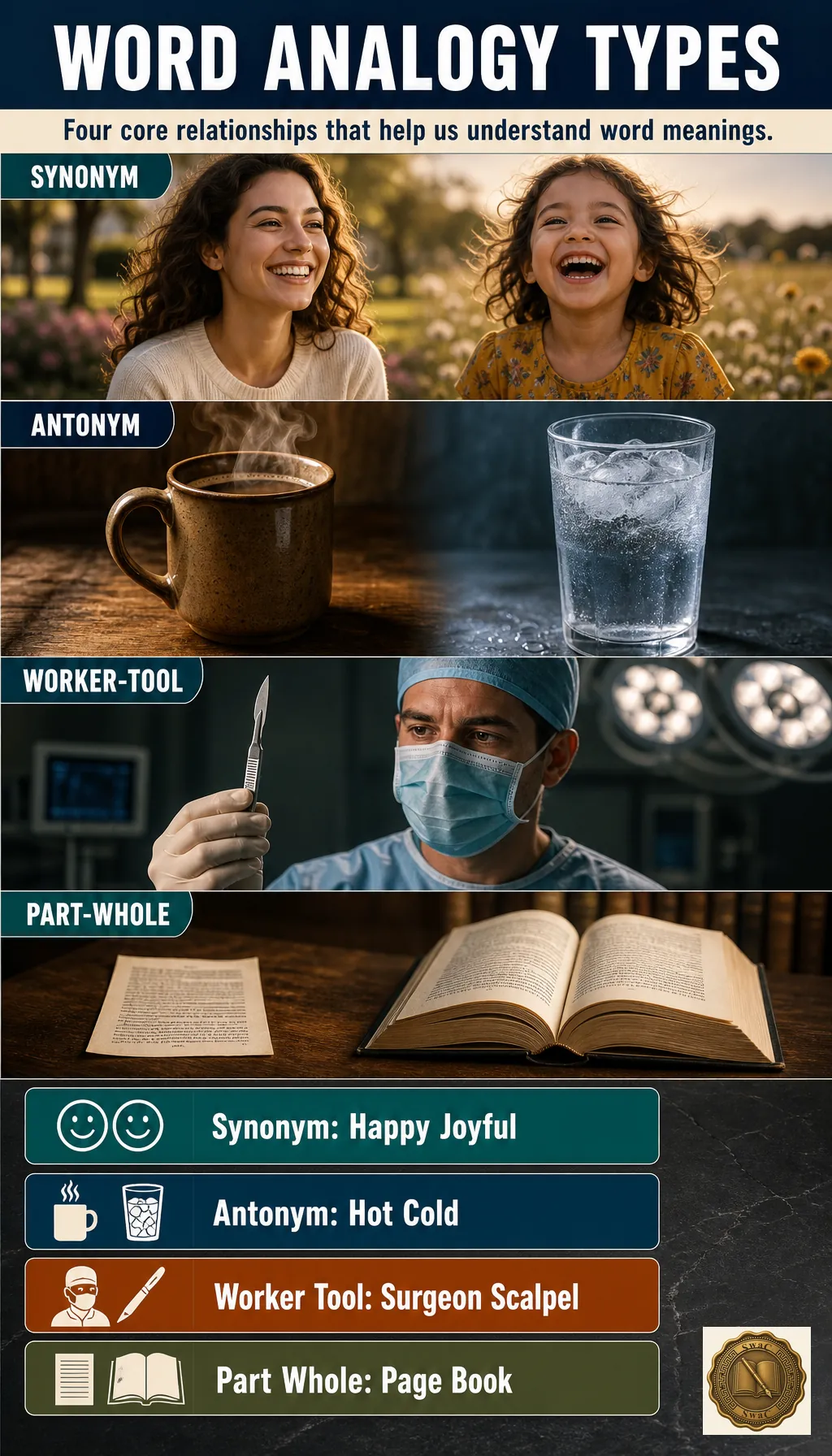
| Synonym | Happy : Joyful :: Sad : ? | Similar meaning → Sorrowful |
| Antonym | Hot : Cold :: Big : ? | Opposite → Small |
| Part-Whole | Page : Book :: Room : ? | Component of → Building |
| Worker-Tool | Carpenter : Hammer :: Surgeon : ? | Professional-instrument → Scalpel |
| Item-Category | Rose : Flower :: Dog : ? | Member of class → Animal |
| Function/Purpose | Knife : Cut :: Pen : ? | Object-action → Write |
| Product-Material | Cloth : Cotton :: Paper : ? | Made from → Wood |
| Male-Female | Bull : Cow :: Horse : ? | Gender pair → Mare |
| Country-Capital | India : New Delhi :: Japan : ? | → Tokyo |
| Country-Currency | India : Rupee :: USA : ? | → Dollar |
| Unit-Measurement | Kilogram : Weight :: Meter : ? | → Length |
| Number (square) | 4 : 16 :: 5 : ? | n² → 25 |
| Number (cube) | 2 : 8 :: 3 : ? | n³ → 27 |
| Letter position | AB : CD :: EF : ? | Consecutive pairs → GH |
Section 3: Worked Examples — Easy
Q1: Doctor : Patient :: Lawyer : ?
- Relationship: Professional : Person served
- Doctor treats a patient; Lawyer represents a client
- Answer: Client
Q2: Bird : Nest :: Horse : ?
- Relationship: Animal : Dwelling
- Bird lives in nest; Horse lives in stable
- Answer: Stable
Q3: 9 : 81 :: 11 : ?
- Relationship: Number : Its square
- 9² = 81, 11² = 121
- Answer: 121
Section 4: Worked Examples — Medium
Q4: Marathon : Race :: Hibernation : ?
- Relationship: Specific instance : General category
- Marathon is a type of race; Hibernation is a type of sleep
- Answer: Sleep
Q5: Cobbler : Leather :: Tailor : ?
- Relationship: Craftsperson : Material
- Cobbler works with leather; Tailor works with cloth
- Answer: Cloth
Q6: ACEG : BDFH :: MOQS : ?
- Pattern: Alternate letters. M(13),O(15),Q(17),S(19) — each +2
- Corresponding shift: N(14),P(16),R(18),T(20) — each +2
- Answer: NPRT
Section 5: Worked Examples — Hard
Q7: 7 : 56 :: 9 : ?
- Pattern: n × (n+1) → 7 × 8 = 56, 9 × 10 = 90
- Trap: Students may try n² (49, 81) — but 56 ≠ 49
- Answer: 90
Q8: Connoisseur : Art :: Gourmet : ?
- Relationship: Expert appreciator : Domain
- Connoisseur appreciates art; Gourmet appreciates food
- Answer: Food
Q9: SEND : VHQG :: HELP : ?
- S→V(+3), E→H(+3), N→Q(+3), D→G(+3)
- H→K(+3), E→H(+3), L→O(+3), P→S(+3)
- Answer: KHOS
Section 6: Shortcuts & Tricks
| Shortcut | When to Use |
|---|---|
| Name the relationship first | Before looking at options, describe the link in one phrase |
| Direction matters | A:B is different from B:A — maintain the same order |
| Number analogies: check square first | Most common: n², then n³, then n(n+1) |
| Letter analogies: convert to numbers | Use position values (A=1...Z=26) to spot arithmetic patterns |
| GK-based: memorize common pairs | Capitals, currencies, inventions, famous landmarks |
| Eliminate by category | If relationship is function-based, drop synonym/antonym options |
Section 7: Common Mistakes
- Reversing the relationship direction — A:B should have the SAME direction as C:D
- Choosing superficially related words — "Doctor : Hospital" is NOT the same as "Doctor : Patient"
- Ignoring degree/intensity — "Warm : Hot" requires a similar intensity jump
- GK gaps — Not knowing capitals/currencies leads to wrong answers on factual analogies
- Overthinking simple relationships — The simplest explanation is usually correct
Section 8: Exam Strategy
- APPSC keeps these at easy-to-medium difficulty
- Build a mental catalog of the 14+ relationship types above
- Identify the type BEFORE looking at options — this prevents distractor traps
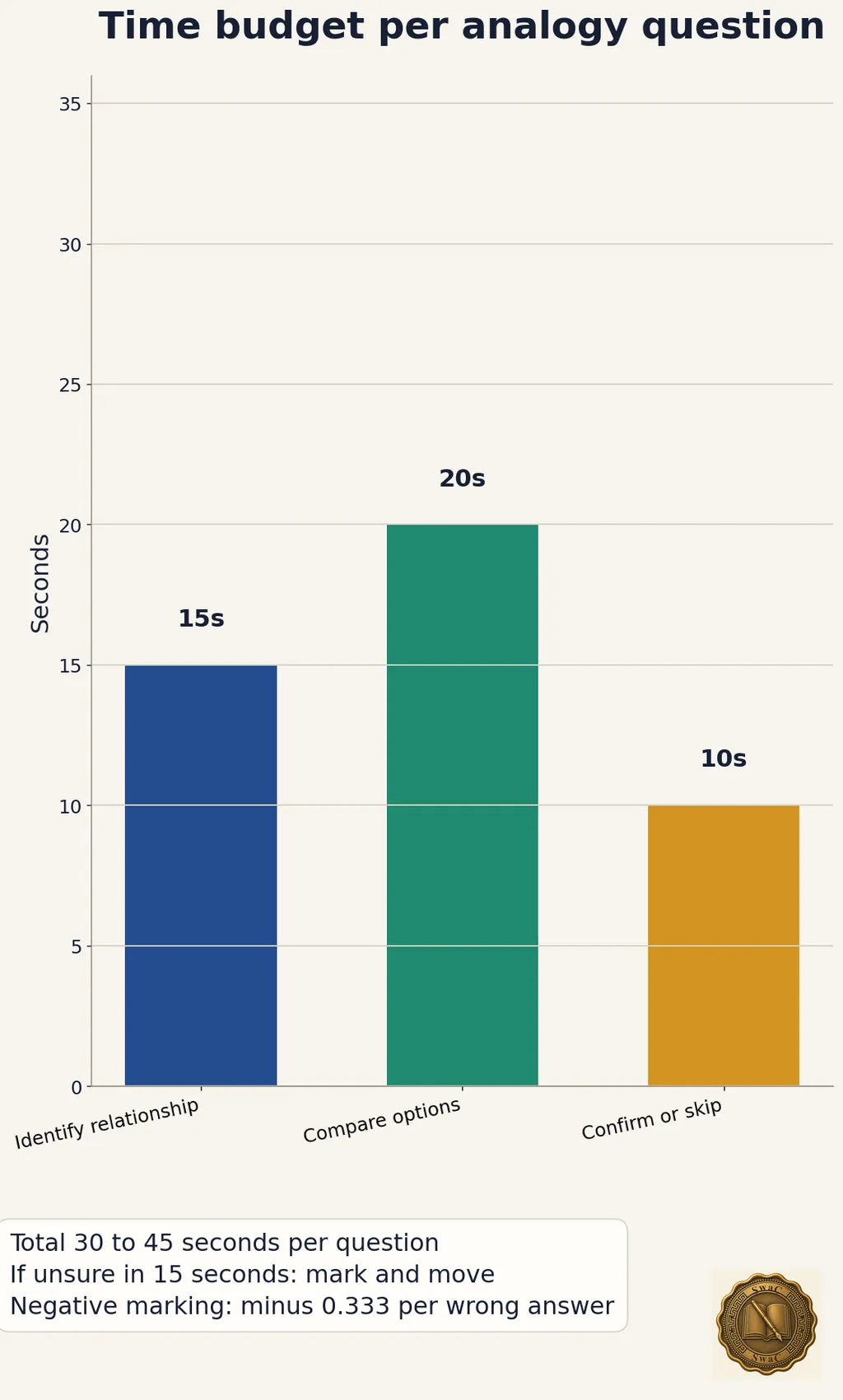
- Time: 30-45 seconds; if you can't identify the relationship in 15 seconds, mark and move on
- Negative marking: -0.333 per wrong answer — skip if unsure between 2 options
Section 9: Practice Questions
- Pen : Write :: Knife : ? → Cut (function)
- Cub : Lion :: Kitten : ? → Cat (young-adult)
- Agra : Taj Mahal :: Paris : ? → Eiffel Tower (place-famous for)
- 3 : 27 :: 4 : ? → 64 (n³)
- Paw : Cat :: Hoof : ? → Horse (body part-animal)
Section 10: Key Terms / Formulas
| Term | Meaning |
|---|---|
| Analogy | A comparison based on identical relationship |
| Verbal analogy | Word-based pairs |
| Number analogy | Mathematical relationship (square, cube, n(n+1)) |
| Letter analogy | Alphabet position-based pattern |
| Direction | The order of the relationship (A→B must match C→D) |
Learn it another way
The same chapter, in other formats
Image lesson
20 cardsThe whole chapter drawn as cards. Scroll through them; tap a card to zoom.




Audio lecture
The audio lecture for this chapter is being recorded. Until then, read the text or flip through the picture cards.
Back to the textVideo lecture
The video lecture for this chapter is being produced. Until then, read the text or flip through the picture cards.
Back to the textEnd of chapter4 min read
You finished Analogies
- 10sections
- 3tables