 Image lesson · 14 cards
Introduction
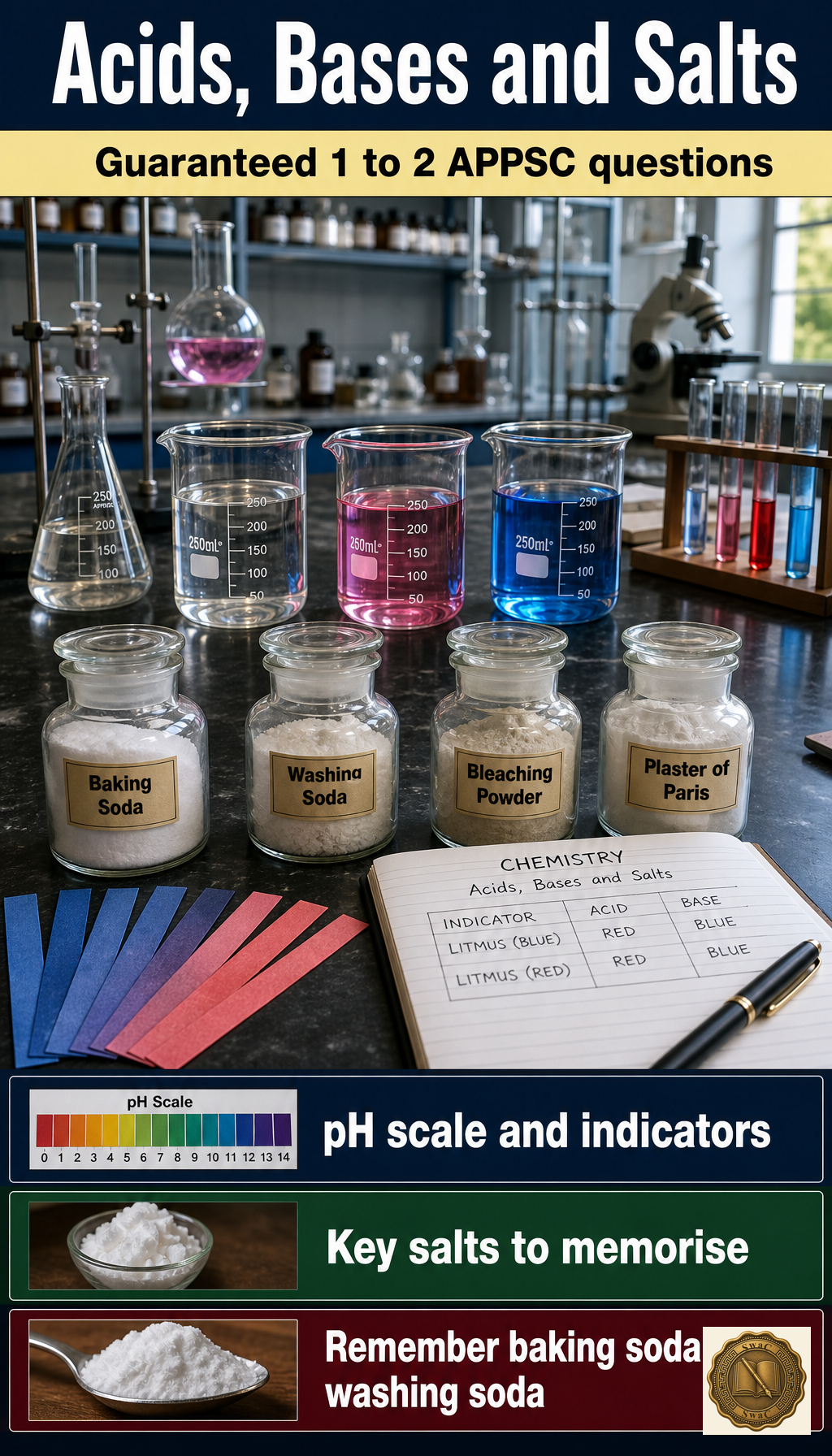
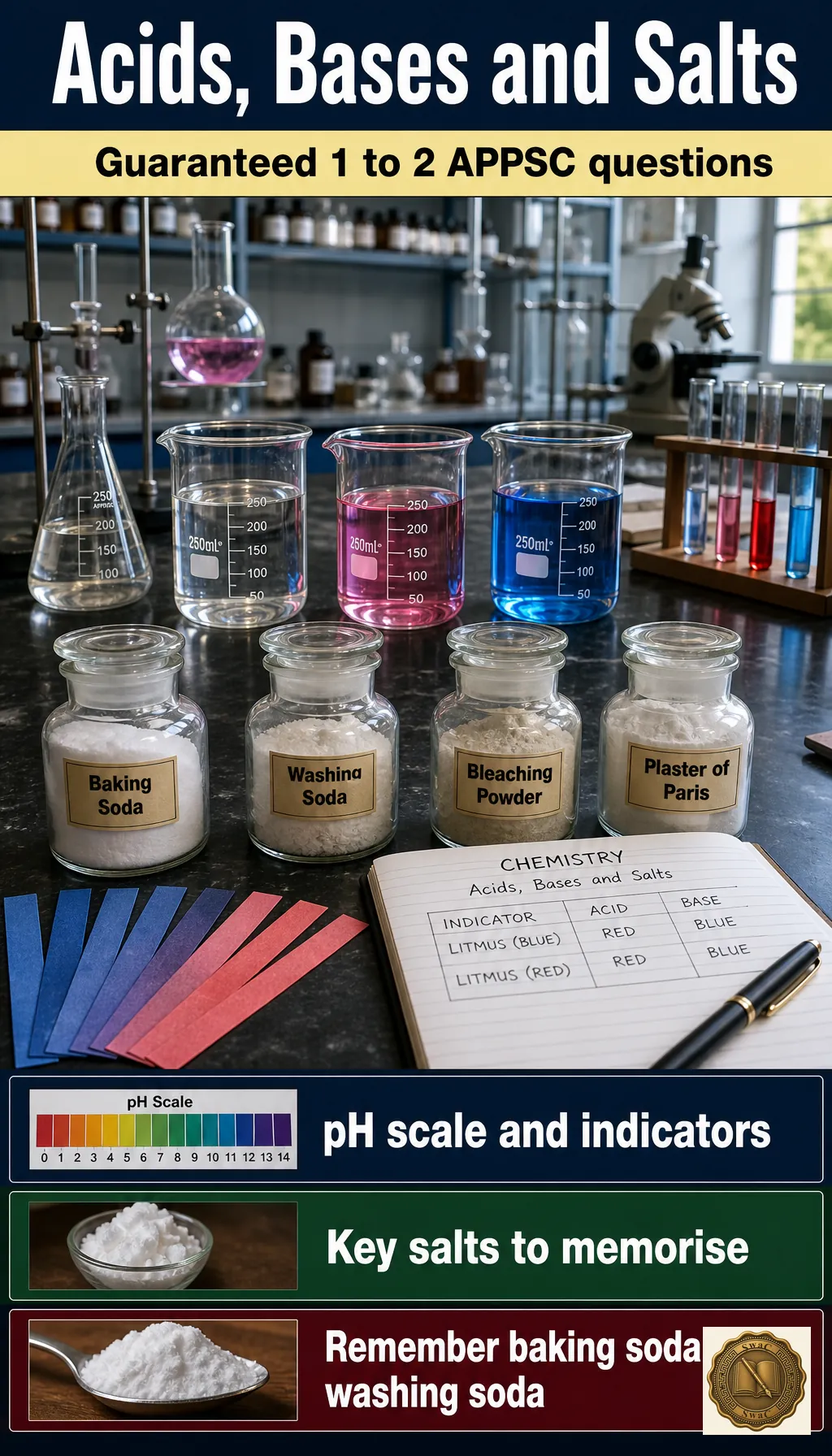
This topic is a guaranteed source of 1-2 APPSC questions. The pH scale, indicator colour changes, and important salts (baking soda, washing soda, bleaching powder, Plaster of Paris) are perennial exam favourites.
Section 1: Acids
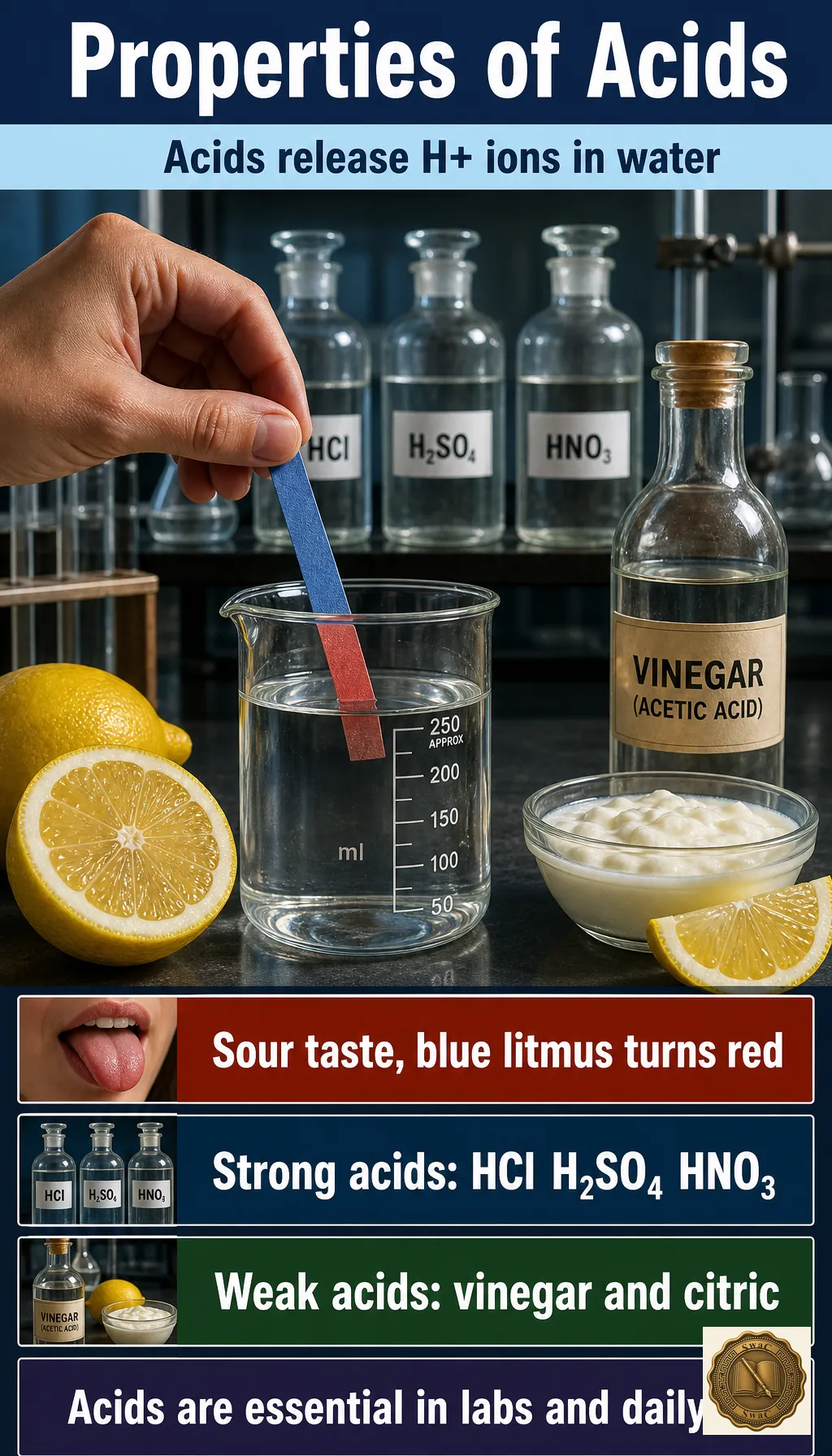
- Produce H⁺ ions in aqueous solution. Sour taste. Turn blue litmus red.
- Strong acids (completely ionise): HCl, H₂SO₄, HNO₃.
- Weak acids (partially ionise): CH₃COOH (vinegar), H₂CO₃, citric acid.
| Type | Examples |
|---|---|
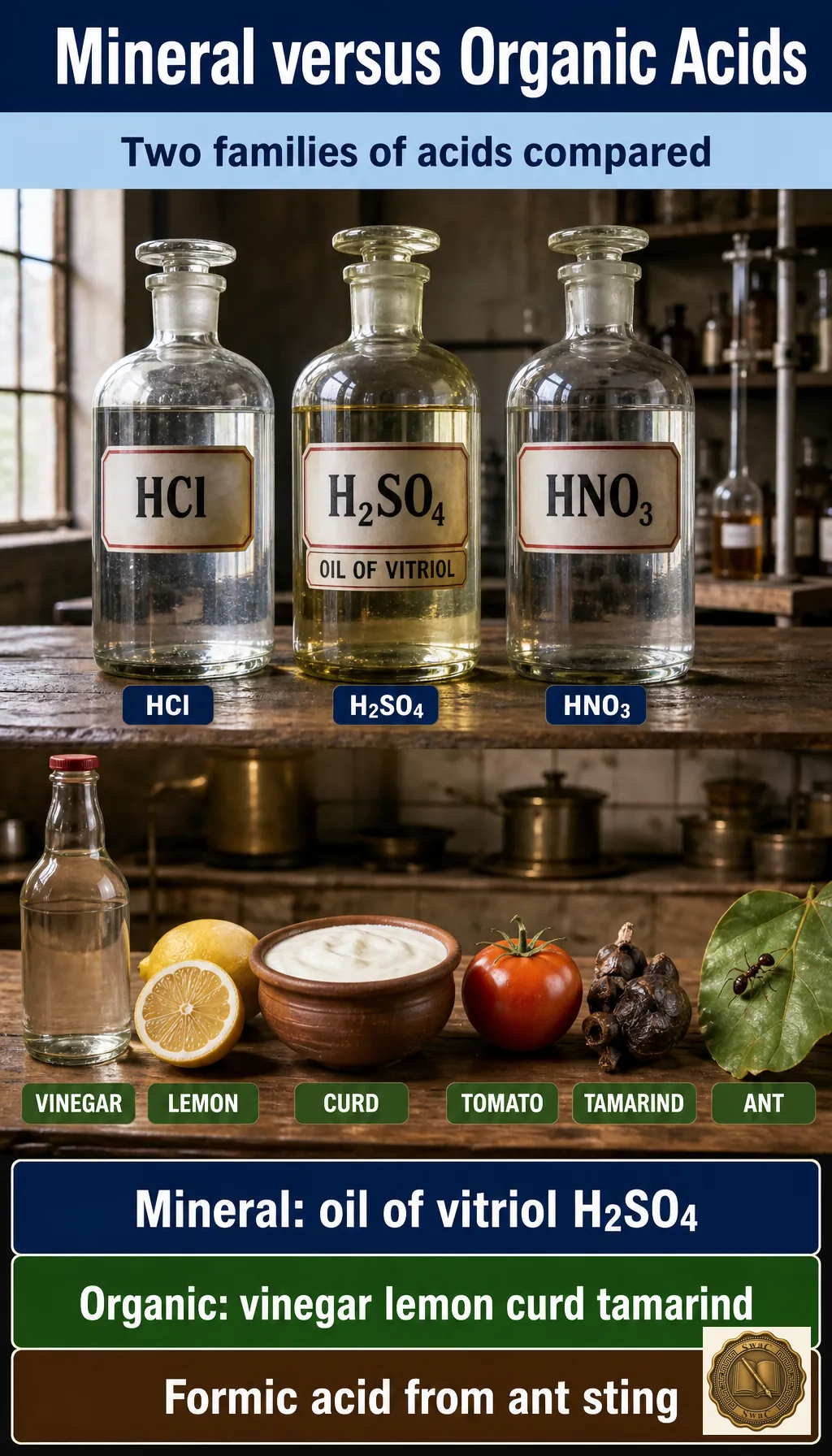
| Mineral/inorganic | HCl (hydrochloric), H₂SO₄ (sulphuric — "oil of vitriol"), HNO₃ (nitric) |
| Organic | Acetic (vinegar), Citric (lemon), Lactic (curd), Oxalic (tomato), Tartaric (tamarind), Formic (ant sting) |
- Acids + metals → salt + H₂ gas.
- Acids + carbonates → salt + H₂O + CO₂ (turns lime water milky).
- Aqua regia: Conc. HCl : Conc. HNO₃ in 3:1 ratio. Dissolves gold and platinum.
Section 2: Bases
- Produce OH⁻ ions in aqueous solution. Bitter taste. Soapy feel. Turn red litmus blue.
- Strong bases: NaOH (caustic soda), KOH (caustic potash), Ca(OH)₂ (slaked lime).
- Weak bases: NH₄OH, Mg(OH)₂ (milk of magnesia).
- Alkali: A base soluble in water. All alkalis are bases, but not all bases are alkalis.
Section 3: Neutralization
Acid + Base → Salt + Water (exothermic reaction)
Example: HCl + NaOH → NaCl + H₂O
Section 4: pH Scale
- pH = potential of Hydrogen. Measures H⁺ concentration. Range: 0-14.
- pH < 7: acidic | pH = 7: neutral | pH > 7: basic/alkaline
| Substance | pH |
|---|---|
| Gastric juice | ~1.2 |
| Lemon juice | ~2.2 |
| Milk | ~6.5 |
| Pure water | 7.0 |
| Blood | 7.35-7.45 |
- Most crops grow best in pH 6-7. Tooth enamel corrodes below pH 5.5.
Section 5: Indicators
| Indicator | In Acid | In Base |
|---|---|---|
| Litmus (from lichen) | Blue → Red | Red → Blue |
| Phenolphthalein | Colourless | Pink |
| Methyl orange | Red/Orange | Yellow |
| Turmeric (haldi) | Yellow | Red/Brown |
Section 6: Important Salts
| Salt | Formula | Preparation | Uses |
|---|---|---|---|
| Baking soda | NaHCO₃ | Solvay process | Cooking (leavening), antacid, fire extinguisher |
| Washing soda | Na₂CO₃·10H₂O | Solvay process | Glass making, softening hard water, cleaning |
| Bleaching powder | CaOCl₂ | Cl₂ + Ca(OH)₂ | Bleaching textiles/paper, water purification |
| Plaster of Paris | CaSO₄·½H₂O | Heating gypsum to 373 K | Fracture casts, sculptures, construction |
| Caustic soda | NaOH | Electrolysis of brine (chlor-alkali) | Soap making, degreasing |
- Water of crystallisation: CuSO₄·5H₂O (blue vitriol — blue; anhydrous = white). FeSO₄·7H₂O = green vitriol. CaSO₄·2H₂O = gypsum.
Section 7: Hard Water
| Type | Due To | Removal |
|---|---|---|
| Temporary hardness | Bicarbonates of Ca/Mg | Boiling |
| Permanent hardness | Chlorides/sulphates of Ca/Mg | Washing soda or ion-exchange |
Section 8: Likely Exam Questions
The pH of human blood is: Ans: 7.35-7.45
Baking soda is chemically: Ans: Sodium bicarbonate (NaHCO₃)
Aqua regia is a mixture of HCl and HNO₃ in the ratio: Ans: 3:1
Plaster of Paris is obtained by heating: Ans: Gypsum (CaSO₄·2H₂O) to 373 K
Phenolphthalein turns ___ in a basic solution: Ans: Pink
Bleaching powder is prepared by passing chlorine over: Ans: Slaked lime — Ca(OH)₂
Temporary hardness in water is caused by: Ans: Bicarbonates of calcium and magnesium
The acid present in curd is: Ans: Lactic acid
Turmeric stain turns red when it comes in contact with: Ans: Soap (basic substance)
H₂SO₄ is commonly known as: Ans: Oil of vitriol
Learn it another way
The same chapter, in other formats
Image lesson
14 cardsThe whole chapter drawn as cards. Scroll through them; tap a card to zoom.


Audio lecture
The audio lecture for this chapter is being recorded. Until then, read the text or flip through the picture cards.
Back to the textVideo lecture
The video lecture for this chapter is being produced. Until then, read the text or flip through the picture cards.
Back to the textKey terms
5 terms- Aqua regia
- Conc. HCl : Conc. HNO₃ in 3:1 ratio. Dissolves gold and platinum.
- Strong bases
- NaOH (caustic soda), KOH (caustic potash), Ca(OH)₂ (slaked lime).
- Weak bases
- NH₄OH, Mg(OH)₂ (milk of magnesia).
- Alkali
- A base soluble in water. All alkalis are bases, but not all bases are alkalis.
- Water of crystallisation
- CuSO₄·5H₂O (blue vitriol — blue; anhydrous = white). FeSO₄·7H₂O = green vitriol. CaSO₄·2H₂O = gypsum.
End of chapter2 min read
You finished Acids, Bases, and Salts
- 8sections
- 5tables
- 5key terms