 Image lesson · 40 cards
Introduction
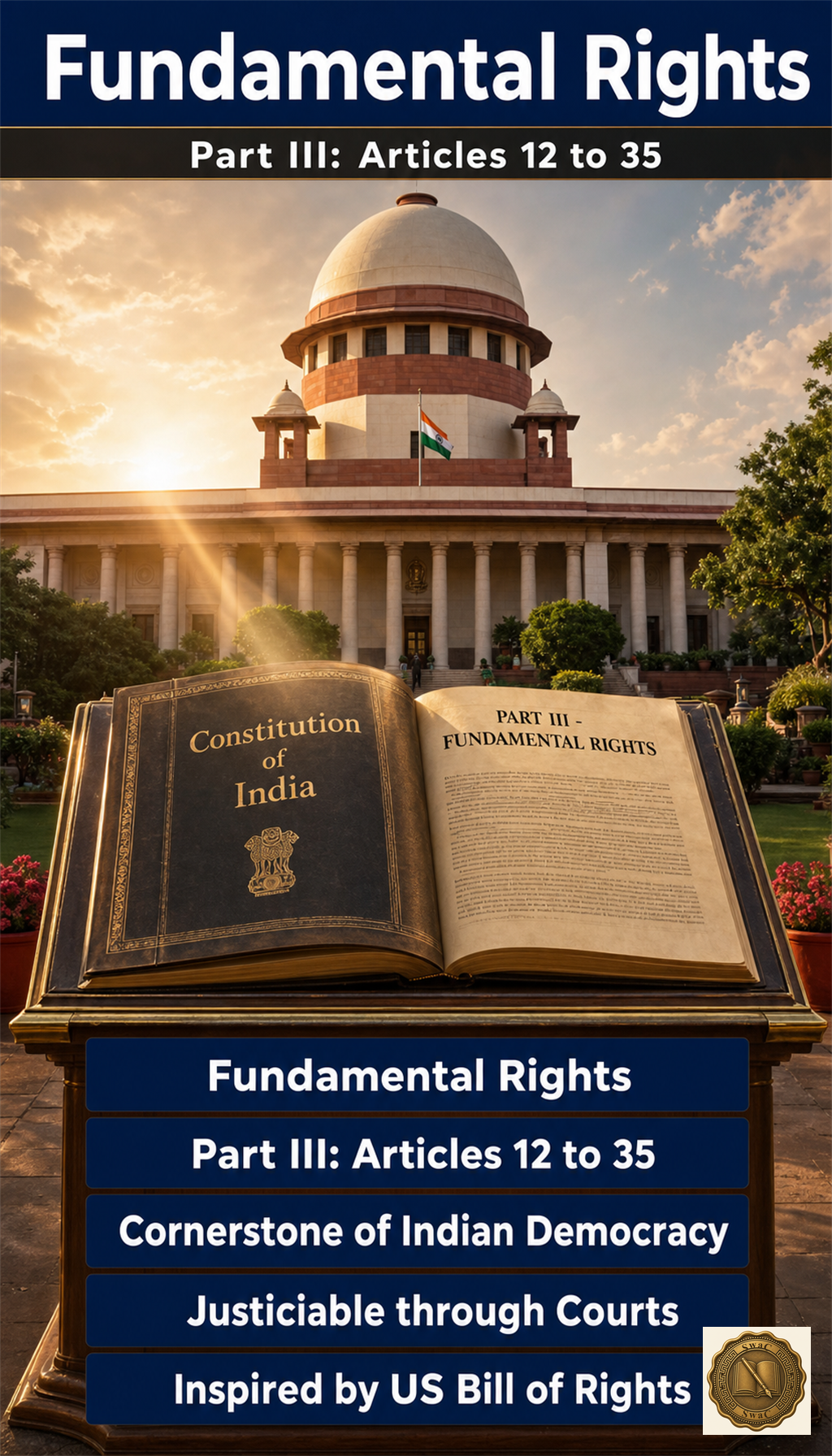
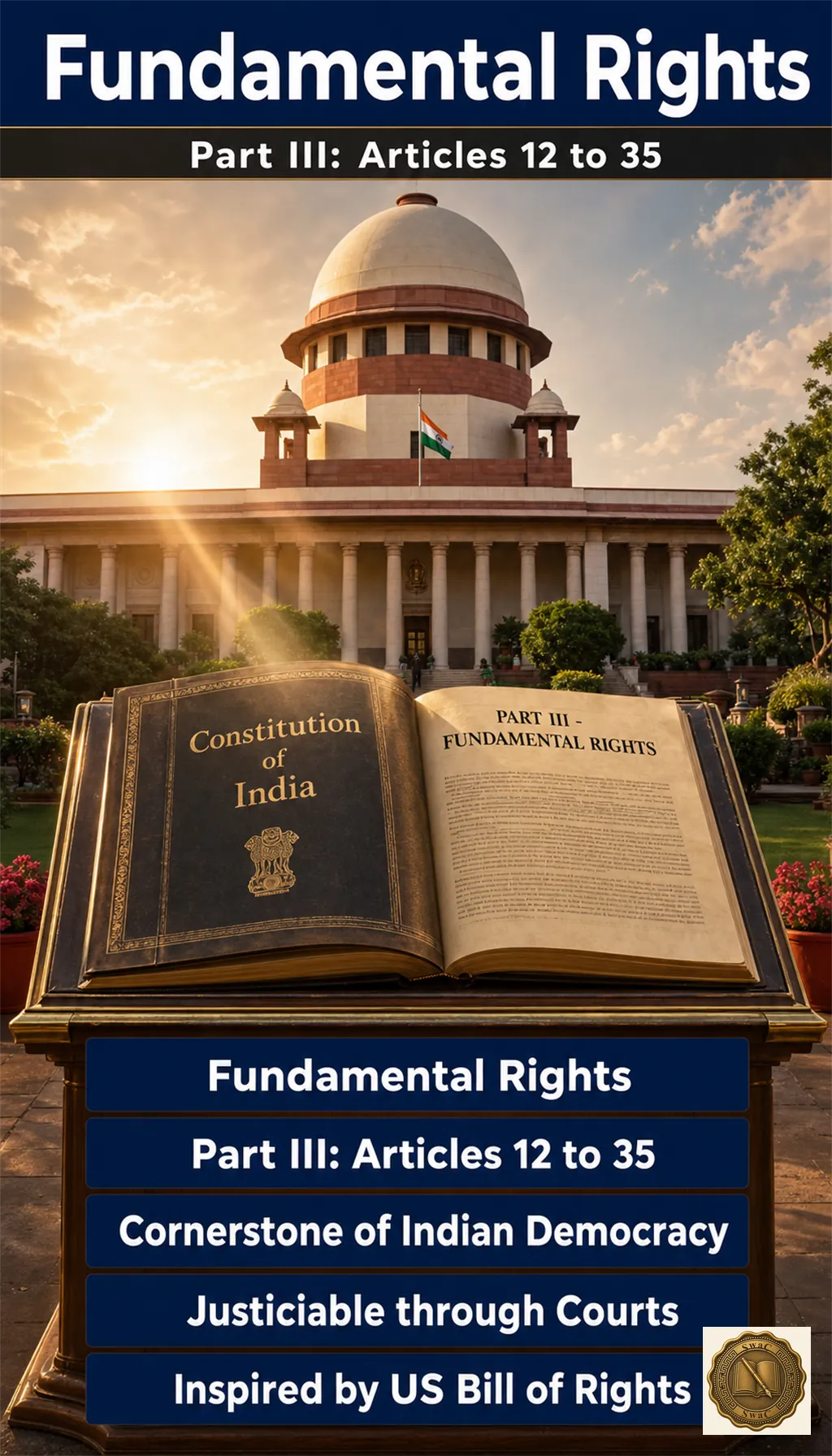
Fundamental Rights are the cornerstone of Indian democracy, enshrined in Part III (Articles 12-35) of the Constitution. Inspired by the Bill of Rights of the US Constitution, they guarantee civil liberties to all citizens and, in some cases, to all persons within India's territory. They are justiciable, meaning they can be enforced through courts, making them the most powerful protection against State tyranny.
Section 1: Historical Context / Constitutional Background
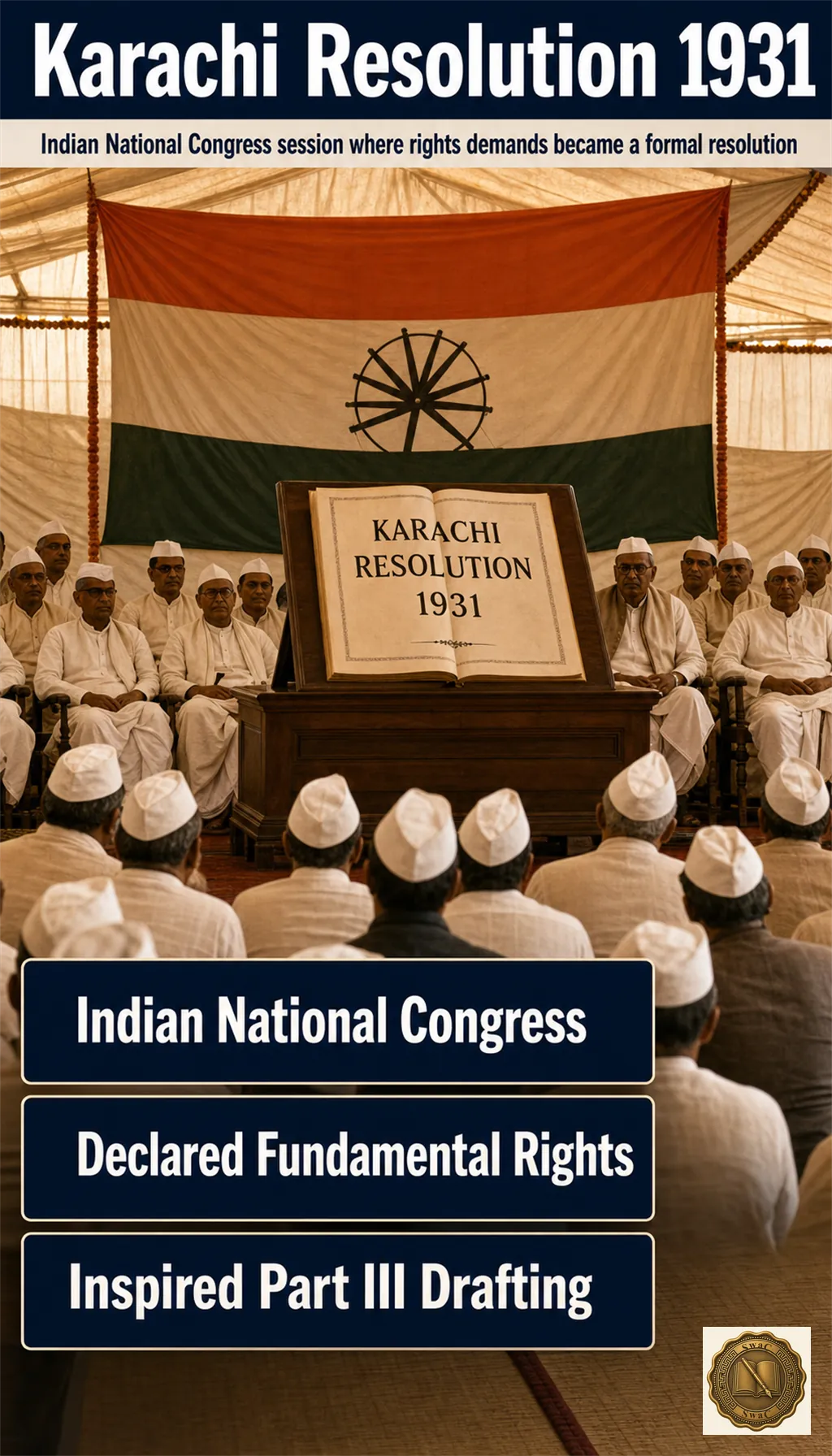
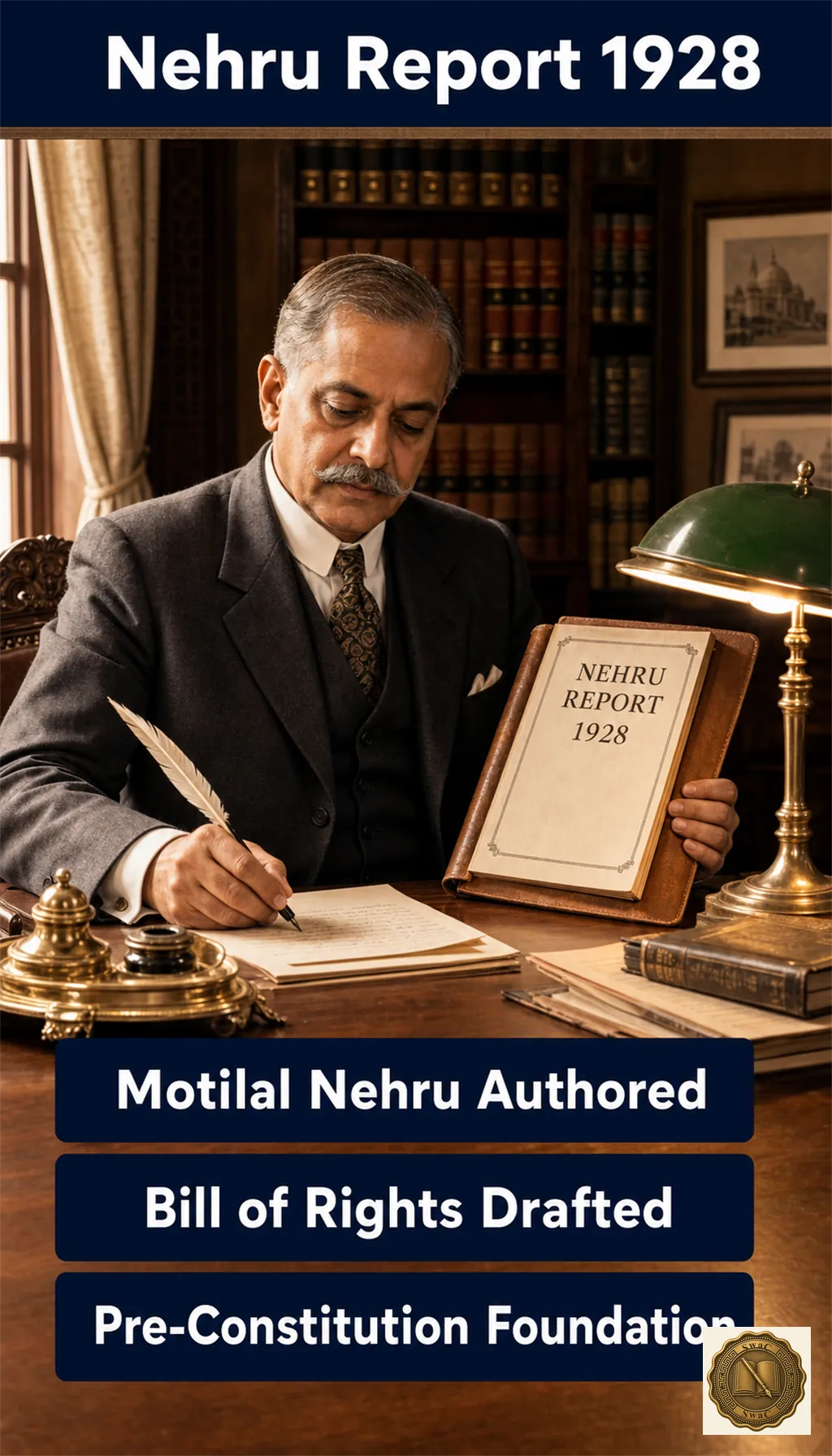
The demand for fundamental rights emerged during the freedom movement. The Indian National Congress's Karachi Resolution (1931) contained a declaration of fundamental rights. The Nehru Report (1928) also included a bill of rights. The framers studied the US Bill of Rights, the French Declaration of Rights, and the UN Declaration of Human Rights before crafting Part III. Originally there were 7 categories of rights; the Right to Property was removed by the 44th Amendment (1978) and made a constitutional right under Article 300A.
Section 2: Core Content
Foundational Provisions
- Article 12: Defines "State" broadly — includes Government, Parliament, State Legislatures, Local bodies, and other authorities
- Article 13: Laws inconsistent with FR are void to the extent of inconsistency
- FRs are not absolute — subject to reasonable restrictions
- FRs can be suspended during National Emergency (Art 358, 359) — EXCEPT Articles 20 and 21
- Parliament can restrict or abrogate FRs for Armed Forces (Art 33) and during Martial Law (Art 34)
The Six Fundamental Rights
1. Right to Equality (Articles 14-18)
| Article | Provision | Details |
|---|---|---|
| 14 | Equality before law AND equal protection of laws | Two concepts: British "equality before law" + American "equal protection" |
| 15 | Prohibition of discrimination | On grounds of religion, race, caste, sex, place of birth ONLY |
| 15(4) | Special provisions for backward classes | Added by 1st Amendment |
| 15(5) | OBC reservation in education | 93rd Amendment (2005) — 27% OBC reservation |
| 15(6) | EWS reservation | 103rd Amendment (2019) — 10% EWS reservation |
| 16 | Equal opportunity in public employment | No discrimination in government jobs |
| 16(4A) | Reservation in promotion for SC/ST | 77th Amendment (1995) |
| 16(6) | EWS reservation in employment | 103rd Amendment (2019) |
| 17 | Abolition of Untouchability | Enforceable against private individuals too |
| 18 | Abolition of Titles | No titles except military/academic |
2. Right to Freedom (Articles 19-22)
| Article | Provision | Details |
|---|---|---|
| 19(1)(a) | Freedom of speech and expression | Restrictions: sovereignty, security, public order, decency, morality, contempt, defamation, incitement |
| 19(1)(b) | Freedom of assembly | Peacefully, without arms |
| 19(1)(c) | Freedom of association/unions | Can form associations, cooperatives |
| 19(1)(d) | Freedom of movement | Throughout India |
| 19(1)(e) | Freedom of residence | Settle in any part of India |
| 19(1)(g) | Freedom of profession/trade/business | Subject to professional qualifications |
| 20 | Protection against conviction | (a) No ex-post-facto laws, (b) No double jeopardy, (c) No self-incrimination |
| 21 | Right to Life and Personal Liberty | "No person shall be deprived of his life or personal liberty except according to procedure established by law" |
| 21A | Right to Education | Free and compulsory education for ages 6-14; 86th Amendment (2002) |
| 22 | Protection against arrest/detention | Right to be informed of grounds; right to lawyer; production before magistrate within 24 hours |
Critical distinction: Article 19 freedoms available only to citizens; Articles 20, 21 available to all persons (citizens and non-citizens).
3. Right against Exploitation (Articles 23-24)
| Article | Provision | Details |
|---|---|---|
| 23 | Prohibition of traffic in human beings and forced labour | Includes begar, bonded labour, trafficking; enforceable against private persons |
| 24 | Prohibition of child labour | No child below 14 years in factories, mines, or hazardous employment |
4. Right to Freedom of Religion (Articles 25-28)
| Article | Provision | Details |
|---|---|---|
| 25 | Freedom of conscience; free profession, practice, propagation | Subject to public order, morality, health |
| 26 | Freedom to manage religious affairs | Establish institutions, manage affairs, own property |
| 27 | No compulsory payment of taxes for religious promotion | Cannot tax for promoting any religion |
| 28 | No religious instruction in State-funded institutions | Exceptions: endowed institutions |
5. Cultural and Educational Rights (Articles 29-30)
| Article | Provision | Details |
|---|---|---|
| 29 | Protection of minority interests | Any section with distinct language/script/culture can conserve it |
| 30 | Right of minorities to establish educational institutions | Both religious and linguistic minorities |
6. Right to Constitutional Remedies (Article 32)
- Article 32: Right to move Supreme Court for enforcement of FR
- Dr. Ambedkar called it the "heart and soul" of the Constitution
- Supreme Court is the "guarantor and guardian" of Fundamental Rights
Five Writs under Article 32
| Writ | Meaning | Purpose |
|---|---|---|
| Habeas Corpus | "To have the body" | Against unlawful detention |
| Mandamus | "We command" | Direct public official to perform duty; NOT against private person or President/Governor |
| Prohibition | "To forbid" | Higher court prevents lower court from exceeding jurisdiction |
| Certiorari | "To be certified" | Higher court quashes order of lower court beyond jurisdiction |
| Quo Warranto | "By what authority" | Challenge person holding public office without legal authority |
Article 226 (High Court writs) is wider than Article 32 — HC can issue writs for FR AND for "any other purpose".
Landmark Cases
| Case | Year | Significance |
|---|---|---|
| A.K. Gopalan v. State of Madras | 1950 | Narrow interpretation of Art 21 |
| Maneka Gandhi v. Union of India | 1978 | Expanded Art 21; procedure must be fair, just, reasonable |
| Vishakha v. State of Rajasthan | 1997 | Sexual harassment guidelines under Art 21 |
| Kesavananda Bharati | 1973 | FR can be amended but Basic Structure cannot be destroyed |
| Indra Sawhney v. Union of India | 1992 | Mandal case; 50% ceiling on reservations; creamy layer |
| K.S. Puttaswamy v. Union of India | 2017 | Right to Privacy is fundamental right under Art 21 |
Rights that Cannot be Suspended During Emergency
- Article 20: Protection against conviction
- Article 21: Right to Life and Personal Liberty
- These are absolute and inviolable even during National Emergency
Section 3: Key Articles Table
| Article | Subject | Key Provision |
|---|---|---|
| Art 12 | Definition of State | Includes govt, Parliament, legislatures, local bodies |
| Art 13 | Judicial review of laws | Laws violating FR are void |
| Art 14 | Equality before law | Equal protection of laws |
| Art 17 | Abolition of untouchability | Enforceable vs private persons |
| Art 19 | Six freedoms | Only for citizens |
| Art 20 | Protection vs conviction | Cannot be suspended even during Emergency |
| Art 21 | Right to life | For all persons (citizens + non-citizens) |
| Art 21A | Right to education | Ages 6-14; 86th Amendment |
| Art 32 | Constitutional remedies | Heart and soul; 5 writs |
| Art 33 | FR modification for armed forces | Parliament can restrict FR |
Section 4: Andhra Pradesh Connection
- AP has significant SC/ST/OBC population — reservation provisions under Articles 15, 16 directly relevant
- APPSC exams frequently test article numbers versus provisions
- Telugu medium students should know writ names in English — these are Latin terms used as-is
- Article 371D provides special provisions for equitable opportunities in AP public employment and education
Section 5: Key Points Summary
- Fundamental Rights: Part III, Articles 12-35
- Originally 7 categories; now 6 (Right to Property removed by 44th Amendment)
- FRs are justiciable — enforceable through courts
- Article 12 defines "State" broadly; Article 13 voids inconsistent laws
- Right to Equality: Articles 14-18
- Right to Freedom: Articles 19-22
- Right against Exploitation: Articles 23-24
- Right to Freedom of Religion: Articles 25-28
- Cultural and Educational Rights: Articles 29-30
- Right to Constitutional Remedies: Article 32 ("heart and soul")
- Article 19: Only for CITIZENS; Articles 20, 21: For ALL PERSONS
- Articles 20 and 21 cannot be suspended even during Emergency
- Article 226 (HC writs) is wider than Article 32 (SC writs)
- Maneka Gandhi (1978): Expanded Art 21 interpretation
- K.S. Puttaswamy (2017): Right to Privacy under Art 21
- Five writs: Habeas Corpus, Mandamus, Prohibition, Certiorari, Quo Warranto
- 44th Amendment removed Right to Property; now Art 300A
Section 6: Exam Strategy
| Question Pattern | Expected Focus | Frequency |
|---|---|---|
| "Article range for each right" | 14-18, 19-22, 23-24, 25-28, 29-30, 32 | Very High |
| "Heart and soul of Constitution" | Article 32 (Ambedkar) | Very High |
| "Cannot be suspended in Emergency" | Articles 20 and 21 | Very High |
| "Available to all persons" | Articles 20, 21 (not just citizens) | High |
| "Wider writ jurisdiction" | HC (Art 226) wider than SC (Art 32) | High |
| "Maneka Gandhi case significance" | Expanded Art 21 | High |
| "Right to Privacy case" | K.S. Puttaswamy (2017) | Medium |
| "50% reservation ceiling" | Indra Sawhney (1992) | High |
| "Match writ with purpose" | Know all 5 writs | Very High |
| "Right to Property removed by" | 44th Amendment; now Art 300A | High |
Section 7: Key Terms Glossary
| English | Telugu | Definition |
|---|---|---|
| Fundamental Rights | ప్రాథమిక హక్కులు | Justiciable rights guaranteed by Constitution |
| Right to Equality | సమానత్వ హక్కు | Articles 14-18; equal treatment |
| Right to Freedom | స్వేచ్ఛా హక్కు | Articles 19-22; personal liberties |
| Right against Exploitation | దోపిడీ నిరోధ హక్కు | Articles 23-24; protection from forced labour |
| Right to Freedom of Religion | మత స్వేచ్ఛ హక్కు | Articles 25-28; religious liberty |
| Cultural and Educational Rights | సాంస్కృతిక, విద్యా హక్కులు | Articles 29-30; minority protections |
| Right to Constitutional Remedies | రాజ్యాంగ పరిహార హక్కు | Article 32; enforcement through SC |
| Writ | రిట్ / ఆదేశం | Court order for enforcement of rights |
| Habeas Corpus | హేబియస్ కార్పస్ | Writ against unlawful detention |
| Mandamus | మాండమస్ | Writ commanding duty performance |
| Untouchability | అంటరానితనం | Abolished by Article 17 |
| Reasonable Restrictions | సహేతుక నిబంధనలు | Limitations on FRs allowed by Constitution |
| Justiciable | న్యాయస్థానంలో అమలు చేయగల | Enforceable through courts |
| Ex-post-facto law | పూర్వ ప్రభావ చట్టం | Law applied retroactively (prohibited by Art 20) |
| Double Jeopardy | ద్విదండన | Being punished twice for same offence (prohibited) |
Learn it another way
The same chapter, in other formats
Image lesson
40 cardsThe whole chapter drawn as cards. Scroll through them; tap a card to zoom.


Audio lecture
The audio lecture for this chapter is being recorded. Until then, read the text or flip through the picture cards.
Back to the textVideo lecture
The video lecture for this chapter is being produced. Until then, read the text or flip through the picture cards.
Back to the textEnd of chapter6 min read
You finished Fundamental Rights
- 7sections
- 10tables